
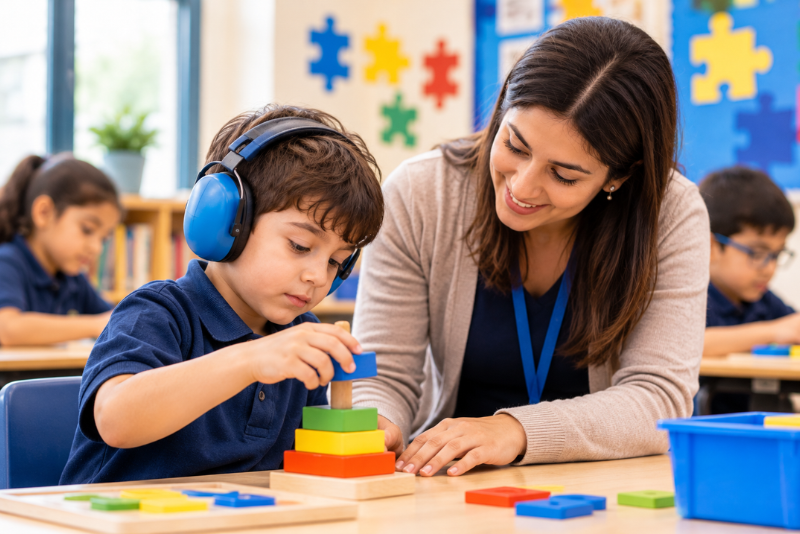
School involves more than academic learning. Children also need to communicate, follow routines, interact with classmates, and participate in group activities. For autistic children who need additional support, ABA strategies can help make these experiences more manageable.
Can ABA Therapy Be Done at School?
Yes, ABA therapy can take place in a school environment, depending on the child’s needs, school policies, and arrangements with the therapy provider.
There are two common ways children may receive ABA-related support at school:
1. School-provided educational support
Schools may use behavioral strategies and provide services through an Individualized Education Program (IEP), when a child qualifies under applicable education laws. These services aim to help the child participate in educational activities.
2. Outside ABA therapy at school
Some schools allow an outside ABA provider to work with a child during school hours. This requires permission from the school and coordination between the therapist, teachers, and parents.
It is important to understand that school-based educational support and clinical ABA therapy are not automatically the same service. Their goals, providers, funding arrangements, and eligibility requirements may differ.
The Indiana Resource Center for Autism at Indiana University provides further information about ABA in schools and clinics.
How Does ABA Therapy Work in a School Environment?
School-based ABA uses individualized strategies to help children develop useful skills during regular school activities. These strategies may be used in classrooms, playgrounds, lunch areas, and other school settings.
1. Supporting Classroom Participation
Some children may need additional support to follow instructions, complete classroom activities, or move between tasks.
Teachers and therapists may use:
- Visual schedules to explain daily activities.
- Simple instructions and smaller learning steps.
- Positive reinforcement for participation.
- Additional time to complete activities.
- Appropriate breaks when children need them.
For example, a teacher might use picture cards to show a child when reading time ends and the next activity begins.
2. Developing Communication Skills
Children need ways to express their needs, ask questions, make choices, and interact with others.
ABA-informed strategies may create communication opportunities during classroom discussions, group activities, lunch breaks, and playtime.
For example, a child may practise requesting help when a classroom activity becomes difficult.
Communication does not have to involve spoken words. Gestures, picture cards, sign language, and AAC devices should also be respected and supported.
3. Encouraging Social Interaction
School provides opportunities for children to interact with classmates and participate in group activities.
An individualized program may support skills such as:
- Taking turns during games.
- Joining preferred group activities.
- Asking classmates to play.
- Sharing materials when comfortable.
- Expressing preferences and boundaries.
For example, during a group puzzle activity, a teacher may help children practise taking turns and requesting the pieces they need.
Social development should never mean forcing eye contact or requiring children to hide their autistic characteristics.
4. Supporting Transitions Between Activities
Moving from one activity to another can be difficult for some autistic children, especially when changes happen unexpectedly.
Teachers and therapists may use visual timetables, advance warnings, first-then boards, and predictable routines.
For example, a teacher might show a child a picture indicating that playtime will be followed by lunch.
These strategies can help children understand what is happening next and prepare for changes.
5. Teaching Everyday Independence
Children also need support with activities beyond academic learning.
ABA-based teaching strategies may help children practise:
- Organizing school bags and books.
- Following handwashing routines.
- Opening lunchboxes.
- Managing personal belongings.
- Asking for assistance when needed.
Some activities can be broken into smaller steps so children can practise them gradually.
The aim is to support meaningful independence while providing appropriate assistance.
6. Understanding and Supporting Behavior
When a child cries, leaves an activity, or becomes distressed, it is important to understand what may be causing the situation.
A Functional Behavior Assessment (FBA) may help professionals identify factors associated with a particular behavior.
They may consider:
- What happens before the behavior?
- What happens during the situation?
- What happens afterward?
- Could communication difficulties be involved?
- Are sensory discomfort, pain, or fatigue contributing?
For example, a child who leaves a noisy classroom may be experiencing sensory discomfort rather than simply refusing to participate.
Understanding these factors can help school staff consider appropriate support and environmental adjustments.
What Are the Benefits of School-Based ABA Therapy?
School-based ABA may provide opportunities for children to practise skills in the environment where they use them regularly.
Some potential benefits include:
- Learning in a familiar environment: Children can practise skills in their regular classrooms and school routines.
- More communication opportunities: Classroom activities and playtime provide opportunities to communicate with teachers and classmates.
- Support with everyday routines: Children can practise organizing belongings, following schedules, and participating in activities.
- Better coordination: Parents, teachers, and therapists can share observations and coordinate appropriate support.
- Practising skills in different situations: Children may have opportunities to use learned skills across classroom activities, group work, and other school settings.
These benefits are not guaranteed. They depend on the child’s needs, the quality of support, and whether the strategies are appropriate.
Who Provides ABA Therapy in a School Setting?
Different professionals may contribute to a child’s school-based support.
| Professional | Possible responsibilities |
| Board Certified Behavior Analyst (BCBA) | Assesses needs, develops behavior-support plans, and supervises ABA services. |
| Registered Behavior Technician (RBT) | Implements assigned behavior-analytic services under appropriate supervision. |
| Special education teacher | Supports educational goals and classroom learning. |
| Classroom teacher | Applies agreed strategies during everyday activities. |
| School psychologist | May contribute to educational assessments and behavior-support planning. |
Not every school has all these professionals. Their responsibilities also depend on local regulations and school policies.
How Can Parents Arrange ABA Therapy at School?
If you want your child to receive ABA-related support at school, begin by discussing their needs with the school and current therapy provider.
Step 1: Talk to the School
Arrange a meeting with the classroom teacher, special education coordinator, or school administration.
Explain where your child may need support, such as communication, classroom participation, transitions, or daily routines.
Step 2: Ask About Available Services
Find out whether the school provides special education, behavior-support services, classroom accommodations, or collaboration with outside therapists.
Step 3: Discuss Outside Therapist Involvement
If your child already receives ABA therapy, ask whether the provider can coordinate with school staff.
Some schools allow outside therapists to visit, while others have restrictions involving permissions, supervision, privacy, and service arrangements.
Step 4: Identify Clear Goals
Discuss which skills would be useful to support at school, such as requesting help, communicating discomfort, participating in preferred activities, or managing transitions.
Goals should respect the child’s communication preferences and wellbeing.
Step 5: Review Progress Regularly
Parents, teachers, and therapists can share observations about what is working and what may need adjustment.
Regular communication helps everyone understand how the child is responding across different situations.
What is the Difference Between School-Based ABA and Clinic-Based ABA?
Both approaches may use ABA principles, but their settings and goals can differ.
| School-based ABA | Clinic-based ABA |
| Takes place in a school. | Takes place in a therapy clinic. |
| May focus on classroom participation and school routines. | May address a broader range of individualized goals. |
| Can involve teachers and school staff. | Usually involves clinical therapy professionals. |
| Works within school schedules and policies. | Follows the clinic’s therapy schedule. |
Neither setting is automatically better for every child. Some children may receive support in both environments, depending on their needs and available services.
Can a Child Receive ABA Therapy at School Through an IEP?
In the United States, a child who qualifies for special education under the Individuals with Disabilities Education Act (IDEA) may receive appropriate educational services through an IEP.
An Individualized Education Program is a written plan describing a student’s educational needs, goals, and required services.
ABA is not automatically included in every IEP because a child has an autism diagnosis. The school team determines appropriate services based on the child’s evaluation and educational needs.
An IEP may include:
- Specially designed instruction.
- Speech and language services.
- Occupational therapy.
- Behavioral support.
- Classroom accommodations.
- Other related educational services.
The American Academy of Pediatrics provides additional information about educational support for autistic children.
Families outside the United States, including those in India, should check their local education policies and school arrangements because eligibility and service procedures differ.
Frequently Asked Questions
1. Can an ABA therapist work inside a school?
Yes, an outside ABA therapist may work inside a school if the school approves the arrangement and the required permissions are in place.
2. Do public schools provide ABA therapy?
Some public schools provide behavioral strategies or related educational support. Availability depends on the child’s needs, eligibility, and local education policies.
3. Is school-based ABA different from regular ABA therapy?
The underlying principles may be similar, but school-based ABA focuses on educational participation and school routines, while clinic-based ABA may address a broader range of individual goals.
4. Can ABA therapy help a child follow classroom instructions?
ABA-informed strategies may help children understand instructions through visual supports, smaller steps, prompting, and positive reinforcement.
5. Does a child need an IEP to receive ABA therapy at school?
Not necessarily. An IEP may provide access to educational services for eligible students in US public schools, but other arrangements may be possible depending on the school and provider.
Conclusion
ABA therapy can be provided in a school environment through educational behavior support or an approved arrangement with an outside therapy provider. It may help children practise communication, classroom participation, daily routines, and other meaningful skills.
Parents should first understand what support their child’s school can provide and whether collaboration with an outside therapist is possible.
The goal should not simply be to make a child follow classroom rules. It should be to create a school environment where the child can communicate, participate, learn, and feel supported.