
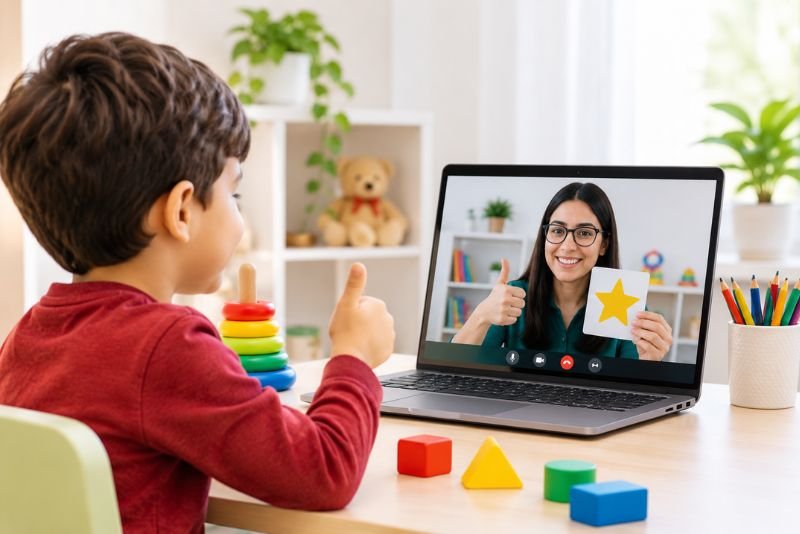
If you’re searching for ABA therapy online, you probably want to know three things: whether it’s real, whether it works, and whether it could suit your child. The short answer is yes, it can be done. Most online programs focus on coaching parents and caregivers rather than sitting a child in front of a camera for hours. This article covers how it works, what research says, who tends to benefit, and what to check before you start.
How Does ABA Therapy Work Over Video?
Applied Behaviour Analysis (ABA) is a structured approach that looks at how behaviour is shaped by the environment, then builds teaching plans from that. Online ABA delivers the same kind of planning and teaching through video calls and digital tools.
In most programs, the child is not left alone with a screen. A caregiver is usually in the room, and a Board Certified Behaviour Analyst (BCBA) guides them live. A typical program includes some mix of these:
- Parent coaching: The clinician watches you practice a strategy with your child and gives feedback in real time.
- Live sessions with the child: Some therapists interact with the child on screen, usually with an adult nearby to help.
- Remote assessments: The clinician observes routines and behaviours over video to help set goals.
- Progress reviews: The supervising BCBA looks at data with you and adjusts the plan as needs change.
- Hybrid support: Hands-on work happens in person, while coaching and check-ins happen online.
What Does a Typical Online Session Look Like?
Sessions vary by provider, but a parent-coaching visit often follows a simple rhythm:
- Check-in: You and the clinician talk through how the week went.
- Practice: You try a specific strategy with your child, such as prompting a request or handling a transition, while the clinician watches.
- Feedback: The clinician suggests small adjustments on the spot.
- Planning: You agree on what to practice before the next session and how you’ll track it.
You should leave each session knowing exactly what to practice and why.
Which Parts of ABA Can Be Done Online?
Not every part of ABA travels well through a camera. Here’s a realistic split.
Usually works well online:
- Parent and caregiver coaching
- Remote assessments of routines and behaviours
- Building daily routines and communication strategies for home
- Reviewing data and updating goals with your BCBA
- Training and supervising others who support the child
Often harder online:
- Skills that need physical prompting or hands-on guidance, such as some self-care tasks
- Teaching that depends on the clinician being in the room with the child
- Situations with significant safety concerns, where a clinician may recommend in-person support
A good provider will tell you honestly which category your child’s goals fall into rather than pushing everything online.
Does Online ABA Therapy Actually Work?
The honest answer is that research is promising but still developing.
- Early results look encouraging. A systematic review of 28 studies on telehealth and ABA found that every study reported improvement in at least one measured outcome.
- Study quality is a limitation. The same review rated the overall research quality as low because of methodological weaknesses, so the evidence is not as strong as it is for traditional delivery.
- Caregiver training has the clearest support. A separate review found that telehealth can help professionals teach caregivers to carry out behavioural procedures.
- Telehealth is a delivery method, not a treatment. It’s a way for professionals to teach and support evidence-based strategies from a distance.
For you, this means the strongest case for online ABA is parent coaching. Results still vary from child to child, and no ethical provider should promise a specific outcome.
Is Your Child a Good Fit for ABA Therapy Online?
There’s no single checklist, but online ABA tends to go more smoothly when:
- A parent or caregiver can take part in most sessions
- The plan focuses on strategies you can use in everyday routines
- Your child can stay with a screen for short stretches, or sessions mainly coach the adult
- You live far from a qualified provider, or local waitlists are long
- You value flexible scheduling and less travel time
It can be more difficult when:
- Your child struggles to engage with video
- Your child needs a lot of hands-on physical support
- Caregivers don’t have the time to take part regularly
That last point matters more than people expect. Because parents often act as the “hands” in a session, online ABA asks for real time and consistency from the adults involved. Some programs shorten sessions or adjust the format to suit a child’s attention span. If it still isn’t working, switching to in-person or hybrid support is a reasonable next step.
What Do You Need to Start ABA Therapy Online?
The setup is simpler than most families expect.
Equipment and space:
- A stable internet connection
- A laptop, tablet, or phone with a camera and microphone
- A quiet space with few distractions
- A few simple toys or materials, if your provider asks
Two checks before your first session:
- Insurance: Ask whether telehealth ABA is covered, since coverage depends on your plan, provider, and location.
- Privacy: Ask which video platform is used and how your child’s information is protected.
How Can You Tell If an Online ABA Provider Is Trustworthy?
Quality varies, so a few questions go a long way:
- Who supervises the program? Look for a BCBA. Certification can be verified through the BACB’s public registry.
- Is the plan built around your child? Goals should come from an assessment of your child and your family’s priorities, not a one-size-fits-all package.
- How is progress tracked? You should be able to see the data and understand what it means.
- What’s expected of you? Get clarity on how many hours of caregiver involvement the program needs.
- Do they listen? A good clinician welcomes questions, respects your family’s values, and is comfortable saying “this may not be the right format.”
Red flags to watch for:
- Guaranteed outcomes or promises of specific results
- Discouraging you from getting a second opinion
- Being unable to explain who is actually delivering the sessions
When Is In-Person ABA the Better Choice?
Consider in-person or hybrid support if:
- Your child needs frequent hands-on teaching
- Your child has difficulty engaging with video at all
- Behavior concerns need close, immediate attention
A qualified clinician can help you decide after an assessment. ABA is also just one of several approaches families explore, and some also look at speech, occupational, or other supports. Your child’s doctor or care team is the right place to talk through what mix makes sense.
Frequently Asked Questions
1. Can ABA therapy be done online?
Yes. Many providers offer telehealth ABA, mainly through parent coaching, virtual assessments, and supervision. How much is delivered online depends on your child’s needs and the provider’s approach.
2. Is online ABA as effective as in-person ABA?
Research is promising, especially for training caregivers, but the studies are limited in quality and number. Results vary by child, and no provider can guarantee outcomes.
3. Does my child have to sit in front of a screen the whole time?
Not usually. Many programs coach the parent while the child plays or practices in a natural setting, and sessions can be adapted to a child’s attention span.
4. What do I need for online ABA therapy?
A reliable internet connection, a device with a camera and microphone, and a quiet space. Your provider may suggest a few simple materials.
5. Does insurance cover online ABA therapy?
It depends on your plan, provider, and location. Check with your insurer and the provider before you start.