
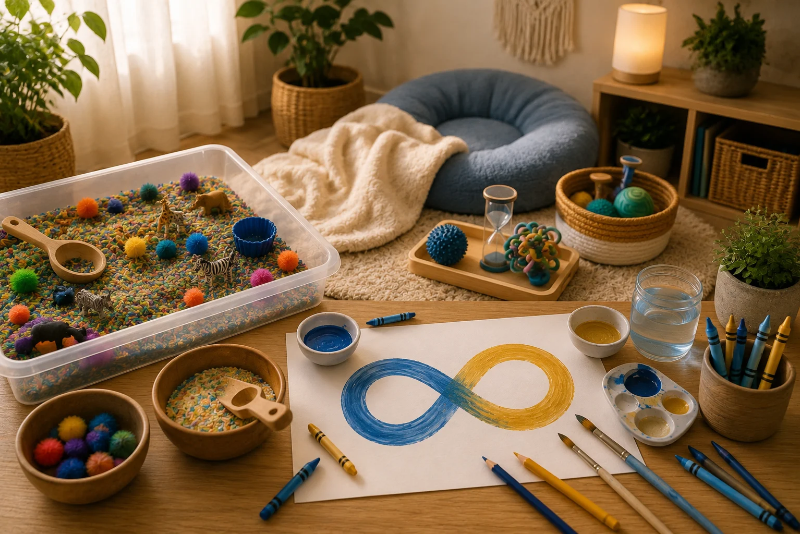
Whether you’re a parent looking for sensory play ideas, a teacher planning something meaningful for World Autism Awareness Day, or you just want simple, well-rounded activities that support autistic kids year-round, this guide brings together ideas across every setting: home, classroom, and community.
A quick note before we dive in: every autistic child is different, and what works wonderfully for one child may not land for another. Think of these as a starting menu to adapt, not a checklist to complete. And if any of these overlap with therapies your child already receives (like occupational or speech therapy), it’s always a good idea to check in with their therapist or care team before trying something new. This list is meant to inform, not replace professional guidance.
Sensory Activities
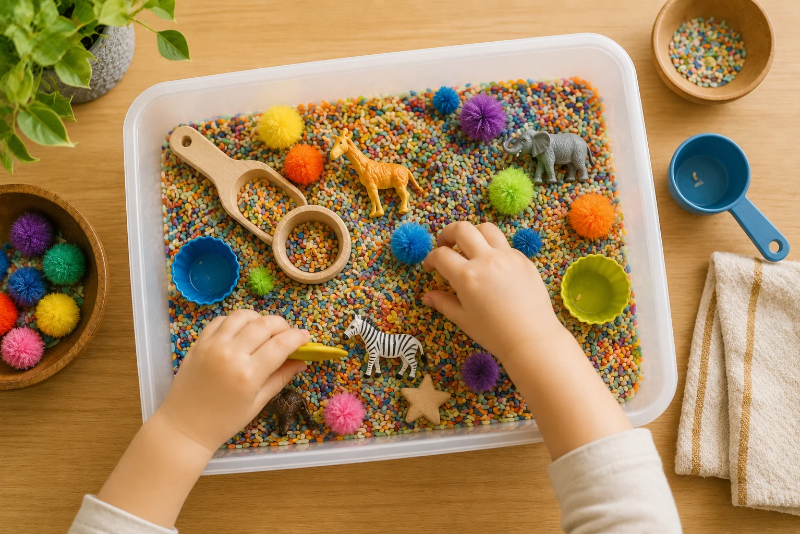
Many autistic children experience the world more or less intensely through touch, sound, sight, or movement. Sensory play can help kids explore these sensations in a safe, low-pressure way, and it’s genuinely fun for most kids, autistic or not.
DIY slime or putty. A classic sensory activity that also doubles as a fun science project.
Shaving cream window painting. Spread shaving cream on a window or tray and let kids draw, swirl, and press their hands into it. Great for tactile exploration and easy cleanup.
Pouring station. Set out various cups, funnels, and containers with water (add food coloring for extra fun) and let kids pour, mix, and measure.
Ball pit. A DIY or store-bought ball pit offers gentle full-body pressure, which some kids find calming, along with a fun space for movement.
Sensory walk. Line up shallow bins filled with different safe textures (sand, dry beans, cotton balls, water) and let kids step from one to the next, describing what they feel.
Sensory bin. Fill a bin with rice, beans, or pasta and hide small toys or shapes inside for kids to find and sort.
Edible sensory play. For kids who explore with their mouths, foods like mashed avocado, cooked rice, or shredded coconut offer safe tactile play.
Fidget toys. Simple tools like stress balls, textured fabric, or fidget spinners can help some kids stay focused or self-regulate throughout the day.
Social Skills Activities
Building social connection looks different for every child, but structured, low-pressure games can help kids, autistic and neurotypical alike, practice recognizing emotions and communicating with each other.
Emotion cards. Simple printable cards showing different facial expressions can help kids name and recognize emotions in themselves and others.
Sharing time. Let each child bring in something they’re passionate about to share with the group. This taps into common autistic strengths, like deep, focused interests, while giving other kids a window into what excites them.
The Name Game. A simple circle game where each child says their name and points to another to build first-day-of-school or first-day-of-group familiarity.
“How would it feel to be…?” After reading a story together, ask kids how a character might feel in a certain scene. This builds perspective-taking in a low-stakes way.
Turn-taking games. Simple board games or games like Simon Says naturally build patience and turn-taking skills.
Calming and Self-Regulation Activities

Many autistic children (and adults) benefit from having reliable tools to help manage big emotions or sensory overwhelm.
Coloring pages. A quiet, screen-free way to help kids refocus during a stressful moment.
Calm-down cards. A set of cards with simple calming strategies (deep breaths, counting, stretching) a child can pick from when overwhelmed.
Mindfulness or breathing exercises. Short, guided breathing exercises can help some kids regulate before a meltdown or shutdown escalates.
Grounding techniques. Simple prompts like naming five things you can see, or holding something textured, can help redirect focus during overwhelming moments.
A designated calm-down space. A quiet corner with soft seating, sensory toys, and low stimulation gives any child, not just autistic kids, somewhere to decompress without being singled out.
Calm-down kit. A small box of go-to comfort items (a stress ball, putty, a favorite fidget, a weighted lap pad) that a child can turn to when things feel like too much.
Classroom and Teaching Ideas
For teachers and group leaders, small shifts in structure can make a big difference for autistic students.
Incorporate special interests into lessons. If a student loves space, weave that into a math or reading lesson. It’s a simple way to boost engagement.
Use visual aids. Many autistic learners process visual information more easily than verbal instruction alone; pictures, charts, and written schedules can help.
Post a visible daily routine. Predictability helps many autistic kids feel more secure, especially around transitions between activities.
Offer flexible participation options. Not every child is comfortable sharing out loud in a group; offering alternatives (writing, drawing, one-on-one check-ins) makes activities more inclusive.
World Autism Awareness Day and Autism Month Activities
April 2nd is recognized by the United Nations as World Autism Awareness Day, and the full month is often used to spotlight autism through art, education, and community events. Many autistic self-advocates now prefer the term “Autism Acceptance Month,” reflecting a broader shift toward centering autistic voices and experiences rather than framing autism only through the lens of outside “awareness.” Both terms are widely used, so you may see either depending on the source.
Autism-themed art activities. Let kids create art using the infinity symbol, which many in the autism community prefer over the puzzle piece, since some feel the puzzle piece implies autistic people are “incomplete.” Painting, collage, or chalk art using the infinity symbol can be a simple, meaningful classroom or family project.
Learn about well-known autistic individuals. Reading about or discussing notable autistic and likely-autistic figures (in science, art, and activism) can help normalize autism and highlight autistic strengths and contributions.
Read picture books featuring autistic characters. Books written with autistic characters (and ideally by autistic authors or with autistic input) can help autistic kids feel seen and give other kids a window into a different experience.
Host or attend a community event. Many schools and organizations run April events: assemblies, informational displays, or fundraisers. If you’re organizing one, consider looping in autistic voices (self-advocates, local autistic-led organizations) to help shape the messaging.
Start a conversation, not just a display. Whatever activity you choose, pairing it with an actual conversation, about what autism is, what it isn’t, and what autistic people themselves say about their own experiences, tends to have more lasting impact than a bulletin board alone.
A Few Things Worth Keeping in Mind
- Every autistic person is different. A popular saying in the autism community is: “If you’ve met one autistic person, you’ve met one autistic person.” Treat any list of activities, including this one, as a starting point to personalize, not a one-size-fits-all plan.
- Follow the child’s lead. If an activity causes distress or disinterest, it’s okay to stop, adjust, or try something else. There’s no “wrong” way to opt out of a sensory or social activity.
- Language and symbols matter to some people. Terms like “awareness” vs. “acceptance,” or symbols like the puzzle piece vs. the infinity symbol, carry different meanings for different people in the autism community. When in doubt, it’s worth listening to autistic voices directly, since perspectives here vary.
- This isn’t medical or therapeutic advice. These are general activity ideas, not a substitute for guidance from a child’s doctor, therapist, or care team.
This article draws on general activity ideas commonly shared by educational and therapy-focused resources, reworded and organized here for general informational purposes. If your child has an occupational or behavioral therapist, they’re a great resource for activities tailored specifically to your child’s needs.