
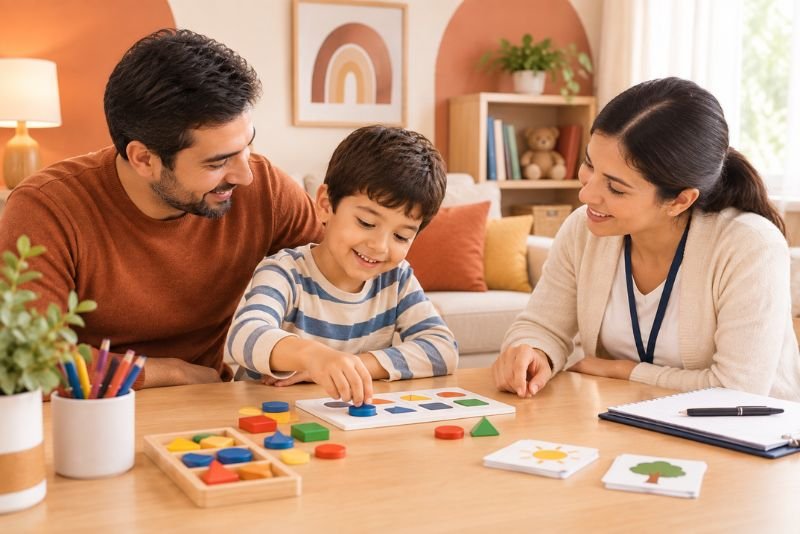
The role of parents in improving ABA therapy outcomes comes down to consistency, reinforcement, and communication practicing the same skills and language at home that a child learns in session. Most articles stop at explaining why this matters. This one focuses on what that actually looks like day to day, especially for parents juggling work, other kids, and everything else on their plate.
Why Parents Are Part of the Equation
A therapist can only be in the room for so many hours a week. The rest of a child’s life mornings, meals, weekends, car rides happen without them.
That’s the whole reason the role of parents in improving ABA therapy outcomes gets so much attention. Skills that only exist inside a therapy session don’t do much good if they disappear the moment the session ends. Parents are the ones who get to decide whether a skill sticks around in real life.
That doesn’t mean parents need to become therapists themselves. It means understanding the shape of what’s being worked on, and finding small, doable ways to support it.
What the Research Actually Shows
Studies on parent involvement in ABA consistently point in the same direction: children whose parents actively reinforce strategies at home tend to generalize skills faster and maintain them longer than children whose therapy stays confined to sessions.
Parent training programs where caregivers are taught the same principles a technician uses, like reinforcement and prompting have also been linked to better outcomes and, notably, to reduced stress for the parents themselves. Understanding why a strategy works tends to make it easier to follow through consistently, rather than guessing at what “should” work.
None of this means more involvement always equals better outcomes in every case. It means consistent, informed involvement tends to help which is a very different message than “do more.”
Practical Ways Parents Can Reinforce ABA Progress
Here’s where most articles stop at theory. In practice, reinforcing ABA progress at home usually looks like small, repeatable habits:
- Mirror the language your child’s therapist uses. If a technician phrases a request a certain way, use that same phrasing at home so your child isn’t relearning the same skill twice.
- Reinforce immediately, not eventually. A specific “you asked for that so clearly!” right after the moment matters more than a delayed, generic “good job” later.
- Practice in short bursts. Five focused minutes during breakfast beats a forced 30-minute session nobody wants to be in.
- Use visual supports. A picture schedule or first-then board reduces how much verbal prompting you need to do yourself.
- Note what you notice. A quick voice memo or phone note after a good (or hard) moment gives your child’s BCBA useful, real-world data.
None of these require special training, just a bit of consistency layered into things you’re already doing.
Building a Realistic Routine (Even With a Busy Schedule)
Most guidance on this topic assumes unlimited time and energy. Real life rarely works that way.
If you’re short on time:
- Pick one skill to focus on for the week, not five.
- Anchor practice to something that already happens daily brushing teeth, getting in the car, bedtime.
- Ask your child’s therapist which single strategy would have the biggest impact if you could only do one.
If you’re managing multiple kids:
- Involve siblings in turn-taking or communication activities instead of treating them as separate obligations.
- Use car rides or shared meals as natural, low-effort practice windows.
If you’re exhausted:
- Remember that “good enough and consistent” beats “perfect but occasional.” A skill practiced imperfectly three times a week still moves the needle more than a flawless session that only happens once a month.
How to Communicate Effectively With the ABA Team
The role of parents in improving ABA therapy outcomes isn’t just about home practice — it’s also about being a reliable source of information for the professionals guiding the plan.
A few habits that go a long way:
- Share specific observations, not just general impressions (“he asked for water using two words today” is more useful than “he did great”).
- Ask directly what’s currently being targeted, so home efforts line up with the plan instead of guessing.
- Bringing up what isn’t working, not just what is, is often more useful data than success stories.
- Ask for the “why” behind a strategy, not just the steps, so it’s easier to adapt on the fly at home.
Good communication turns you into a genuine partner in the process, not just an observer waiting for updates.
What If You Can’t Be Fully Involved Right Now?
Life happens. A demanding job, a health issue, another child needing attention full involvement isn’t always realistic, and that’s worth saying out loud instead of glossing over.
If that’s where you are right now:
- Focus on one small, consistent habit rather than an ambitious plan you can’t sustain.
- Lean on other caregivers a partner, grandparent, or babysitter to help maintain consistency when you can’t.
- Communicate your capacity honestly with your child’s BCBA so the home plan is realistic, not aspirational.
- Remember that some involvement, done consistently, is more valuable than an all-or-nothing approach that burns out after two weeks.
Also Read: ABA Therapy at Home: Common Mistakes Parents Make and How to Fix Them
Common Mistakes to Avoid
- Trying to work on too many skills at once. Focus produces better results than breadth.
- Turning every interaction into a lesson. Kids also need unstructured time that isn’t a teaching moment.
- Going quiet with the therapy team. Even small updates help keep the plan aligned with real life.
- Comparing progress to other kids or timelines. Every child’s pace looks different, and that’s normal.
Conclusion
The role of parents in improving ABA therapy outcomes isn’t about becoming a second therapist in the house. It’s about consistency in small moments, honest communication with the professionals involved, and giving yourself permission to do what’s realistic rather than what’s ideal on paper.
Progress tends to come from steady, sustainable habits, not heroic effort that burns out in a month.
FAQ’s
1. What is the role of parents in improving ABA therapy outcomes?
Parents help by reinforcing skills learned in therapy at home, maintaining consistent routines, and communicating regularly with their child’s ABA team all of which support skill generalization beyond the therapy session itself.
2. Do parents need formal training to support ABA therapy at home?
Not necessarily. While parent training programs can be helpful, many parents support progress simply by mirroring the language and strategies used in sessions and reinforcing them consistently at home.
3. What if I don’t have much time to be involved in my child’s ABA therapy?
Focusing on one small, consistent habit is more sustainable than an ambitious plan you can’t keep up with. Communicating your capacity honestly with your child’s BCBA helps keep expectations realistic.
4. How can I reinforce ABA skills without turning every moment into a lesson?
Anchor short, focused practice to routines you already have, like mealtime or bedtime, and allow other moments to stay unstructured. Balance matters as much as consistency.
5. Does parental involvement guarantee better ABA therapy outcomes?
No single factor guarantees outcomes, and every child’s progress looks different. This article is for general informational purposes and isn’t a substitute for guidance from your child’s licensed provider.