
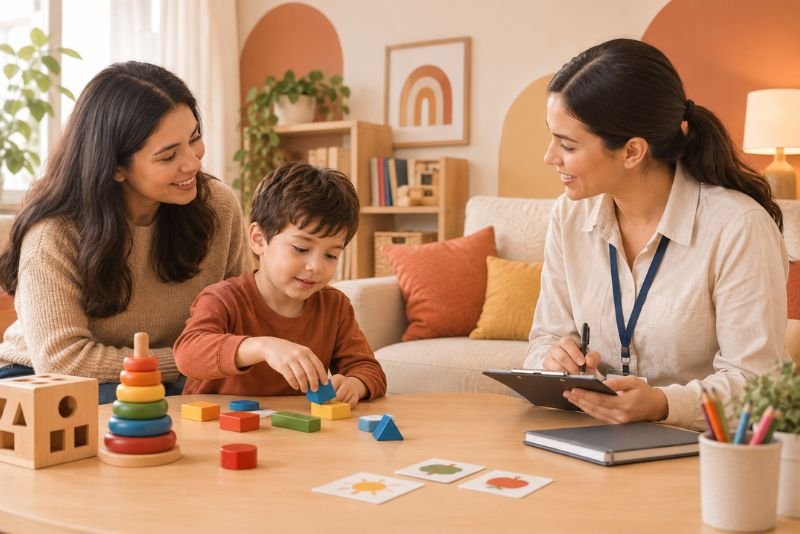
To choose a trustworthy in-home ABA therapy provider, check for BCBA oversight, RBT-certified staff, background screening, and clear communication before signing on. In-home ABA therapy means welcoming a therapist into your family’s daily routine your kitchen, your child’s comfort zone, several times a week so the right fit matters as much as the right credentials. This guide breaks down exactly what to look for, what to ask, and what red flags to avoid.
What In-Home ABA Therapy Actually Involves
In-home ABA therapy is Applied Behavior Analysis delivered in a family’s own house rather than a clinic or center. A behavior technician, usually a Registered Behavior Technician (RBT), works directly with the child, while a Board Certified Behavior Analyst (BCBA) designs and oversees the treatment plan behind the scenes.
The appeal is straightforward: skills get practiced in the same rooms, routines, and moments where they’re actually needed: mealtime, bedtime, sibling play, homework. That’s a real advantage over learning something in a clinic and hoping it transfers home.
But because this therapy happens inside your household, the relationship with the provider looks different than picking a pediatrician or a tutor. You’re choosing someone who’ll be a regular presence in your home life, not just an appointment on a calendar.
Why Trust Matters More in a Home Setting
A center-based therapy session ends when you walk out the door. In-home ABA therapy doesn’t work that way the technician sees your kitchen, your parenting style, your other kids, your good days and your hard ones.
That level of access means trust isn’t a nice-to-have. It’s the foundation the whole arrangement rests on. A provider who communicates clearly, respects your family’s boundaries, and treats your child with genuine warmth will make an enormous difference in how comfortable everyone feels including your child, who needs to feel safe before any real learning can happen.
Credentials to Look For
Before anything else, it’s worth confirming the basics.
- BCBA oversight. Every legitimate in-home ABA program should be supervised by a Board Certified Behavior Analyst, even if a technician is the one physically present for sessions.
- RBT certification. The person working directly with your child should hold current Registered Behavior Technician credentials, or an equivalent supervised-in-training status.
- Background checks. Ask directly whether staff go through background screening before being placed in a family’s home this should be standard, not an unusual request.
- State licensing. Depending on where you live, ABA providers may need specific state licensure or registration. A quick check with your state’s licensing board can confirm a provider is operating properly.
None of this guarantees a good personality fit, but it’s the floor every provider should meet.
Questions to Ask Before You Choose a Provider
A short conversation can tell you a lot. Some worth asking directly:
- How often will a BCBA actually be involved, beyond the initial assessment?
- What does a typical session look like, and how is progress measured?
- How do you handle a session that isn’t going well — a meltdown, a bad day, a refusal to participate?
- How do you train and support the technicians who’ll be coming into our home?
- What happens if the technician assigned to us isn’t the right fit?
- How do you communicate with parents between sessions — notes, calls, a shared app?
A provider that answers these clearly and specifically, rather than vaguely, is usually a good early sign.
Red Flags Worth Paying Attention To
Trusting your gut matters here. A few signs worth taking seriously:
- Vague answers about supervision. If it’s unclear how often a BCBA actually reviews progress, that’s worth pushing on.
- High staff turnover. Constant changes in who shows up at your door can be disruptive for a child who thrives on consistency.
- Pressure to commit quickly. A reputable provider should welcome questions, not rush you into signing paperwork.
- No clear way to reach someone if a session needs to be rescheduled or a concern comes up.
- Reluctance to share credentials or answer questions about staff training and background checks.
None of these on their own are automatically disqualifying, but a pattern of them is worth taking seriously.
Preparing Your Home and Family
Once you’ve chosen a provider, a little preparation goes a long way.
For the space itself:
- Set aside a consistent area for sessions, ideally somewhere with minimal distractions.
- Keep favorite toys or reinforcers accessible, since the technician will likely need to use them.
For the household:
- Talk with siblings about what to expect, especially if sessions happen during shared family time.
- Set expectations about privacy —some families prefer sessions in a specific room rather than throughout the house.
- Ask the provider how they’d like you to be involved during sessions versus giving the technician space to work.
A little structure upfront tends to make the first few weeks smoother for everyone.
In-Home vs. Center-Based: A Quick, Honest Comparison
Neither setting is universally “better” — it depends on the child and the goals.
In-home ABA therapy tends to work well when:
- A child struggles to generalize skills across settings
- Family routines (mealtime, bedtime, sibling interaction) are a major focus
- Transitioning to a new environment is especially difficult for the child
Center-based therapy tends to work well when:
- Peer interaction and group settings are a priority
- A child benefits from more structured, distraction-controlled environments
- Access to specialized equipment or resources is important
Many families use a mix of both, based on a BCBA’s recommendation and how their child responds to each setting.
Trusting Your Own Judgment
Credentials and clean paperwork matter, but so does how a provider makes your family feel. If something seems off during initial conversations —rushed answers, unclear communication, a mismatch in values around how your child should be supported — it’s worth continuing your search.
You know your child and your household better than any outside provider. A good in-home ABA therapy provider will welcome that expertise, not dismiss it.
FAQ’s
1. What credentials should an in-home ABA therapy provider have?
Look for BCBA oversight of the treatment plan and RBT certification (or equivalent supervised status) for the technician working directly with your child, along with proper state licensing where applicable.
2. How often should a BCBA be involved in in-home ABA therapy?
This varies by provider and by your child’s specific plan, but a BCBA should be reviewing progress and adjusting the treatment plan on a regular, ongoing basis — not just during an initial assessment.
3. Is in-home ABA therapy better than center-based therapy?
Neither is universally better. In-home therapy often helps with generalizing skills into daily routines, while center-based therapy can offer more peer interaction and structured environments. The right fit depends on your child’s needs.
4. What questions should I ask before hiring an in-home ABA provider?
Ask about BCBA supervision frequency, how progress is measured, staff training and background checks, and how the provider communicates with parents between sessions.
5. How do I know if an in-home ABA therapy provider is trustworthy?
Clear, specific answers to your questions, transparency about credentials and staff training, and a communication style that respects your family’s input are all good signs. This article is for general informational purposes and doesn’t replace direct verification with a licensed provider.