
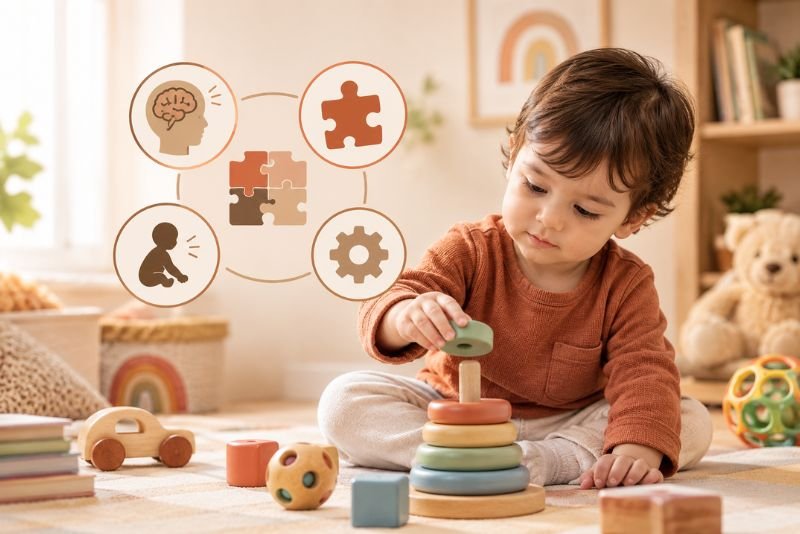
Infantile autism is an older term for autism that becomes noticeable in infancy or early childhood. Today it falls under autism spectrum disorder (ASD), a neurodevelopmental difference in social communication, behaviour, and sensory processing. There is no single cause, and genetics play a large role. Signs often appear before age 3, but only a qualified professional can diagnose it.
What Does “Infantile Autism” Actually Mean?
The word “infantile” doesn’t mean the condition only affects babies. It points to when the first signs tend to show up: in the early years of life.
You’ll still see the term in older textbooks, school records, and family conversations. Modern diagnostic manuals no longer list it as a separate condition.
Where the term came from
In 1943, child psychiatrist Leo Kanner described a group of children who seemed unusually withdrawn, preferred sameness, and struggled to connect socially. He called the pattern “early infantile autism.”
Early theories were limited by the knowledge of the time, and some wrongly blamed parents. Research since then has shifted the focus to brain development and genetics.
How it became ASD
The DSM-5, published in 2013, brought several older labels (autistic disorder, Asperger’s syndrome, and PDD-NOS) under one umbrella: autism spectrum disorder. The ICD-11, the World Health Organization’s classification system, takes the same approach.
So the practical answer is yes: ‘infantile autism’ is the historical name for what is now called ASD.
The “spectrum” isn’t a line running from “mild” to “severe”. It’s a mix of different strengths and needs in areas like communication, sensory processing, and daily living. Two autistic children can look very different from each other.
Common Signs of Infantile Autism
Autism looks different in every child, and plenty of typically developing babies show a few of these behaviors now and then. Professionals usually look at two areas: social communication and interaction, and restricted or repetitive behaviours, interests, or sensory responses.
Possible early signs in babies
- Limited eye contact, or little response to smiles
- Not responding to their name by around 9 to 12 months
- Few back-and-forth sounds, like babbling “conversations”
- Limited gestures such as pointing, waving, or reaching up
- Less interest in peek-a-boo or simple social games
Possible signs in toddlers
- Delayed speech, or losing words they once used
- Repeating words or phrases (echolalia)
- Not sharing interest, such as showing you a toy or pointing at a plane
- Lining up objects or playing with one part of a toy repeatedly
- Strong distress over small changes in routine
- Repetitive movements like hand-flapping, rocking, or spinning
Some children develop skills on time and then lose them. Professionals take any loss of skills seriously.
Sensory differences are also common. A child might cover their ears with a vacuum cleaner, refuse certain clothing textures, or be drawn to spinning wheels. These aren’t “bad behaviour”. They often reflect how the child’s nervous system processes the world.
What these signs do and don’t mean
Seeing one or two of these doesn’t mean a child is autistic. Children develop at different speeds, and hearing problems or language delays can look similar.
What matters is the overall pattern, how long it lasts, and how it affects daily life. A paediatrician or developmental specialist is trained to assess that.
What Causes Infantile Autism?
This is usually the first question parents ask and often the most emotional one. Researchers haven’t found one single cause. Current evidence points to a mix of factors affecting early brain development.
Genetics
Genetics is the strongest piece of the picture. Studies of families and twins suggest inherited factors account for a large share of the likelihood of autism.
It isn’t a single “autism gene.” Many gene variations have been linked to autism, each contributing a small part. In some children a specific genetic condition, such as fragile X syndrome, is also present. In others, no clear genetic explanation is found.
Prenatal and birth-related factors
Research has looked at factors around pregnancy and birth, including premature birth, older parental age, and certain pregnancy complications or exposures.
These are associations, not proven direct causes. Many children with these factors are not autistic, and many autistic children had none of them.
What does not cause autism?
- Vaccines: Large studies across many countries have found no link between vaccines and autism.
- Parenting style: Autism isn’t caused by “cold” parenting or anything a parent did or didn’t do.
- Screen time or diet alone: Neither has been shown to cause autism on its own.
If you’re reading this worried about something you did, it’s very unlikely to be the explanation.
How Is Autism Identified in Young Children?
There’s no blood test or brain scan for autism. Identification relies on observing development, talking with caregivers, and using standardized tools.
Screening
In the United States, the American Academy of Pediatrics recommends autism-specific screening at the 18-month and 24-month check-ups. A common tool is the M-CHAT-R/F, a short parent questionnaire.
A screening result isn’t a diagnosis. It’s a signal that a closer look might be useful.
A full evaluation
If screening raises questions, a child may be referred to a developmental pediatrician, child psychologist, speech-language pathologist, or a team of them. They may observe the child at play, ask detailed questions, and check hearing and language.
Identification is possible in toddlerhood, but it often happens later. CDC surveillance data shows a median diagnosis age of about 47 months in the US, even though many families notice differences earlier.
Everyday Support at Home
This article can’t recommend treatment, and every child’s needs are different. A qualified professional can help you decide what fits your family.
Alongside professional support, many families find small daily habits helpful: predictable routines, extra time to respond, calm spaces for sensory breaks, and following the child’s interests during play.
Visual supports are another common choice. Pictures can make the day easier to follow, and you can create your own with our free visual cue card and schedule maker. These tools are practical aids, not medical treatments.
When to Talk to a Professional
You don’t need to wait for certainty. If something about your child’s communication, play, or development feels off, it’s reasonable to raise it with their doctor.
It helps to bring a few specific examples, short videos of your child playing or communicating, and notes on when skills appeared or stopped. You know your child’s everyday behaviour better than anyone. If you’re told to “wait and see” but your concern remains, it’s fair to ask for a referral or a second opinion.
How Common Is Autism Today?
The CDC’s ADDM Network reported that about 1 in 31 eight-year-olds in the US were identified with autism in 2022, up from 1 in 36 in the previous report.
The CDC and other experts largely link the rise to better awareness, wider screening, and improved access to evaluations. This figure describes the US, and numbers elsewhere differ.
Frequently Asked Questions
1. Is infantile autism the same as autism spectrum disorder?
Essentially, yes. “Infantile autism” is the older name for what is now called autism spectrum disorder (ASD). Current diagnostic systems, including the DSM-5 and ICD-11, use ASD as the single umbrella term, though you may still see the older phrase in books, records, or conversations.
2. At what age does infantile autism appear?
Signs usually emerge in the first three years of life. Some are subtle in infancy, like limited eye contact or few gestures, and become clearer in toddlerhood as communication and play develop. Every child’s timeline is different, so the age at which signs are noticed can vary.
3. Can vaccines or parenting cause infantile autism?
No. Large studies across many countries have found no link between vaccines and autism, and autism isn’t caused by parenting style or anything a parent did or didn’t do. Research points mainly to genetics and early brain development.
4. Can autism be detected in a baby?
Some early differences can be noticed in babies, but they aren’t definitive on their own, since infants develop at different speeds. Screening is typically recommended at 18 and 24 months, and only a qualified professional can make a diagnosis after a proper evaluation.
5. What should I do if I think my child shows signs?
Talk to your child’s paediatrician and share specific examples of what you’ve noticed, such as how your child responds to their name, plays, or communicates. Short videos can help too. The doctor can guide you toward screening or a developmental evaluation if it’s appropriate, and you can ask for a second opinion if your concerns remain.