
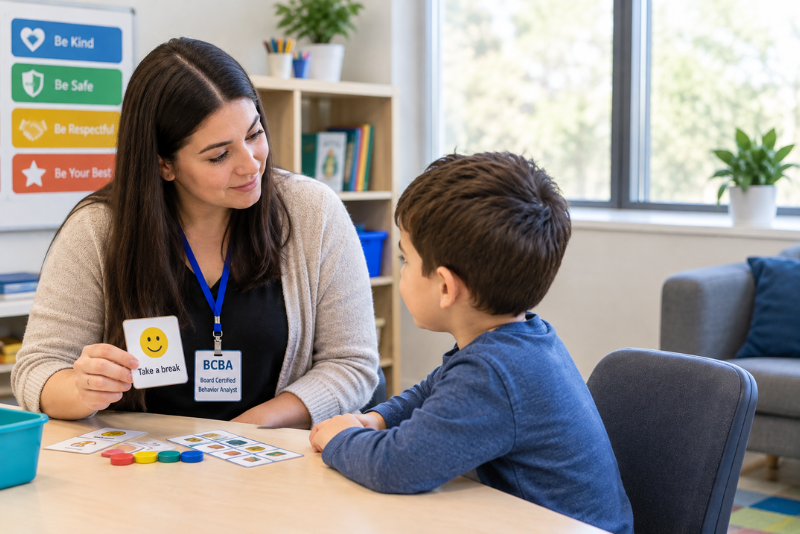
Few things are as stressful as watching a child, teen, or adult struggle with daily outbursts, aggression, or refusal to follow routines. Many families try different strategies and still feel stuck. A Board Certified Behavior Analyst (BCBA) examines the underlying factors that may be contributing to a child’s behavior, rather than focusing only on what is happening. Once the reason is clear, it becomes much easier to teach a better way to communicate and cope.
This article explains who a BCBA is, how they work, and what you can expect from the process.
Quick Answer: A Board Certified Behavior Analyst is a graduate-level professional who studies why a behavior happens, builds a plan to replace it with useful skills, trains caregivers to use that plan, and checks progress with data. The goal is to understand why the behavior occurs rather than simply trying to stop it.
What Is a Board Certified Behavior Analyst?
A Board Certified Behavior Analyst is a professional certified by the Behavior Analyst Certification Board (BACB), a non-profit organization that sets standards for the field. BCBAs use applied behavior analysis (ABA), a science-based approach that studies how the environment, learning, and consequences shape what people do.
To earn this credential, a person generally needs to:
- Hold a master’s degree or higher from an accredited university
- Complete behavior-analytic coursework approved by the BACB
- Finish a long period of supervised fieldwork
- Pass a national certification exam
The work does not stop there. BCBAs must renew their certification every two years by completing continuing education, and they must follow the BACB’s Ethics Code for Behavior Analysts. Some hold the BCBA-D designation, which means they also have a doctoral degree.
You may also hear about two related roles. A Board Certified Assistant Behavior Analyst (BCaBA) holds a bachelor’s-level certification and works under a BCBA’s supervision. A Registered Behavior Technician (RBT) carries out treatment plans directly with clients, also under supervision.
What Are Challenging Behaviors?
Challenging behaviors are actions that cause harm, get in the way of learning, or make everyday life hard for the person and the people around them. Common examples include:
- Hitting, kicking, or biting
- Self-injury, such as head-banging
- Frequent meltdowns or tantrums
- Running away or leaving a safe area
- Throwing or breaking objects
- Refusing to follow instructions or join activities
- Repetitive behaviors that interfere with daily life
These behaviors are not signs of a “bad” child or a “difficult” adult. In most cases, the person is trying to get something, avoid something, or cope with something, and they do not yet have a better way to do it.
Why Do Challenging Behaviors Happen?
Behavior analysts believe that behavior serves a purpose, called its function. Most challenging behaviors fall into four main functions:
- Attention: The person wants interaction from others, even if it is negative attention.
- Escape or avoidance: The person wants to get away from a task, demand, place, or person.
- Access to items or activities: The person wants a toy, snack, device, or preferred activity.
- Sensory or automatic: The behavior feels good or relieves discomfort on its own, without involving anyone else.
Two behaviors may appear the same on the surface but serve entirely different purposes. A child who screams during homework might be avoiding a hard task, while a child who screams at the grocery store might be asking for candy. The strategies that work for one will not work for the other, which is why guessing often fails and careful assessment matters.
How a BCBA Solves Challenging Behaviors: Step by Step
Step 1: Gather Background Information
The BCBA begins by talking with parents, caregivers, teachers, and sometimes the individual. They ask about daily routines, health, sleep, communication skills, past strategies, and what the person enjoys. Medical or physical issues, such as pain, hunger, or poor sleep, can contribute to behavior, so these are discussed early. A BCBA will usually recommend a medical check when something seems physical.
Step 2: Conduct a Functional Behavior Assessment
The core tool is the Functional Behavior Assessment (FBA). It combines interviews, checklists, and direct observation. The BCBA often records what is known as ABC data:
- Antecedent: What happened right before the behavior?
- Behavior: What exactly did the person do?
- Consequence: What happened right after?
Patterns appear over time. For example, the data might show that most meltdowns happen right after a worksheet is placed on the table, and that the task is usually removed afterward. That pattern points toward escape as the function.
Step 3: Form a Hypothesis
Using the data, the BCBA forms a clear, testable statement about why the behavior happens. In some cases, they run a structured analysis to confirm the cause. This step turns a vague problem (“he is always angry”) into a specific one (“he screams to escape difficult tasks”).
Step 4: Create a Behavior Intervention Plan
Next comes a written Behavior Intervention Plan (BIP). A good plan does more than reduce the problem behavior. It helps the person learn a more appropriate way to respond or communicate instead. Plans usually include:
- Prevention strategies: Changing the setting or routine so the behavior is less likely, such as using visual schedules or giving advance warnings before transitions.
- Replacement skills: Teaching a safer, more effective behavior that serves the same purpose, such as asking for a break with a card, sign, or words.
- Response strategies: Clear steps for how adults react when the behavior occurs, so they avoid accidentally rewarding it.
- Reinforcement: Rewarding the new, positive behavior so it grows stronger.
Step 5: Train the People Around the Person
A plan is most effective when everyone responsible for implementing it understands how it works. BCBAs spend a good deal of time coaching parents, teachers, and therapists. They model techniques, give feedback, and answer questions. Consistency across home, school, and therapy is one of the biggest factors in lasting change.
Step 6: Track Data and Adjust
Throughout treatment, the BCBA reviews data on how often, how long, and how intense the behavior is. If the numbers are not improving, the plan is changed. This ongoing cycle of measuring and adjusting is what separates behavior analysis from trial-and-error approaches.
Common Strategies BCBAs Use
Here are a few well-known techniques, explained simply:
- Functional Communication Training (FCT): The person learns an appropriate way to ask for what they need, such as “break, please,” instead of screaming.
- Differential reinforcement: Adults reward positive or alternative behaviors and give little attention to the problem behavior.
- Visual supports: Pictures, schedules, and timers help the person understand what is coming next, which lowers anxiety.
- Task modification: Breaking big tasks into small steps or mixing easy tasks with harder ones to reduce frustration.
- Teaching coping and waiting skills: Gradually building tolerance for waiting, hearing “no,” or handling changes.
A Simple Example
Imagine a six-year-old who hits his teacher every time it is time to clean up. Data shows that after he hits, cleanup stops and the teacher lets him keep playing. The BCBA identifies the function as escape. The plan might include a visual cleanup routine, a “first clean up, then game” rule, and a break card he can hand over when he feels overwhelmed. Adults praise him when he uses the card and no longer let hitting end the task. Over several weeks, the data show hitting dropping as card use rises.
Who Can Benefit?
Although many people connect behavior analysts with autism, their services reach further. People with ADHD, intellectual and developmental disabilities, brain injuries, and other support needs may also benefit. BCBAs work in homes, clinics, schools, hospitals, and community settings, and they support people of all ages.
How to Choose a Qualified BCBA
When looking for a professional, keep these points in mind:
- Verify the certification. The BACB maintains an online registry where you can check whether a certification is active.
- Ask about experience. Look for experience working with the age group and type of behavior you are concerned about.
- Look for a clear assessment process. A reliable analyst should explain how they will find the cause of the behavior before creating a plan.
- Expect collaboration. Good BCBAs involve families and respect personal values, culture, and preferences.
- Look for dignity-focused methods. Modern practice emphasizes informed consent, individual comfort, and positive reinforcement, while avoiding punitive or coercive approaches.
Final Thoughts
Challenging behaviors can feel overwhelming, but they usually have a reason, and that reason can be understood. A Board Certified Behavior Analyst brings training, structured assessment, and data-based decision-making to the problem. By identifying why a behavior occurs and teaching practical replacement skills, they help people communicate better, learn more easily, and take part more fully in daily life. If behaviors are affecting safety, learning, or family life, a professional assessment is a sensible first step.
FAQs
What does a Board Certified Behavior Analyst do?
A Board Certified Behavior Analyst assesses why a behavior happens, designs a plan to teach better skills, trains caregivers to use it, and tracks progress with data. They also supervise registered behavior technicians, who deliver much of the day-to-day therapy in homes and schools.
How do I know if a BCBA is certified?
Search the Behavior Analyst Certification Board’s online certificate registry by name. It indicates whether the certification is currently active. Certified analysts must renew every two years with continuing education, so an active listing confirms current standing and agreement to follow the ethics code.
What are challenging behaviors?
Challenging behaviors are actions that cause harm, disrupt learning, or limit daily life. Examples include aggression, self-injury, tantrums, running away, and property destruction. They are not bad choices; they are often a way to communicate a need when other skills are missing.
Is a BCBA only for autism?
No. Although many work with autistic children, a BCBA also supports people with ADHD, developmental delays, anxiety-related behaviors, and brain injuries. They also work across schools, workplaces, and healthcare settings. Behavior analysis studies how the environment and learning affect behavior in anyone.
How long does it take to see improvement in behavior?
It varies. Some families notice small changes within weeks, while complex behaviors may need months of steady work. Progress depends on how consistently the plan is used across home and school, and the analyst adjusts the approach based on collected data.
What is the difference between a BCBA and an RBT?
A BCBA assesses, designs, and oversees the treatment plan. A Registered Behavior Technician works directly with the person, carrying out that plan under the BCBA’s supervision. The BCBA holds a master’s-level certification, while the RBT credential requires less formal education and focuses on hands-on implementation.
Disclaimer: The information on this website, including this article, is for general educational purposes only and is not a substitute for professional medical, psychological, or therapeutic advice, diagnosis, or treatment. Always consult a qualified healthcare provider or a Board Certified Behavior Analyst about your or your child’s specific needs.