
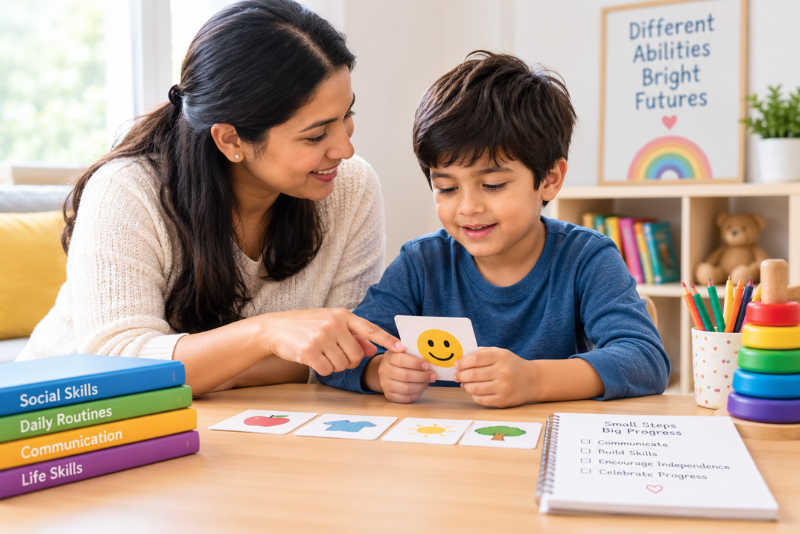
Hearing the word “autism” about your child can bring many feelings at once. You may feel fear, relief, worry, or hope. All of these are normal.
The good news is that you can help your child in many ways. Autism is not caused by parenting. And with the right support, many autistic children learn new skills, build bonds, and grow in their own way.
This guide explains what you can do, step by step. It uses simple words and follows advice from trusted health groups.
Medical disclaimer: This article is for general information only. It is not medical advice. It does not replace care from a doctor, therapist, or other health professional. Every child is different. Please talk to your child’s healthcare provider before you start, change, or stop any therapy, diet, or medicine.
What Autism Is
Autism spectrum disorder (ASD) is a lifelong difference in how the brain develops. It affects how a person communicates, plays, learns, and relates to others.
Doctors usually look for two main areas:
- Social communication. This may include less eye contact, fewer gestures, or trouble with back-and-forth talk.
- Repeated behaviors and strong interests. This may include repeated movements, a need for sameness, or a deep focus on certain topics.
Autism is called a spectrum because it looks different in every child. Some children need a lot of daily support. Others need much less.
Here are three facts every parent should know:
- Autism is not caused by bad parenting.
- Vaccines do not cause autism. Large studies around the world have shown this.
- Autism is not an illness to cure. The goal of support is to help your child learn, feel safe, and live well.
Know the Early Signs
Every child grows at their own pace. But some signs are worth sharing with your doctor. Examples include:
- Not responding to their name by about 12 months
- Little or no babbling or baby talk by about 12 months
- Not pointing or waving to share interest
- Few or no spoken words by about 16 months
- No meaningful two-word phrases by about 24 months
- Losing words or skills they once had at any age
- Limited eye contact or little pretend play
One sign alone does not mean autism. But if you notice any of these, do not wait. Talk to your child’s doctor and ask for a developmental check.
The American Academy of Pediatrics advises autism screening at the 18-month and 24-month checkups. You can ask for a screening at any age if you have concerns.
Step 1: Ask for an Evaluation
If you think your child may be autistic, start with your pediatrician or family doctor. Say what you have seen. Be as specific as you can.
It helps to:
- Write down what worries you, with examples
- Note when each sign began
- Bring short videos of your child, if you can
- Share any family history of developmental delay
Your doctor may do a screening. If needed, they will refer you to a specialist. This may be a developmental pediatrician, a child psychologist, or a child neurologist. Hearing tests are often done too, to rule out hearing loss.
A proper evaluation takes time. Be patient. It is worth getting it right.
Step 2: Start Support Early
Research shows that early support can help a child build language, thinking, and daily living skills. So do not wait for a full diagnosis if your child already needs help. In many places, you can start therapy while the evaluation is still in progress.
Still, it is never too late. Support helps at every age.
Evidence-based support often includes:
- Speech and language therapy. It helps with talking, understanding, and other ways to communicate.
- Occupational therapy. It helps with daily skills, play, and sensory needs.
- Behavioral and developmental programs. Examples include approaches based on applied behavior analysis (ABA) and play-based programs that involve parents. A good program focuses on teaching skills and respects your child’s comfort and dignity.
- Parent coaching. Many programs teach parents how to support skills at home.
- Educational support. Many schools can adjust teaching to fit your child’s needs.
The right mix depends on your child’s age, strengths, and needs. A care team can help you choose.
Services, laws, and costs differ from country to country. Ask your doctor or local autism group what is available near you.
Step 3: Be Careful with Unproven Treatments
When you are worried, any promise of a quick cure can sound tempting. Please be careful.
There is no cure for autism. No single treatment works for every child. Some products and methods have no proof that they work. Some can be harmful.
Be cautious if someone:
- Promises to cure or reverse autism
- Sells a special supplement, powder, or device
- Asks you to stop your child’s regular care
- Claims results with no solid research
Examples of harmful or unproven practices include chelation, bleach-based “treatments,” and unregulated products. Never give your child these.
Before you try any new diet, supplement, or therapy, talk to your child’s doctor. Medicine can help with some related problems, such as severe irritability, anxiety, or sleep trouble. But it should only be used when a doctor prescribes it. And no medicine treats autism itself.
Build Your Care Team
No parent has to do this alone. A care team may include:
- A pediatrician. Looks after your child’s overall health and coordinates care.
- A developmental pediatrician or child psychologist. Evaluates and guides care plans.
- A speech-language therapist. Supports communication.
- An occupational therapist. Supports daily skills and sensory needs.
- A behavior or developmental therapist. Helps teach new skills.
- Teachers and school staff. Support learning and social growth.
- A counselor. Can support your child with big feelings, and you as a parent.
Not every child needs every service. If a provider does not feel like a good fit, it is okay to look for another.
Help Your Child Communicate
Many hard moments happen because a child cannot say what they need. When communication improves, behavior often does too.
These tips are widely used by therapists:
- Use short, clear words. Say “Shoes on” instead of a long sentence.
- Give extra time. Wait several seconds before you repeat yourself. Many children need time to process.
- Use pictures. Picture cards can help a child choose between “snack” and “play.”
- Use gestures and signs. A simple sign for “help” or “more” can lower stress.
- Follow your child’s lead. Join their play. Name what they do and see.
- Welcome every attempt. A sound, a point, or a look all count as communication.
If your child does not speak, ask a speech-language therapist about other ways to communicate. These include picture systems, sign, and speech devices. They do not stop speech from developing. They often support it.
Make Home Calm and Predictable
Many autistic children feel safer when the day is predictable. Small changes at home can lower stress.
- Keep a steady routine. Try to keep wake-up, meals, and bedtime about the same each day.
- Use a visual schedule. Pictures that show what comes next lower worry.
- Give a warning before changes. A phrase like “Five more minutes, then dinner” helps. A visual timer can help too.
- Create a quiet space. A cozy corner with soft light gives your child a place to rest. It is a safe spot, never a punishment.
- Reduce sensory triggers. Dim bright lights. Lower the noise. Cut scratchy tags from clothes.
You do not need to do everything at once. Start with one change. See how it goes. Then add more.
Understand Meltdowns
A meltdown is not bad behavior. It happens when a child is overwhelmed and cannot cope. It is not a choice, and it is not a way to get attention.
A tantrum is different. A tantrum is often about wanting something. A child may calm down if they get it or if the goal changes. A meltdown is about being overloaded.
It can be hard to tell them apart. If you are unsure, treat it as a meltdown first.
During a meltdown:
- Stay calm. Your calm helps your child find theirs.
- Keep everyone safe. Move hard or sharp objects away.
- Use few words. Speak softly. Do not try to reason right now.
- Lower the input. Reduce noise and light. Move to a quiet space if you can.
- Do not punish. Your child needs comfort and time.
- Offer help once it passes. A drink, a snack, or quiet time can help.
Later, when everyone is calm, think about what came before. Was it noise, hunger, tiredness, or a sudden change? Each meltdown gives you a clue. Over time, you can prevent many of them.
Keep Your Child Safe
Safety needs extra attention. Some autistic children wander or run off. Some do not sense danger well.
The American Academy of Pediatrics warns that wandering is common and can be risky. Water is a special concern. Drowning is a leading cause of death for autistic children.
Here are some steps that help:
- Secure doors and windows. Use locks, alarms, or door chimes if needed.
- Watch near water. Stay close to pools, ponds, tubs, and buckets. Ask about swim lessons that suit your child.
- Teach safety skills. Practice simple rules like holding hands near roads.
- Use ID. A bracelet or tag with your phone number can help if your child gets lost.
- Tell neighbors and school. Make sure trusted people know your child’s needs.
- Make a plan. Know what you will do if your child goes missing.
Teach Skills Step by Step
Many skills that seem easy for others need practice. Examples are brushing teeth, dressing, taking turns, and saying hello.
Here is a simple way to teach a new skill:
- Pick one skill. Do not try to teach five things at once.
- Break it into small steps. For example, brushing teeth has many steps.
- Show, help, then step back. Model it first. Then guide your child. Then let them try alone.
- Practice often. Short and regular practice works better than long sessions.
- Praise the effort. Be specific. Say “You put the toothpaste on by yourself!”
Progress may be slow. That is okay. Every small step counts.
Use Praise and Rewards
Children repeat what feels good. So notice when your child does something well.
Be specific. Say “Thank you for waiting. That was hard.” This works better than a plain “Good job.”
If praise does not mean much to your child, find something that does. It may be a sticker, a favorite song, or a few minutes of a favorite activity. This is not a bribe. It shows your child that effort leads to good things.
Avoid harsh punishment, yelling, or shaming. These do not teach skills. They can raise stress and harm trust.
Use Your Child’s Interests as a Bridge
Many autistic children have deep interests. It may be trains, dinosaurs, numbers, maps, or cartoons.
These interests can be a strength. Use them to teach counting, colors, reading, or turn-taking. They can also build joy and confidence.
Try not to take away a special interest as a punishment. For many children, it is a main source of comfort.
Support Friendships and Play
Social skills can take extra practice. Your child may not read faces or hidden rules easily. They may also prefer to play alone at times.
Here are ways to help:
- Start small. One playmate is easier than a group.
- Pick a good place. A calm space with a shared interest works well.
- Practice at home. Role-play simple things like saying hello.
- Use social stories. Short picture stories can explain what to expect.
- Respect their pace. Some children want fewer friends, and that is fine.
The goal is not to make your child act like everyone else. It is to help them connect in ways that feel good to them.
Work with the School
School can be a place of growth. It can also be a place of stress.
- Talk to the teacher early. Share what your child needs and what works at home.
- Ask about support. Many schools offer extra help or a written support plan. Rules differ by country and school.
- Stay in touch. A short daily note keeps everyone on the same page.
- Speak up. You know your child best.
When home and school work as a team, your child often does better.
Look After Your Child’s Health
Good health supports learning and mood. Autistic children often have other health needs too. These may include:
- Sleep problems
- Picky eating or feeding trouble
- Stomach or bowel problems
- Anxiety
- Attention problems such as ADHD
- Seizures, in some children
Pain can look like a behavior problem when a child cannot say what hurts. If your child changes suddenly, ask your doctor to check for a health cause first.
Keep up with regular checkups, vaccines, dental visits, and hearing and vision checks. Talk to your doctor before you give melatonin or any other supplement.
Take Care of Yourself
Your child needs you well. But caring for a child with extra needs is tiring.
- Ask for help. Let family and friends step in.
- Find other parents. Talking with people who understand can ease the load.
- Take short breaks. Even ten quiet minutes help.
- Rest and eat well. Your body needs care too.
- Talk to a professional. A counselor can help with stress, guilt, or sadness.
If you feel hopeless, or you have thoughts of harming yourself, reach out for help right away. Contact a doctor, a mental health professional, or your local emergency or crisis service.
Do Not Compare, and Celebrate Small Wins
It is hard not to compare. But every child grows on their own timeline. Your child has strengths too. Look for them. Name them.
The best comparison is your child today and your child a few months ago. A new word, a calm goodbye, or a new food tried are all big wins. Write them down. On hard days, read them. They show how far your child has come.
When to Get Help Right Away
Contact your doctor or therapist soon if your child:
- Hurts themselves, such as biting or head banging
- Is often aggressive toward others
- Loses words or skills they once had
- Has seizures or unusual staring spells
- Has sleep or eating problems that get worse
- Runs off or wanders in unsafe ways
If your child is in immediate danger, call your local emergency number.
Frequently Asked Questions
What should I do first if I think my child may be autistic?
Talk to your child’s doctor and ask for a developmental evaluation. Share what you have seen. You can start speech or other therapy while you wait for results.
Can autism be cured?
No. Autism is a lifelong difference, not a disease. But the right support can help your child build skills, communicate better, and live a full life.
Do vaccines cause autism?
No. Many large studies in many countries found no link between vaccines and autism. Talk to your doctor if you have worries.
Is it my fault that my child has autism?
No. Autism is not caused by anything a parent did or did not do. Please let go of the guilt.
How can I help my autistic child talk?
Use short, clear words and give extra time to answer. Use pictures and gestures. Follow your child’s lead in play. Work with a speech-language therapist to find what fits your child.
How do I calm my child during a meltdown?
Stay calm and keep your child safe. Lower noise and light. Use few words. Do not punish. Offer comfort when it passes.
Is a special diet or supplement helpful?
There is no strong proof that special diets or supplements treat autism. Some can cause harm, such as poor nutrition. Always check with your child’s doctor or a dietitian first.
How can I find support as a parent?
Ask your doctor or therapist about local parent groups. Look for trusted autism organizations. Many offer free guides and support.
Final Thoughts
Helping a child with autism takes patience, learning, and support. You do not have to do it all at once.
Get an evaluation. Start support early. Stay away from miracle cures. Build a good team. Keep your child safe. And take care of yourself too.
Your child can grow, learn, and thrive. One small step at a time is enough.
Medical Disclaimer
The information on this page is for education only. It is not medical advice, diagnosis, or treatment. Always ask a qualified healthcare provider about your child’s care. Never ignore professional advice or delay getting help because of something you read here. If you think your child is in danger, call your local emergency number right away.