
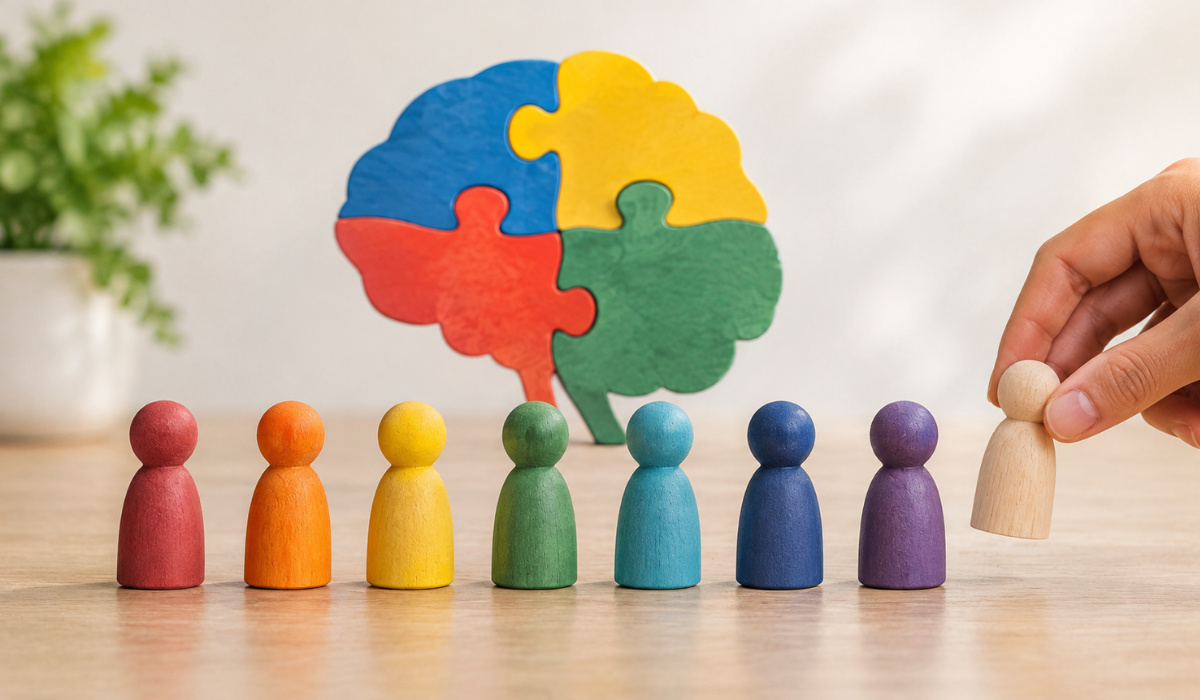
No, not everyone is on the autism spectrum. Only people who meet the medical criteria for autism spectrum disorder (ASD) are autistic. But the confusion is understandable, because many autistic traits, such as liking routines, feeling overwhelmed by noise, or finding small talk tiring, show up in people who are not autistic. The difference is how big, how constant, and how disruptive those traits are.
Below, we explain where the idea comes from, what “spectrum” really means, and what research says about autistic traits in the general population.
Why Do People Wonder If Everyone Is on the Autism Spectrum?
The question usually comes from three places.
- The word “spectrum” sounds universal. In everyday language, a spectrum is something everyone can sit somewhere on, like a color spectrum or a political spectrum. So it feels natural to think, “If autism is a spectrum, I must be on it somewhere.”
- Social media makes traits look common. Short videos describing “signs of autism” often list things that almost everyone does at some point: double-checking a door lock, hating loud restaurants, or needing quiet time after a party. Without context, these seem like proof that everyone is a little autistic.
- Awareness has grown. More adults now recognize their own traits and seek answers. That is a good thing, but it can blur the line between having a few traits and having autism.
What Does “Spectrum” Actually Mean in Autism?
In autism, “spectrum” does not mean a straight line from “a little autistic” to “very autistic.” It means autism shows up in many different ways from person to person.
A more accurate way to understand it is to imagine a sound mixing board with several sliders, each representing a different trait.
Each slider controls one area, such as:
- Social communication
- Sensory sensitivity
- Need for routine
- Focused interests
- Speech and language
- Daily living skills
Each autistic person has their own mix of settings. One person may speak fluently but struggle badly with noise and crowds. Another may have little spoken language but strong visual memory. Calling someone “high-functioning” or “low-functioning” hides this variety, which is why many clinicians and autistic people now prefer to talk about support needs.
The idea of an autism spectrum was shaped by British psychiatrist Lorna Wing in the early 1980s, who noticed that autistic traits appear in many forms. In 2013, the DSM-5 (the manual used for diagnosis in the United States) combined several older labels, including Asperger’s syndrome and PDD-NOS, into one diagnosis: autism spectrum disorder. It also added three support levels, from Level 1 (needs some support) to Level 3 (needs very substantial support).
How Is Autism Diagnosed?
Autism is a diagnosis, not a personality type. According to the DSM-5-TR, an autism diagnosis requires a person to show the following characteristics:
- Ongoing differences in social communication and interaction. This might include trouble with back-and-forth conversation, reading body language, or building and keeping friendships.
- Repetitive behaviors or routines, along with strong or focused interests. This includes repeated movements, strong need for sameness, intense interests, or unusual reactions to sound, light, touch, or texture.
- Traits present in early development. They may only become obvious later, when social demands increase.
- Real impact on daily life. The traits must cause meaningful difficulty at school, at work, or in relationships.
- The traits cannot be explained solely by another condition, such as an intellectual disability.
That last point about impact matters most in this discussion. Plenty of people like routine. An autistic person may feel real distress or be unable to function when a routine changes. The trait is the same, but the effect on life is very different.
Autism is diagnosed by trained professionals, such as psychologists, psychiatrists, or developmental pediatricians, using interviews, history, and observation. There is currently no blood test or brain scan that can diagnose it.
Having Some Similar Traits Doesn’t Mean Someone Is Autistic
Think about sadness. Everyone feels sad sometimes, but that does not mean everyone has clinical depression. Depression is diagnosed when low mood is intense, lasting, and disruptive. Autism works the same way.
Research supports this idea of overlap. Studies using questionnaires such as the Autism-Spectrum Quotient and the Social Responsiveness Scale have found that autistic-like traits are spread across the general population, with most people scoring low, some in the middle, and autistic people scoring highest. Family studies also show that relatives of autistic people sometimes have milder versions of these traits without meeting diagnostic criteria.
So there is a real scientific basis for saying that autistic traits exist on a continuum. However, there is an important difference between:
- Having some traits (very common), and
- Being autistic (a smaller group whose traits are strong, lasting, and affect daily functioning).
Most researchers see autism as the high end of a trait range combined with real functional difficulty, not as something everyone has.
Myths vs. Facts
| Myth | What the evidence says |
| Everyone is a little bit autistic. | Everyone may have some traits, but autism is a diagnosis that requires persistent differences that affect daily life. |
| The spectrum goes from “mild” to “severe.” | It describes different profiles of strengths and challenges. A person’s support needs may vary depending on their age, environment, and stress levels. |
| Autism is just being shy or quirky. | Autism is a neurodevelopmental condition linked to how the brain develops and processes information. |
| Autism comes from bad parenting. | Research does not support this. Genetics plays the largest known role, and studies estimate heritability to be high. |
| Vaccines cause autism. | Large-scale studies conducted in several countries have found no evidence of a connection. |
| Only boys are autistic. | Boys are diagnosed more often, but girls and women are frequently missed because they may hide or “mask” their traits. |
| Autism can be seen from the outside. | Many autistic people look and sound typical, especially adults who have learned to mask. |
How Common Is Autism?
The U.S. Centers for Disease Control and Prevention (CDC) reported in 2025 that about 1 in 31 eight-year-old children were identified with autism, based on 2022 data. Estimates for adults are generally around 1 to 2 percent, though numbers vary because of differences in screening and healthcare access.
These figures show something important: autism is not rare, but it is also clearly not “everyone.” Roughly 97 to 99 out of every 100 people are not autistic.
Rising numbers do not mean autism is suddenly spreading. Experts point to broader diagnostic criteria, better awareness, improved screening, and more recognition in groups that were once overlooked, such as girls, women, and adults diagnosed later in life.
Why Getting This Right Matters
When “everyone is a little autistic” becomes the common view, a few problems follow.
It can minimize real struggles. An autistic adult who needs workplace adjustments may hear, “Oh, I’m like that too,” and the need for support gets dismissed.
It can delay help. People who truly need an evaluation may assume their difficulties are normal and never seek answers.
It can blur important differences. Autism comes with legal protections, educational services, and healthcare supports in many countries. These exist because the challenges are significant, not because the traits are universal.
At the same time, it helps to be kind and curious. If you see yourself in some autistic traits, that does not make you “fake” or wrong. It may simply mean you have a sensitive, detail-focused, or routine-loving way of experiencing the world, or it may be a reason to talk with a professional.
When Should You Consider an Evaluation?
It may be worth speaking with a qualified professional if you or your child:
- Have long-term difficulty understanding social cues or keeping friendships
- Feel intense distress with changes in routine
- Have strong sensory reactions that limit everyday activities
- Notice these patterns going back to early childhood
- Feel exhausted from constantly hiding or managing natural behaviors
For young children, delays in speech, limited eye contact, or unusual responses to their name are common reasons to ask a pediatrician for a developmental screening. Early support tends to help, but a diagnosis at any age can bring clarity.
Final Thoughts
So, is everyone on the autism spectrum? No. The spectrum describes the wide range of ways autism appears in autistic people, not a scale that every human sits on. Still, science does show that autistic-like traits are spread through the whole population, which is why the idea feels familiar.
The most accurate way to put it is this: many people share some autistic traits, but only some people are autistic. Understanding that difference helps us respect autistic people, avoid stereotypes, and make better decisions about when to seek support.
Frequently Asked Questions
Is everyone on the autism spectrum?
No. Only people who meet diagnostic criteria for autism spectrum disorder are on the spectrum. Everyone has some traits, like liking routines or sensitivity to noise, but autism requires persistent differences in communication and behavior, present from early childhood, that affect daily life.
What does “on the spectrum” mean?
It means a person is autistic. The word spectrum shows that autism looks different in each person, with varied strengths, challenges, and support needs. It does not describe a straight line from mild to severe, but a wide range of ways autism shows up.
Can you be a little bit autistic?
Not in a diagnostic sense. A person either meets the criteria or does not. However, research shows autistic-like traits exist across the general population, and some people have several traits without a diagnosis. Those traits on their own do not equal autism.
How common is autism?
According to the CDC, about 1 in 31 eight-year-old children in the United States were identified with autism in 2022 data. Adult estimates are generally around 1 to 2 percent. Numbers vary by country because of differences in screening and diagnosis.
How is autism diagnosed?
Specialists such as psychologists, developmental pediatricians, or psychiatrists assess developmental history, behavior, and communication using standardized tools and clinical interviews. They compare findings with DSM-5-TR criteria. There is currently no blood test or brain scan that can diagnose autism on its own.
Why are more people being diagnosed with autism?
Higher numbers mostly reflect better awareness, wider diagnostic criteria, and improved screening, especially among girls and adults who were missed before. Researchers do not believe a single new cause explains the rise. Genetics remains the strongest known factor in autism.
Disclaimer: The information on AutismCue is for general educational purposes only and is not a substitute for professional medical, psychological, or diagnostic advice. If you have concerns about yourself or your child, please consult a qualified healthcare professional.