
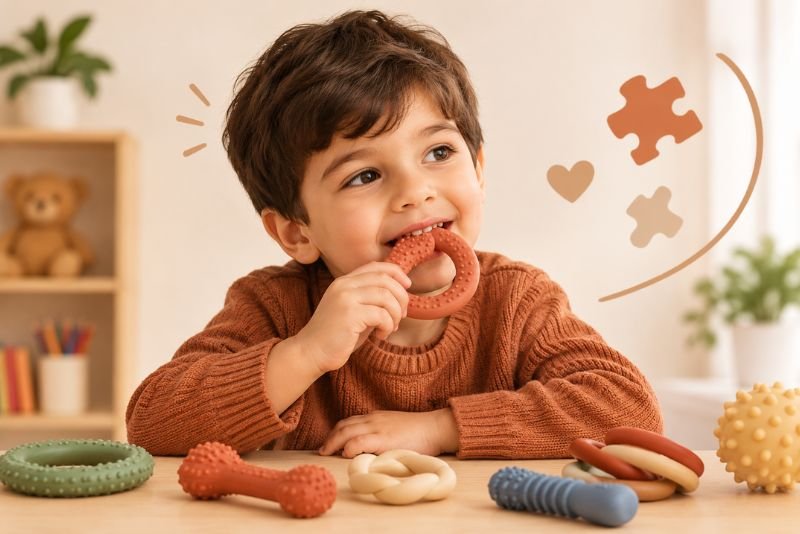
Autism biting toys are specially designed chewable tools that give children a safer option when they feel the need to bite or chew. They may help children manage sensory-seeking behaviours, find comfort, and redirect chewing away from clothing, fingers, pencils, or other unsafe objects.
The short answer: these toys can be useful for some children, but choosing the right texture, size, and firmness is essential for safety. Every child has different sensory needs, so the best option depends on their individual preferences and chewing habits.
What Are Autism Biting Toys?
Autism biting toys, also called sensory chew toys or chewies, help children who seek oral sensory input. Often made from chewable materials like silicone, they offer an alternative to chewing clothes, pencils, or fingers. Their usefulness depends on each child’s needs, and chewing does not automatically indicate autism.
Why Do Some Autistic Children Bite or Chew Objects?
Children may chew for several reasons, and the behaviour does not always have the same meaning. Understanding what happens before, during, and after chewing can help parents decide what kind of support might be appropriate.
1. Seeking sensory input
Some children enjoy the pressure and physical feedback that chewing provides. They may seek this sensation by biting soft toys, chewing clothing, or repeatedly putting objects in their mouths.
This behaviour is sometimes described as oral sensory seeking. A suitable chew toy offers a specific texture and resistance that a child may find satisfying.
2. Finding comfort during stressful moments
Chewing may be a familiar, repetitive activity that some children use when they feel overwhelmed, anxious, bored, or tired. It may be especially noticeable in busy classrooms, crowded places, or during changes in routine.
However, chewing is not always a sign of distress. It may simply be a preferred sensory activity.
3. Supporting attention during activities
Some children chew while listening to instructions, completing schoolwork, watching television, or travelling. The additional sensory input may feel helpful to them while they concentrate.
Parents should observe whether chewing actually supports participation rather than assuming it automatically improves attention.
4. Communicating discomfort or an unmet need
For children who have difficulty communicating their needs, chewing or biting may occur when they are uncomfortable, frustrated, hungry, or struggling with an activity.
If biting suddenly increases, causes injuries, or happens mainly in particular situations, consider possible triggers rather than focusing only on stopping the behavior. Autism Speaks also recommends considering sensory, emotional, and environmental factors when a child chews or swallows non-food objects.
Also Read: Best Toys for Preschoolers With Autism
How Do Autism-Biting Toys Help Children?
Autism-biting toys are not a treatment for autism. They are practical sensory tools that may help some children meet their need to chew in a more appropriate way.
1. They provide a designated chewing option
When a child regularly chews on sleeves, pencils, or other unsuitable items, a purpose-made chew toy can provide an alternative. Keeping the tool accessible may make it easier for the child to choose it when the urge to chew arises.
For example, a parent might offer a chew toy before a long car journey if the child commonly chews on clothing during travel.
2. They may support sensory regulation
Some children find the resistance and pressure of chewing satisfying. Having access to an appropriate sensory tool may help them feel more comfortable during certain everyday activities.
However, responses vary. A chew toy may be useful for one child and uninteresting or uncomfortable for another.
3. They can support participation in daily routines
A child who likes chewing while drawing, reading, or completing classroom activities may find a suitable chew toy convenient. Wearable designs and handheld options can make the tool easier to access when needed.
The aim is to support comfortable participation, not to require children to stop harmless sensory behaviours or use a particular toy.
4. They may reduce contact with unsuitable objects
Chewing pencils, plastic toys, clothing, and small household objects can present different risks, particularly when materials break or pieces are swallowed. A properly selected chew toy may offer a more appropriate alternative.
Important: A chew toy cannot guarantee that a child will stop mouthing other objects. Continue supervising as needed and keep hazardous items out of reach.
Types of Autism Biting Toys to Consider
Different designs suit different preferences. The right choice depends on how a child chews, what textures they prefer, and how they handle objects.
1. Chew necklaces
These wearable pendants can be convenient for children who want their chew tool close at hand. Choose an age-appropriate design with a suitable breakaway clasp, and supervise use according to the manufacturer’s guidance. Neck cords can pose strangulation risks, especially for younger children.
2. Chew tubes and chew sticks
These are handheld tools that children can bite along a designated surface. Some are easier to grip than pendants, making them worth considering for children who prefer holding their chew toy.
3. Textured chew toys
Raised bumps, ridges, and other surface patterns offer different tactile experiences. A child who prefers a particular texture may accept one design more readily than a smooth toy.
4. Firmer chew tools
Some products are designed for children who bite with greater force. Firmness alone does not determine safety, so the tool must be appropriate for the child’s chewing pattern and recommended age.
These categories describe common designs rather than a ranking of products. A paediatric occupational therapist or other qualified professional can help families consider suitable options when chewing is frequent or creates safety concerns.
How to Choose the Right Autism Biting Toy
Choosing a chew toy involves more than picking a colourful design. The child’s safety, chewing strength, and preferences should guide the decision.
Consider these five factors.
- Chewing strength: Look for a product specifically designed for the child’s chewing intensity. A toy that is too soft may tear, while a design that is too firm may not suit the child.
- Size and shape: Select an age-appropriate product that cannot easily be swallowed or become lodged in the mouth. Avoid small detachable parts.
- Material: Check the manufacturer’s material information, intended use, and applicable safety standards. Avoid products with unclear composition or unsupported safety claims.
- Texture and grip: Consider whether the child prefers smooth surfaces, ridges, flexible tubes, or a shape that is easy to hold.
- Cleaning and maintenance: Choose a design that can be cleaned thoroughly according to its instructions and inspected regularly for wear.
The American Academy of Paediatrics notes that sensory chew tools are used by some children with developmental disabilities, but carers should still consider individual oral habits and dental health.
Should you choose a soft or firm chew toy?
There is no single firmness level that works for every child. Observe what the child currently chews, how forcefully they bite, and whether they tend to tear or swallow pieces of non-food objects.
If the child can bite through ordinary toys or silicone products, ask a qualified professional to help assess safer alternatives. Do not assume that a product advertised as heavy-duty is automatically safe for your child.
Safety Tips for Using Autism Biting Toys
Safety should come before convenience. Even a product marketed for sensory chewing can become hazardous if it is damaged, unsuitable, or used incorrectly.
- Supervise use appropriately: Follow the manufacturer’s age, supervision, and use instructions. Children who bite aggressively or have a history of swallowing objects may need closer supervision.
- Inspect the toy before each use: Look for cracks, tears, punctures, loose pieces, or other damage. Remove damaged products immediately and replace them.
- Clean the toy regularly: Follow the manufacturer’s cleaning instructions, including any restrictions on boiling, dishwashers, or heat.
- Avoid improvised substitutes: Pen caps, plastic lids, ordinary toys, and jewellery not designed for chewing are not reliable alternatives.
- Use extra caution with necklaces: Check the cord and clasp, follow the intended-use instructions, and avoid use during sleep or situations where the cord could catch.
- Monitor dental concerns: Frequent or forceful chewing may warrant advice from a dentist, particularly if you notice tooth damage, jaw discomfort, or changes in the bite.
No chew toy is completely risk-free. Product quality, the child’s behaviour, and the condition of the toy all matter.
What If a Child Chews or Swallows Non-Food Items?
Chewing and swallowing are not the same behaviour. Some children chew an object and spit it out, while others may swallow pieces or deliberately eat non-food materials.
Repeated eating of non-food substances may be associated with pica, a condition that requires professional assessment. Do not assume that swallowing objects is simply a sensory habit.
If your child repeatedly swallows non-food items, speak with a healthcare professional. They can assess possible medical, nutritional, developmental, and environmental factors. Keep potentially dangerous objects, medicines, chemicals, batteries, and small choking hazards out of reach.
Seek urgent medical help if a child swallows a battery, magnet, sharp object, or potentially poisonous substance. Do not wait for symptoms to appear.
Autism Speaks discusses the importance of identifying the reasons behind chewing and swallowing behaviours rather than relying on sensory tools alone.
How Parents Can Introduce Biting Toys at Home or School
A new chew toy may take time for a child to accept. Introducing it without pressure can help parents understand whether it suits the child’s preferences.
- Observe existing habits: Note when chewing occurs, which objects the child chooses, and whether particular situations seem to trigger it.
- Offer an appropriate option: Introduce a suitable chew toy when the child commonly seeks oral sensory input.
- Let the child explore it: Allow the child to accept or reject the option rather than forcing it into their mouth.
- Make it accessible: If appropriate, keep the tool in a familiar, agreed-upon place at home or school.
- Review what happens: Notice whether the child uses it comfortably, whether it becomes damaged, and whether unsafe chewing continues.
If the toy is used at school, communicate with teachers and carers about safe handling, cleaning, storage, and replacement. A consistent approach can help adults understand the child’s needs without treating every instance of chewing as misbehaviour.
If chewing causes injury, interferes with daily activities, or remains difficult to manage, a paediatric occupational therapist may help assess sensory preferences and suggest individualised strategies. A healthcare professional can also help evaluate sudden changes or possible medical causes.
Conclusion
Autism biting toys may offer a safer chewing option for children with sensory needs. Choose an age-appropriate toy, inspect it regularly, and seek professional guidance if chewing causes injuries or involves swallowing objects.
FAQ’s
1. Do autism biting toys help children stop chewing clothes?
They may provide an alternative for some children who chew clothing. However, they do not guarantee that the behaviour will stop, and the reasons for chewing can vary.
2. What material is best for autism biting toys?
Products made from appropriately tested, food-contact-grade silicone are common. Always check the manufacturer’s safety information, age recommendations, and intended use.
3. Are chew necklaces safe for autistic children?
They can present risks, including choking and strangulation. Choose an age-appropriate product with suitable safety features, follow the instructions, and supervise use as recommended.
4. Can toddlers use autism biting toys?
Some products are designed for young children, but suitability depends on the child’s age, development, chewing habits, and the manufacturer’s instructions. Ask a qualified professional if you are unsure.
5. When should parents seek professional help for chewing behaviour?
Seek guidance if chewing causes injuries, damages teeth, suddenly increases, or involves swallowing non-food items. Swallowing dangerous objects requires urgent medical attention.
Disclaimer: AutismCue is an informational platform, not a healthcare provider. This content is for educational purposes only and is not medical advice.