
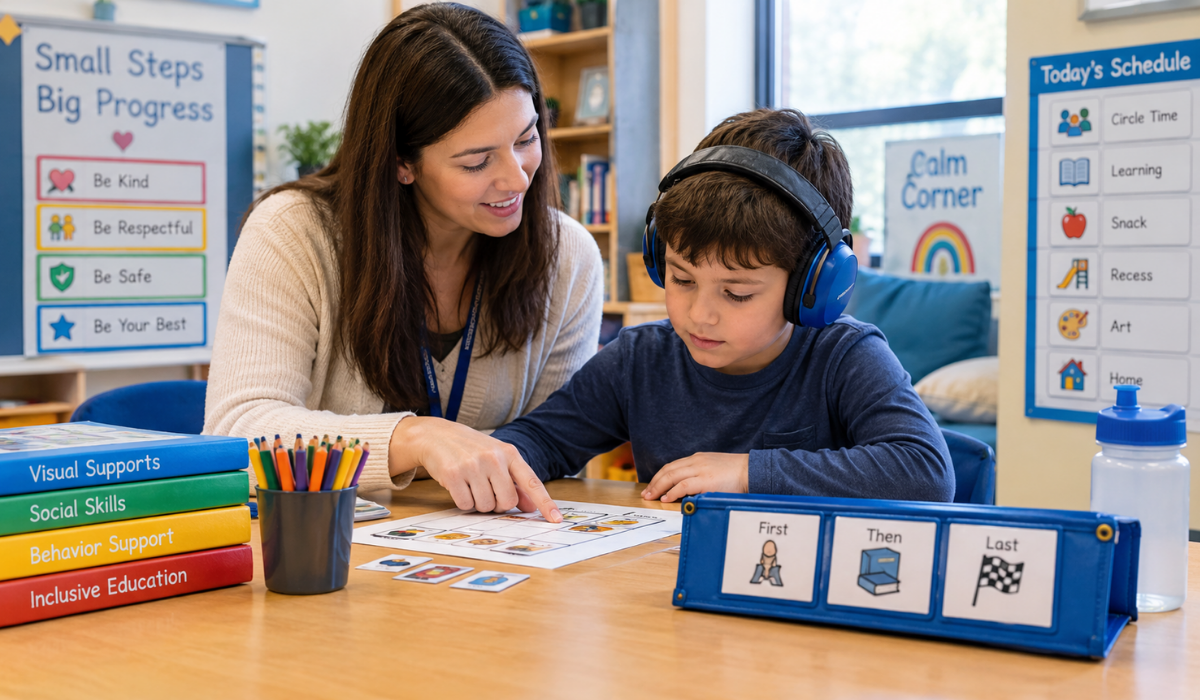
Autism classroom accommodations are changes to the learning environment, teaching style, or materials that help autistic students learn alongside their peers. They do not lower expectations. They remove barriers, such as sensory overload, unclear instructions, or social stress, so students can show what they know.
Every autistic student is different. One child may struggle with loud rooms, while another needs help with changes in routine. The strategies outlined below provide a helpful place to start. Teachers and parents can mix, adjust, and drop them based on what the student needs.
What Are Autism Classroom Accommodations?
Accommodations adjust how a student accesses lessons or demonstrates what they have learned. The lesson goal stays the same, but the path to it becomes more accessible.
A student who finds handwriting hard might type answers instead. A student who is overwhelmed by noise might use headphones during seatwork. In both cases, the student still learns the same content.
Accommodations vs. Modifications
These two terms are often mixed up:
- Accommodations change how a student learns (extra time, a quiet space, visual aids).
- Modifications change what a student is expected to learn (fewer questions, simpler content).
Many autistic students need only accommodations. Modifications are used when learning goals themselves must change.
Why Accommodations Matter
Autism can affect communication, social interaction, sensory processing, and flexibility with routines. A typical classroom may be loud, move quickly, and involve many social expectations that aren’t always clearly explained. Without support, a capable student may seem unmotivated or “difficult” when the real problem is stress or confusion.
Good accommodations can reduce anxiety, improve focus, build confidence, and prevent small problems from becoming big ones.
15 Practical Autism Classroom Accommodations
Environment and Sensory Supports
- Create a calm space.
A quiet corner with soft seating gives students a place to reset when overwhelmed. Make it a safe spot, never a punishment. Let the student choose when to use it, within agreed limits. - Choose seating carefully.
Seat the student away from busy doors, noisy hallways, humming equipment, or bright windows. Some students focus best near the teacher, while others prefer the back of the room. Ask the student and observe what works. - Reduce sensory triggers.
Soften harsh lighting where possible, limit visual clutter on walls, and give advance notice before fire drills or loud announcements. Noise-reducing headphones can help during assemblies or independent work. - Offer flexible seating and movement breaks.
Wobble stools, standing desks, or resistance bands can help students stay regulated. Short movement breaks, such as handing out papers or walking to the water fountain, can help them refocus.
Structure and Routine
- Use visual schedules.
A picture or written schedule shows what will happen during the day. Many autistic students feel calmer when they know what comes next. Cross off or remove completed tasks so progress is clear. - Prepare students for changes.
Substitute teachers, schedule changes, and special events can be stressful. Tell students early, explain what will be different, and show what will stay the same. Social stories can help explain new situations. - Give clear, short instructions.
Say one step at a time, and use plain, literal language. Avoid sarcasm and idioms such as “pull your socks up,” which can confuse literal thinkers. Write the steps on the board or on a checklist. - Use timers and transition warnings.
Switching from one activity to the next can sometimes be challenging. Give a warning, such as “Five minutes until we clean up,” and use a visual timer so students can see time passing.
Learning and Communication Supports
- Break tasks into smaller steps.
A long assignment can feel impossible. Divide it into short, numbered steps with clear start and finish points. A checklist gives a sense of progress and success. - Allow extra processing time.
Many autistic students need more time to understand a question and form an answer. After asking, wait several seconds before calling on them or repeating the question. For tests, extended time can reduce pressure. - Use visual supports and graphic organizers.
Charts, diagrams, color-coded notes, and templates help organize information. For writing tasks, a simple outline gives structure so the student can focus on ideas instead of layout. - Offer alternative ways to respond.
Some students communicate better by typing, drawing, pointing, or using a speech device than by speaking. Let them show knowledge in the way that works best, as long as the learning goal is met.
Social and Emotional Supports
- Teach social skills directly.
Do not assume students will pick up social rules on their own. Practice greetings, turn-taking, asking for help, and joining a group through role-play, modeling, and clear examples. Structured group activities with defined roles can make teamwork easier. - Provide a break system.
A break card, a signal, or a simple “I need a break” phrase lets students step away before stress becomes a meltdown. Teach and practice the system when the student is calm so it works when needed. - Use positive reinforcement and strengths.
Notice and praise effort and progress. Build lessons around a student’s interests, such as trains, maps, or animals, to boost motivation. Focusing on strengths builds confidence and helps students stay engaged.
How Teachers and Parents Can Work Together
Accommodations work best when home and school share the same approach.
For teachers:
- Ask parents what works at home. They know their child best.
- Start with one or two accommodations, then add more as needed.
- Track what helps, and adjust if something is not working.
- Involve the student in choosing supports whenever possible.
For parents:
- Share your child’s triggers, strengths, and calming strategies.
- Ask for regular updates about what is working at school.
- Use similar tools at home, such as visual schedules, to keep things consistent.
- Keep notes and examples to share at meetings.
Getting Accommodations Written Into a Plan
In the United States, students with autism may qualify for support through an Individualized Education Program (IEP) or a 504 plan. An IEP is for students who need specialized instruction, while a 504 plan provides accommodations so a student can access learning.
To start, parents can request an evaluation from the school in writing. If the student qualifies, a team that includes parents, teachers, and specialists decides on the supports and writes them into the plan. Rules and terms vary by country and region, so check with your local school or education authority.
Reviewing and Adjusting Accommodations
Needs change as students grow. A support that helps in third grade may not be needed in sixth grade, and new challenges may appear in middle or high school.
Review accommodations regularly, ask the student for feedback, and remove supports that are no longer useful. The goal is not permanent dependence on supports but building independence and self-advocacy over time.
Final Thoughts
Autism classroom accommodations are practical, often low-cost changes that help students learn with less stress. Whether it is a visual schedule, a quiet corner, or extra time to answer, small adjustments can make a big difference. The best approach is patient observation, open communication between teachers and parents, and a willingness to adjust.
FAQs
What are autism classroom accommodations?
Autism classroom accommodations are changes to the learning environment, teaching methods, or materials that help autistic students access the same curriculum as their peers. Examples include visual schedules, quiet workspaces, sensory breaks, and extra processing time. They adjust the way a student learns without changing the learning goals or expectations.
How are accommodations different from modifications in education?
Accommodations change how a student learns or shows knowledge, such as extra time or a quiet room, while expectations stay the same. Modifications change what a student is expected to learn, such as shorter assignments or simpler content. Many students need only accommodations.
What steps can I take to request school accommodations for my child?
Parents can request accommodations by writing to the school and asking for an evaluation. In the United States, eligible students may receive an Individualized Education Program (IEP) or a 504 plan. The team, including parents, then agrees on supports, writes them down, and reviews them regularly.
Which accommodations help with sensory sensitivities?
Helpful sensory accommodations include noise-reducing headphones, a calm corner, softer lighting, flexible seating, and scheduled movement breaks. Seating away from busy doors or windows can also help. Because sensory needs differ from child to child, teachers should observe the student and adjust supports based on what works.
Can accommodations be used in general education classrooms?
Yes. Most autism classroom accommodations, such as visual schedules, clear instructions, and break passes, work well in general education classrooms. They often help other students too. Teachers can add them without major changes, and many students succeed in mainstream settings when the right supports are in place consistently.
How often should accommodations be reviewed?
Accommodations should be reviewed at least once a year, and sooner if the student struggles or outgrows a support. Many teams check in every few months. Regular reviews keep supports useful, remove those no longer needed, and help students gradually build independence.
Disclaimer: The information on AutismCue is for general educational purposes only and is not a substitute for professional medical, psychological, or educational advice. Every child is different. Please consult a qualified healthcare provider, therapist, or your child’s school team before making decisions about a child’s support plan.