
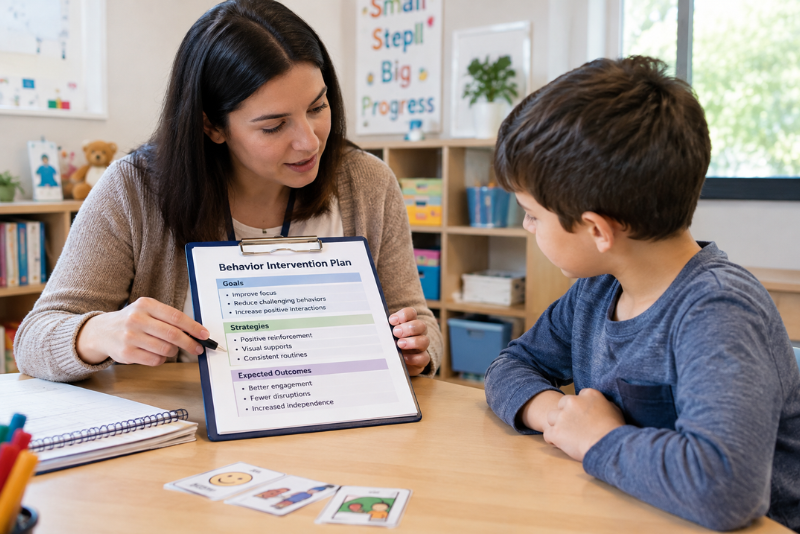
A behavior intervention plan (BIP) is a written plan that explains why a child shows a challenging behavior and what adults will do to reduce it. It lists the behavior, the likely reason for it, the steps that prevent it, the new skills to teach, and how adults should respond. A BIP is built on an assessment and focuses on teaching better ways to meet the child’s needs, not on punishment.
Many parents hear this term for the first time in a school meeting. This guide explains what a behavior intervention plan is, what it includes, who may need one, and how it is made.
What Is a Behavior Intervention Plan?
A behavior intervention plan is a structured, written strategy for handling behavior that gets in the way of learning, safety, or daily life. It is most often used in schools, but similar plans are also used in therapy settings, clinics, and homes.
The main idea is simple. Behavior has a purpose. A child who screams, runs away, hits, or refuses to work is usually trying to communicate something or avoid something. A BIP finds that purpose and then teaches the child a safer, more useful way to reach the same goal.
For example, a student may tear up worksheets whenever the work looks hard. The plan would not just punish the tearing. It might teach the child to ask for a break or for help, break the worksheet into smaller parts, and reward the child for using those new skills.
What Does a Behavior Intervention Plan Include?
Most plans share the same core parts. The exact format can differ by school, state, or provider.
- A clear description of the target behavior. The behavior is described in plain, observable terms. Saying “throws materials onto the floor” is a clear and specific description. “Has a bad attitude” is not.
- The function of the behavior. This is the reason behind it. Most behaviors serve one of four purposes: getting attention, escaping or avoiding a task, getting a wanted item or activity, or meeting a sensory need.
- Triggers (antecedents). These are the events or situations that often come right before the behavior, such as a loud room, a change in routine, or a difficult task.
- Prevention strategies. These change the environment or task so the behavior is less likely to happen. Examples include visual schedules, advance warnings before transitions, and shorter assignments.
- Replacement behaviors. These are the new skills taught in place of the problem behavior, such as asking for a break with a card, a word, or a gesture.
- Response strategies. These tell adults how to react when the behavior happens and how to reward the new skill when it appears.
- Data collection. The team tracks how often the behavior happens and how the plan is working.
- A review schedule. The plan is checked on a regular basis and changed when needed.
What Is the Difference Between an FBA and a BIP?
A BIP does not start from guesswork. It usually follows a functional behavior assessment (FBA).
An FBA is the investigation. A trained professional, such as a school psychologist, special educator, or board-certified behavior analyst (BCBA), gathers information through observation, interviews, and records. They look at what happens before the behavior, what happens after it, and what the child gains or avoids.
The BIP is the action plan that comes from those findings. Without an FBA, a plan may target the wrong cause and fail. If a child acts out to escape hard work, giving extra attention will not help. The plan has to match the real reason.
Who Needs a Behavior Intervention Plan?
A behavior intervention plan may be helpful for any child whose behavior keeps interfering with learning, safety, or relationships, especially when simple classroom strategies have not worked.
Students with disabilities
BIPs are often used for children with special education needs. These can include autism, ADHD, emotional or behavioral disorders, learning disabilities, intellectual disabilities, and speech or language disorders. Children who have trouble communicating, handling change, or managing sensory input may show behavior that adults find hard to understand. A BIP helps the team respond in a consistent and informed way.
Students whose behavior affects learning
In the United States, the Individuals with Disabilities Education Act (IDEA) says that when a child’s behavior interferes with their own learning or the learning of others, the IEP team must consider positive behavioral interventions and supports. A BIP is one common way schools do this.
Students facing serious discipline
Under IDEA, schools must take certain steps when a student with a disability faces a removal of more than 10 school days, depending on whether the behavior is linked to the disability. This process often involves an FBA and a new or revised BIP.
Children outside of school
Families, therapists, and clinics may also use behavior plans at home or in community settings. Children with frequent aggression, self-injury, running away, or severe tantrums may benefit when parents and professionals follow one shared plan.
Does every child with a disability need one?
No. Having a diagnosis does not automatically mean a child needs a BIP. The need depends on the child’s behavior and how much it affects daily life. Many children with autism or ADHD never need a formal plan, while some children without a diagnosis may benefit from one. Rules and procedures also differ by state and country, so families should check local requirements.
Signs a Child May Need a Behavior Intervention Plan
Occasional challenging behavior is a typical part of childhood development. A formal plan is usually considered when the behavior is:
- Frequent, intense, or lasting for a long time
- Creating a risk of injury to the child or those around them.
- Causing the child to miss class time or be removed from activities
- Making it hard to learn, make friends, or take part in routines
- Not improving with general classroom or home strategies
How Is a Behavior Intervention Plan Created?
The process usually follows these steps.
- A concern is raised. A teacher, parent, or other professional notices that the behavior is not improving.
- Consent and team formation. The school or provider forms a team. This often includes parents, teachers, a school psychologist, and a behavior specialist.
- An FBA is completed. The team gathers relevant information to determine what purpose the behavior may serve.
- The plan is written. The team agrees on prevention steps, replacement skills, and responses.
- The plan is put into practice. Everyone who works with the child learns the plan and follows it the same way.
- Data is reviewed. The team checks progress and adjusts the plan when it is not working.
Consistency matters a great deal. If one adult follows the plan and another does not, the child gets mixed messages, and progress slows.
What Makes a Good Behavior Intervention Plan?
Strong plans tend to share a few qualities:
- They are positive. They focus on teaching skills and rewarding good choices, not just stopping bad behavior.
- They are individual. A strategy that works well for one child may not produce the same results for another.
- They are specific. Adults know exactly what to do and say.
- They are respectful. The child’s dignity, culture, and communication needs are considered.
- They are based on data. Changes are made from evidence, not opinion.
- They include the family. Parents know their child best and can share what works at home.
Common Mistakes to Avoid
- Writing a plan without an FBA
- Using vague language such as “will behave better”
- Relying on punishment instead of teaching new skills
- Failing to train all staff or caregivers
- Never reviewing or updating the plan
- Leaving parents out of the process
What Parents Can Do
If you think your child may need a behavior intervention plan, you can ask the school in writing to evaluate your child’s behavior. Keep notes about what happens at home, including patterns, triggers, and strategies that help. Ask questions during meetings, such as why the behavior is happening, what skills will be taught, and how progress will be measured. You are a valued part of the team and can request adjustments when the current plan isn’t meeting your child’s needs.
Final Thoughts
A behavior intervention plan is designed as a support strategy, not as a form of punishment or a label. It is a practical tool that helps adults understand a child’s behavior and teach better ways to cope, communicate, and learn. It is most effective when it is based on a proper assessment, applied consistently, and reviewed often. When parents, teachers, and specialists work together, a BIP can make school and home life calmer and more successful for the child and everyone around them.
Frequently Asked Questions
What is a behavior intervention plan in simple words?
A behavior intervention plan is a written plan that explains why a child shows a challenging behavior and what adults will do about it. It lists prevention steps, new skills to teach, and responses to use, so everyone handles the behavior the same way.
Who needs a behavior intervention plan?
A child whose behavior interferes with their own learning or the learning of others may need one. This often includes students with autism, ADHD, emotional disturbance, or other disabilities, though any child with ongoing, serious behavior concerns can be considered after an assessment by a school team.
Is a Behavior Intervention Plan (BIP) the same as an IEP?
No. An IEP is a broad legal document describing a student’s special education services and goals. A behavior intervention plan specifically targets behavioral needs instead of covering the child’s broader educational needs. A BIP can be attached to an IEP, but it can also exist on its own.
What is an FBA, and why does it come before a BIP?
A functional behavior assessment, or FBA, is a process for finding out why a behavior happens. It looks at what comes before, what follows, and what the child gains or avoids. The BIP is built from these findings, so the plan matches the real cause of the behavior.
How long does a Behavior Intervention Plan typically remain in place?
A BIP has no fixed end date. It stays in place as long as it is needed and is reviewed regularly, often every few months or at yearly IEP meetings. Teams update it sooner if the behavior changes or the plan is not working.
Can parents request a behavior intervention plan?
Yes. Parents can ask the school in writing to evaluate their child’s behavior and consider a behavior intervention plan. Parents are also part of the team, so they can share what works at home, review the plan, and ask for changes if it is not helping.
Disclaimer: The information in this article is provided for general educational purposes only and is not a substitute for professional medical, psychological, educational, or legal advice. Every child is different. Please consult a qualified professional, such as a pediatrician, psychologist, or board-certified behavior analyst, before making decisions about your child’s care or support plan. Laws and school procedures vary by location.