
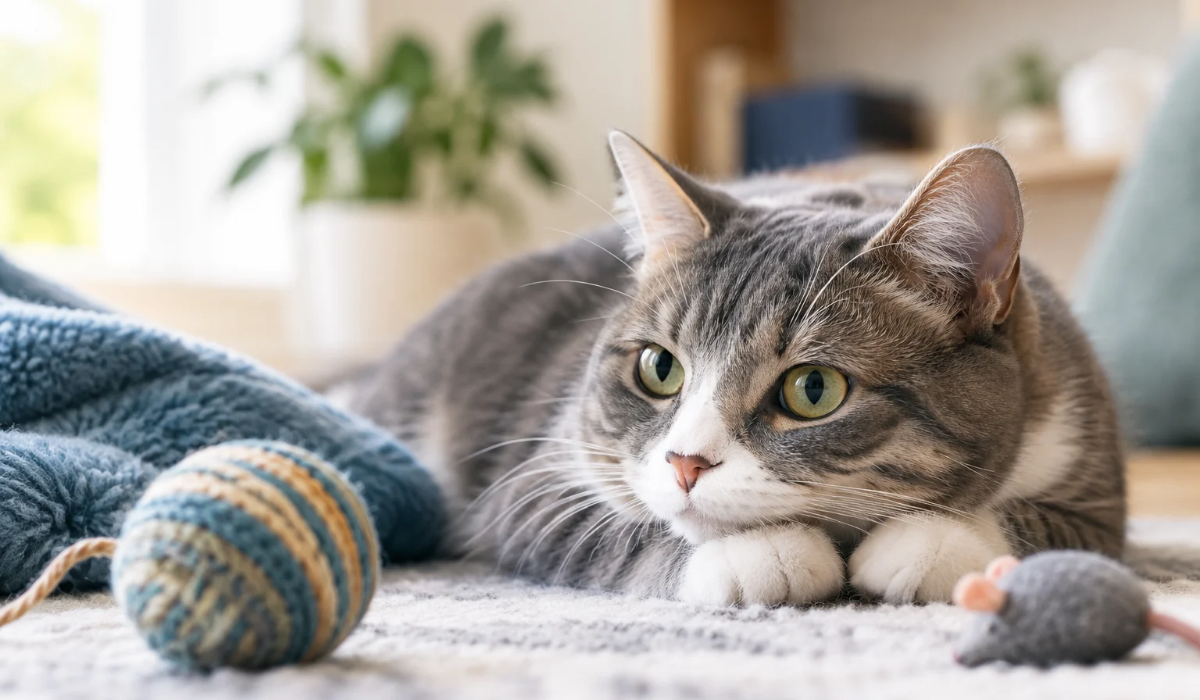
If your cat lines up her toys the exact same way every day, loses her mind when you move the food bowl an inch, or stares at one spot on the wall for way too long, you’ve probably asked yourself: is my cat autistic?
The short answer: no
Cats can’t be diagnosed with autism. Autism is a human condition, and the whole diagnosis is built around things like human communication, human social behavior, and how a human brain develops. There’s nothing like it in veterinary medicine. No vet is ever going to tell you “your cat has autism,” because that’s just not a thing that exists for animals.
But here’s the part that actually explains why this question comes up so much: cats really do act in ways that look like autism traits in people. That part’s real. It’s just not the same thing as having autism.
Why your cat seems “autistic” sometimes
A ton of completely ordinary cat behavior just happens to look like stuff people associate with autism. Worth going through why, one by one, because the “why” matters more than the surface similarity.
Doing the same thing over and over. Pacing the same route across the living room, chasing her own tail, grooming one spot raw, obsessing over one toy. In people, repetitive behavior is a real autism trait. In cats, it’s usually just… a cat thing. Sometimes it’s boredom or stress. Sometimes it’s worth a vet visit to rule something out, but it’s rarely anything more mysterious than that.
Being weirdly sensitive to noise or light. Some cats totally lose it over a specific sound or a change in lighting. That tracks, because sensory sensitivity is also an autism trait in humans. But cats’ hearing and sense of smell are just built way more sensitive than ours to begin with. A meltdown over the vacuum cleaner isn’t a red flag — it’s a cat with cat ears.
Wanting to be left alone. Some cats just aren’t that into people or other pets. That can look like the social withdrawal you see mentioned with autism, but a lot of cats are simply independent by nature. That’s a personality, not a symptom.
Hating any change to the routine. A cat who gets genuinely upset because dinner was ten minutes late, or the couch got moved, isn’t broken. Cats like things predictable. That’s just how they are.
So yeah, the behaviors overlap. The reason behind them almost never does.
So what’s actually causing it?
If your cat is acting off — sudden confusion, circling, aggression that wasn’t there before, a big change in how vocal or social she is — that’s worth paying attention to. Just don’t jump to “autism.” More likely explanations:
- Stress or anxiety. A new pet, a move, rearranged furniture, anything that shakes up their environment. Anxious cats often overgroom, hide, scratch things they normally wouldn’t, or start marking around the house.
- A medical or neurological issue. Seizures, pain, hearing or vision loss, and other neurological problems can all cause behavior that looks strange or repetitive from the outside. This is exactly why a vet visit matters when something feels genuinely off, not just quirky.
- Just her personality. Cats have personalities the same way people do. Some are naturally more skittish, more independent, or more particular. That’s not a disorder — it’s just who they are.
If you can’t tell whether it’s “just my cat being my cat” or something that needs looking at, that’s a question for your vet, not a search engine. An actual exam can rule out medical stuff and give you a real answer instead of a guess.
Is there any actual science behind “cat autism”?
Not really, and it’s worth just being straight about that instead of dressing it up. There’s no diagnostic criteria for autism in cats, and no real scientific evidence that cats experience anything like it. Some researchers have looked at genetic mutations (like the Shank3 gene) as autism models in other animals, including dogs — but that’s a separate line of research, and it doesn’t mean cats can be diagnosed with anything similar.
So if you come across an article confidently listing “signs of autism in cats” like it’s an established medical fact, take it with a grain of salt. Most of that content is just a normal list of feline stress behaviors with a catchier title slapped on.
Why people keep asking this
Honestly, this question probably has less to do with cats and more to do with how much more people are thinking about autism these days — whether it’s their own diagnosis, their kid’s, or just general awareness going up. Once you’re paying closer attention to those patterns in daily life, it makes sense you’d start noticing something similar in your pet.
There’s actually a more useful, more real connection here: cats can be great companions for autistic kids and adults. Some research suggests cats interact with autistic children more gently than dogs often do — shorter glances instead of the intense, prolonged eye contact that a lot of dogs go for, which some autistic people find overwhelming. That’s a much more grounded connection between cats and autism than trying to diagnose the cat itself.
Bottom line
Your cat can’t have autism — not in any way a vet could actually diagnose. If she’s quirky, repetitive, and obsessed with her routine, that doesn’t mean something’s wrong with her. It probably just means you have a cat, because a lot of that is just normal cat stuff.
If something about her behavior changes suddenly, or genuinely worries you rather than just seeming quirky, the right move is a vet visit — not a diagnosis from an article, including this one. A vet can actually rule out anxiety, pain, or a neurological issue and give you answers specific to your cat.
FAQ
Can cats be diagnosed with autism?
No. Autism is a human diagnosis based on human development and behavior. There’s no recognized version of it in veterinary medicine.
Why does my cat act like it has autism?
Cats naturally show behaviors routine attachment, sensory sensitivity, repetitive habits that happen to resemble autism traits in people. Most of the time, it’s just normal cat behavior. Sudden or extreme changes are worth mentioning to a vet.
What do people usually mean by “autism” in cats?
Things like pacing, tail chasing, fixating on objects, big reactions to noise or light, and wanting to be alone. These are usually just personality, stress, or occasionally an underlying medical issue not autism.
Should I take my cat to the vet if she’s acting unusual?
Yes, especially if it’s new, sudden, or seems to be distressing her. A vet can check for anxiety, pain, or neurological causes, which are far more likely than “autism.”
Are cats good companions for autistic kids?
Many autistic kids and adults do well with cats, and some research points to cats interacting more gently than dogs tend to. It really varies by individual, though both the cat and the person.