
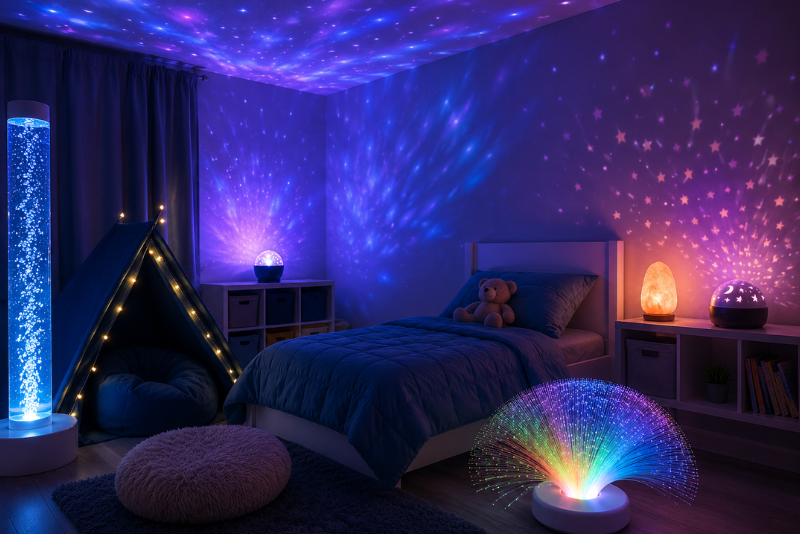
If your child struggles to settle at night, or seems to melt down the moment a bright overhead light switches on, lighting might be playing a bigger role than you’d expect. For many autistic kids, light isn’t just background, it’s sensory input the brain has to process, and the wrong kind can make winding down genuinely harder. The right kind, on the other hand, can turn a bedroom into a space that actually helps a child settle.
Here’s a clear, practical look at what makes sensory lighting effective, the mistakes worth avoiding, and how to set up a calming space without overcomplicating it.
Why Lighting Affects Autistic Kids Differently
Many autistic children experience heightened visual sensitivity. A flicker most people can’t consciously notice, a color temperature that reads as “harsh” rather than simply bright, or a room that’s technically well lit but still feels like too much, these are common experiences, not exaggerations.
When sensory input builds up faster than the brain can process it, the body can shift into a stress response, sometimes described as sensory overload. This is part of why lighting is one of the more effective environmental factors that parents and caregivers can actually control, since it’s something you can adjust in the moment.
What Actually Makes a Light “Calming”
Three qualities matter far more than how a light looks in a product photo:
Flicker-free. This is arguably the most important factor, and the most overlooked. Cheap LED bulbs and older fluorescent lights can flicker at rates many adults can’t consciously see, but that some autistic children can perceive, sometimes showing up as eye strain, headaches, or low-level anxiety they may not have the words to describe. Look for lights specifically labeled flicker-free, and avoid fluorescent tubes altogether.
Dimmable. A light that’s only “on” or “off” forces an all-or-nothing environment. A light that can be gradually adjusted lets a child (or parent) ease into or out of a space, rather than being hit with full brightness first thing in the morning or right before bed.
Warm, muted color tones. Soft ambers, dusty blues, and low-saturation greens tend to feel calming, while stark white, neon, and highly saturated colors can be more stimulating. Warmer color temperatures (roughly in the 2200K to 3000K range, similar to a sunset) are generally more soothing than cool, blue-heavy white light.
That said, sensory preferences vary a lot from child to child. Some sensory-seeking kids actually respond well to gentle color-shifting patterns, while sensory-avoidant kids do better with one steady, unchanging tone. The only real way to know is to let your child try a few settings and see what genuinely helps them settle.
Popular Types of Sensory Lights
A few common categories show up again and again in sensory-friendly bedroom and classroom setups:
- Fiber-optic lights (lamps, curtains, or strands). Cool to the touch and safe to handle, these offer a gentle visual and tactile experience that many kids find soothing.
- Bubble tubes. Slow-moving colors in a contained tube create a calming, predictable focal point, popular in both bedrooms and dedicated sensory spaces.
- Projectors and galaxy lamps. These cast gentle, moving patterns (like a starry sky) onto the ceiling, often used specifically to ease bedtime routines. Steer clear of settings with rapid movement or flashing.
- Smart bulbs and LED strips. Fully adjustable in color and brightness, these are a flexible, often budget-friendly option that can shift gradually throughout the day or evening.
- Jellyfish and aquarium lamps. Slow, drifting movement paired with soft light offers a similar calming effect to a bubble tube, in a smaller, more portable format.
Building a Calming Corner Without Overcomplicating It
You don’t need a fully converted sensory room to see the benefit. A single, thoughtfully lit corner of a bedroom often does most of the work:
- Choose one adjustable light source with both dimming and color range, rather than several competing lights in different tones.
- Keep it low and indirect where possible. Light bouncing off a wall or ceiling generally feels softer than a direct bulb at eye level.
- Let your child control it, whether that’s a simple remote, an app, or just teaching them how to adjust it themselves. Having agency over their own environment matters as much as the light itself.
- Pair it with a routine. Using the same lighting cue before bed, or after school, helps signal “this is wind-down time” on its own over time.
- Let the space feel like theirs. A calming corner tends to get used more when it feels like a normal part of a child’s room, rather than an imposed “therapy corner.” Simple personal touches, like their own choice of stickers or decor nearby, can help with this.
A Few Mistakes Worth Avoiding
- Jumping straight to bright, “fun” colors without testing. Rainbow-cycling or neon lighting can look appealing but may be genuinely overstimulating for a sensory-avoidant child.
- Skipping the dimmer to save money. An on/off-only light removes the single most useful feature for a calming setup.
- Assuming a light is flicker-free just because it looks fine. If it isn’t specifically labeled flicker-free, it’s safest to assume it does flicker.
- Treating every child’s sensory profile the same. What calms one child can genuinely agitate another, it’s worth testing and adjusting rather than copying someone else’s exact setup.
Safety Basics to Keep in Mind
Whatever lighting you choose, a few safety checks are worth doing:
- Look for recognized safety marks on any electrical product
- Choose cool-touch surfaces, especially for younger children
- Make sure any mounted lights are securely and stably installed
- Keep cords tidy and low-voltage where possible
- Clean and inspect equipment regularly
Watch for signs of sensory overload, like squinting, covering the eyes or ears, or increased agitation, and be ready to adjust the lighting if those signs appear.
A Few Honest Reminders
- Every child’s sensory needs are different. What calms one child might do nothing for another, or even overstimulate them. Personalization matters more than following a specific formula.
- Start simple. One well-chosen, adjustable light often makes more difference than a room full of features.
- This is general guidance, not therapy advice. If your child has significant sensory processing needs, an occupational therapist can offer recommendations tailored specifically to them.
This article draws on general guidance commonly shared by sensory-focused resources and occupational therapy sources, reworded here for informational purposes. It isn’t medical or therapeutic advice, if you have specific concerns about your child’s sensory needs, a pediatrician or occupational therapist is the best next step.