
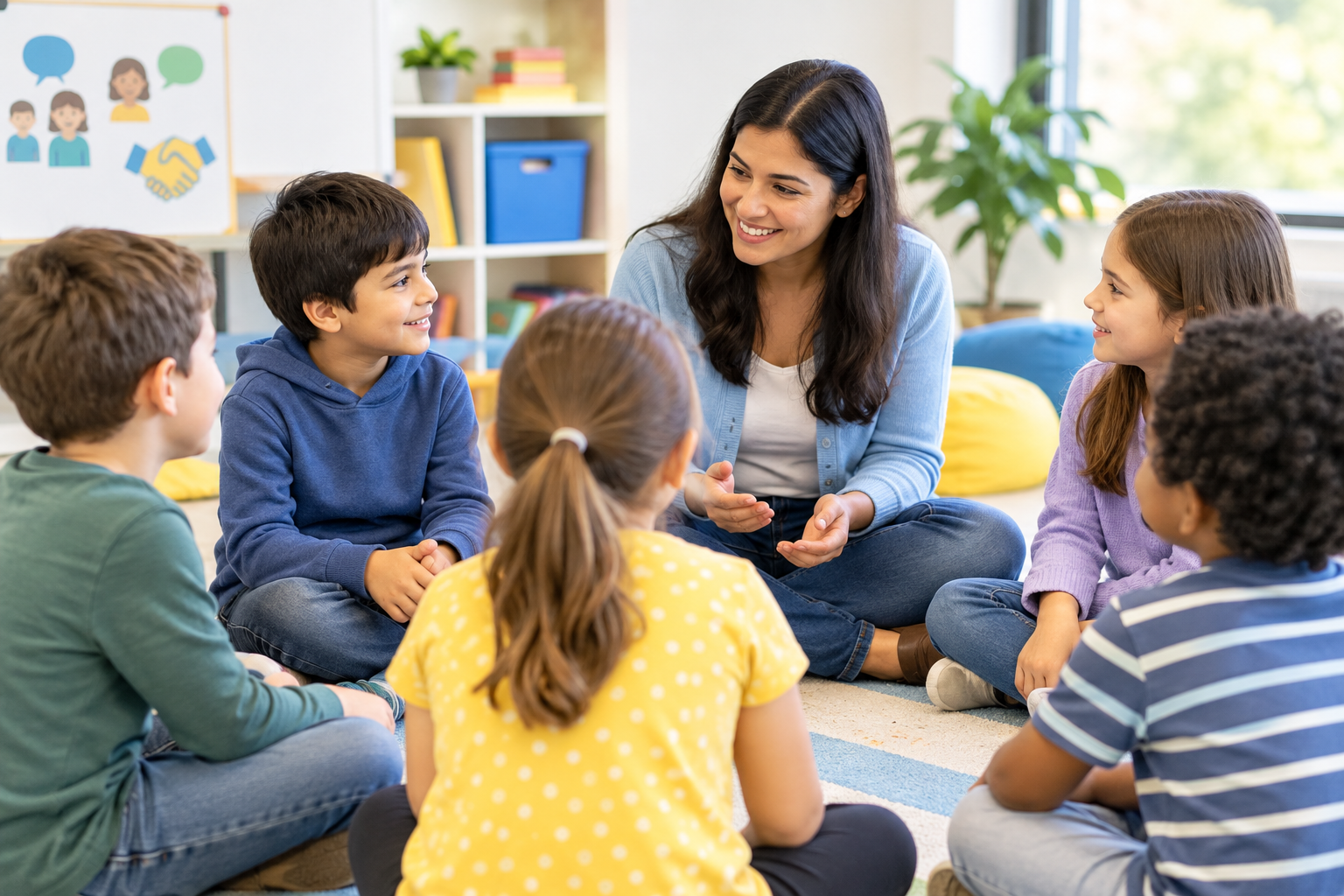
A one-on-one session can teach a child what eye contact looks like. It can’t teach them what it feels like to wait their turn while someone else is talking, or what to do when a peer disagrees with them. That’s the gap group therapy is built to close.
Social skills development in group therapy for children with autism works because it recreates something a solo session simply can’t: real social pressure, in a room designed to help a child handle it well.
Why groups work differently than one-on-one sessions
Autism affects how a child reads social cues, times a response, or picks up on things that go unsaid. A therapist can explain all of that in a quiet room. But explaining a skill and using it live, with another kid who won’t wait patiently while you figure out what to say, are two different challenges.
Group settings put children in front of real peers, real pauses, real moments of confusion. That’s uncomfortable at first, and it’s also exactly the point. A child who’s only ever practiced turn-taking with an adult hasn’t really practiced turn-taking. They’ve practiced turn-taking with someone who already knows to be patient.
What actually happens in a session
Most groups build around a handful of methods that tend to reinforce each other rather than working in isolation.
Role-playing. Children act out situations they’ll actually run into: asking to join a game, handling a disagreement, starting a conversation with someone new. Doing it in a low-stakes setting first means the real version doesn’t feel like the first attempt.
Peer modeling. Some groups bring in typically developing peers who’ve been coached on how to model good social behavior without turning the interaction into a lesson. Watching a peer navigate a conversation naturally tends to land differently than watching an adult demonstrate it.
Visual supports. Social stories, cue cards, and visual schedules give kids something concrete to hold onto. A short story describing what happens at a birthday party, for instance, helps a child walk in already knowing roughly what to expect, which cuts down on a lot of the anxiety that comes from not knowing.
Structured group activities. Cooperative games built around shared goals rather than winning and losing give kids a reason to communicate that doesn’t feel like a drill. Nobody wants to practice conversation. Everyone wants to win the game, and talking turns out to be part of how you do that.
Emotion and self-regulation work. A lot of what looks like a social skills gap is actually an overwhelm problem. Teaching a child to recognize when they’re getting flooded, and giving them a way to calm down before it boils over, often does more for their social interactions than another round of conversation drills.
What tends to actually change
Progress in group therapy rarely announces itself. It shows up in smaller ways first.
A child starts responding to their name more consistently. They wait a beat before interrupting instead of jumping straight in. They notice when a friend looks upset, even if they don’t know exactly what to say about it yet. None of that looks dramatic from the outside, but it’s the groundwork everything else gets built on.
Confidence tends to follow once a child has a few genuine wins under their belt. A kid who successfully joined a game without an adult stepping in to help is a kid who’s a little more willing to try it again next time. That’s often the bigger shift, more than any specific skill.
Friendships are the harder, slower outcome, and also the one that matters most. Skills practiced in a group don’t automatically transfer to the playground. That transfer usually needs deliberate support, which is where the environment around the group matters as much as the group itself.
Making it stick outside the therapy room
A skill that only shows up in one room isn’t much of a skill yet. Getting it to travel takes some intentional effort from the adults around the child.
Reinforcing what a child does well, specifically and right away, tends to work better than correcting what went wrong. A comment like “you waited for your turn there, nice job” does more than a general “good job” ever will, because it tells the child exactly which behavior to repeat.
Pairing a child with peers who already have strong social skills, in ordinary, unforced situations, gives them a model to learn from without making the interaction feel like a lesson. Structured but low-pressure settings, like a small lunch group built around a shared topic, can also give kids just enough scaffolding to make conversation feel manageable instead of overwhelming.
It also helps to separate the skill from other challenges the child is facing at the same time. A child who struggles with fine motor tasks probably won’t have much bandwidth left for conversation if you ask them to do both at once. Practicing social skills during an activity that isn’t already hard in some other way tends to get better results.
What to look for in a group
Not every social skills group is structured the same way, and the differences matter. A group led by someone trained specifically in autism intervention, whether that’s a speech-language pathologist, occupational therapist, or behavior analyst, tends to bring a level of individualization that a general social club can’t.
Look for a group that starts with an actual assessment of where a child currently stands, rather than placing every child into the same fixed curriculum regardless of age or ability. And ask how the group works to help skills generalize beyond the room itself. A program that only measures success by what happens during the session is missing half the picture.
FAQ
At what age can a child start social skills group therapy?
Many programs begin as early as preschool age, though the right starting point depends on a child’s individual development and readiness, which is best assessed by a qualified professional.
How long does it typically take to see progress?
This varies widely by child. Some families notice small shifts within a few months, while deeper changes, like forming actual friendships, often take longer and depend on consistent practice outside of sessions too.
Is group therapy better than one-on-one therapy for social skills?
They’re not competing approaches. Many children benefit most from a combination, using one-on-one sessions to build specific skills and group settings to practice them under real social conditions.
Do typically developing peers need special training to join these groups?
Yes, in well-run programs. Peers are usually coached on how to model appropriate behavior and support interaction naturally, without turning the session into an unofficial teaching role.
Disclaimer: This article is written from an informational perspective to help parents and caregivers understand common approaches used in social skills group therapy for children with autism. It draws on publicly available clinical and educational resources, including guidance commonly used in school-based autism support programs and established practices within Applied Behavior Analysis (ABA) therapy. This content is not medical or clinical advice and should not be used to design or replace an individualized treatment plan. If you have questions about your child’s social development or therapy options, please consult a licensed healthcare professional, speech-language pathologist, or board-certified behavior analyst.