
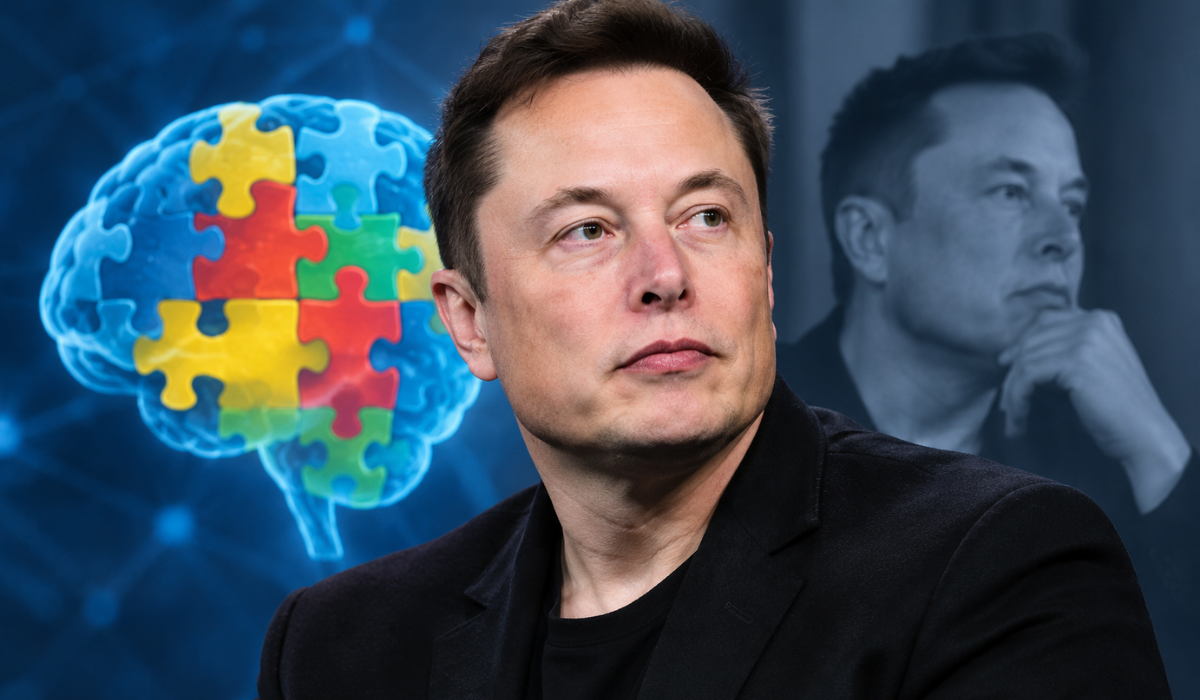
Does Elon Musk have autism? People have asked this for years, and the honest answer has a few parts. Musk has said in public that he has Asperger’s syndrome, a label that now falls under autism spectrum disorder (ASD). But there are also questions about how he was diagnosed and about the word he chose. This article covers what he actually said, when he said it, and what is still unclear.
The Short Answer
Yes, Musk says he is on the autism spectrum. He told viewers during his opening monologue on Saturday Night Live that he has Asperger’s syndrome, a condition on the autism spectrum. He has not released his medical records, and reports suggest that no professional has formally diagnosed him. Therefore, the most appropriate response is that he has stated this himself and has described certain traits that appear to align with it.
What Musk Said on Saturday Night Live
On May 8, 2021, Musk was the host of Saturday Night Live. During his opening monologue, he mentioned that he was making history by becoming the first person with Asperger’s to host the show, or at least the first to openly acknowledge it.
He didn’t stop to explain the condition. He mentioned it only briefly and spent the end of the monologue on his mother, Maye Musk, since the show aired the night before Mother’s Day. He joked about his flat way of speaking and his habit of posting odd things online. The joke worked because people already knew him as an unusual public figure. It was also the first time many viewers heard him link his behavior to autism.
Was He Really the First Host With Asperger’s?
No. Dan Aykroyd, an original SNL cast member who hosted in 2003, has talked openly about his Asperger’s for many years. Viewers pointed this out on social media almost right away. Other commentators noted that comedian Chris Rock and musician David Byrne have also spoken about being on or near the spectrum.
Musk’s line was a joke, but it did leave out people who had been open about autism long before him.
Why Everyone Talked About the Word “Asperger’s”
Many people, including many autistic people, reacted to the word he chose more than to the news itself.
Asperger’s used to be a separate diagnosis. It was often given to people with strong language and thinking skills who still found social situations hard. In 2012, the American Psychiatric Association announced it would group Asperger’s and similar conditions under one label, autism spectrum disorder. The change took effect with the DSM-5 in 2013.
So in medical terms, Musk was using an older label. That is not unusual. Many adults who were told they had Asperger’s before 2013 still use the word, and some like it. Others avoid it. Some in the autism community also object to it because the pediatrician it is named after, Hans Asperger, has a troubling history.
For everyday purposes, saying “Musk has Asperger’s” and “Musk is autistic” point to the same thing under current medical language.
What He Said at TED 2022
Musk spoke about it again in April 2022, when he was interviewed on stage at the TED conference in Vancouver. The interviewer asked him about growing up with Asperger’s. Musk said social cues did not come naturally to him as a child. He said he tended to take things very literally and later learned that people often mean more than the words they say. He said it took him a while to work that out.
He was later asked whether his condition could be connected to his work in technology, to which he replied that it was “certainly possible.” Reflecting on his younger years, he recalled spending entire nights programming alone and finding the experience deeply rewarding, despite recognizing that it was unusual. He also described developing a strong interest in physics and exploring broader questions about life.
These are his own words about his own experience. They are not a medical evaluation, and they should not be treated as one.
Has Elon Musk Been Formally Diagnosed?
This is the part that is least clear, and reports do not fully agree.
Some outlets say Musk was “previously diagnosed.” But his own mother has said something different. In Walter Isaacson’s 2023 biography of Musk, Maye Musk said her son was never diagnosed as a child, but that he says he has Asperger’s and she is sure he is right. A later article in Skeptical Inquirer, which cited Isaacson, said Musk was never diagnosed by a qualified mental health professional and diagnosed himself.
Musk has not shared any clinical report that clears this up. So the fair summary is:
- He has publicly stated that he is on the autism spectrum.
- He has described traits that many autistic people recognize.
- There is no public proof of a formal diagnosis.
None of this means he is wrong. Many adults, especially those who grew up before autism was widely understood, go undiagnosed for years. Some never get an official assessment. But without an evaluation, nobody outside his own circle can say for sure. It is best not to guess about a person’s health from a distance.
How the Autism Community Responded
The reaction was mixed, and both sides had fair points.
Some autistic people welcomed the moment. One opinion writer in Newsweek called it a small but important step for neurodiversity, since so few autistic public figures have Musk’s level of fame. Researchers who study autism at work also told Axios that his openness may inspire young adults with Asperger’s. Many autistic adults hide their diagnosis at work to avoid stigma, so a famous name speaking up can matter.
Others were worried. Some feared his comments would feed old stereotypes, such as the idea that all autistic people are geniuses like the character in the film Rain Man. Others said the moment gave no real context about what autism is like for most people.
Autism Is Not One Thing
Musk’s story is a good reminder that autism looks very different from person to person. It is referred to as a spectrum for this reason.
Some autistic people are talented in math or technology. Many aren’t, and that’s okay. Some speak easily, and some do not speak at all. Some live on their own, and some need daily support. Success in business is not a sign of autism, and it is not proof that autism is “easy.” A billionaire’s experience is one story among millions.
It’s also important to dispel a prevalent misconception. Some critics have said Musk’s behavior shows he “lacks empathy” and linked that to autism. That link is not accurate. Many autistic people feel emotions deeply. The difference is often in how they read and show feelings, not whether they have them. And a public figure’s choices, good or bad, cannot be blamed on a diagnosis.
Common Traits Musk Has Talked About
Musk did not give a full list, but a few things he has mentioned are commonly discussed in autism:
- Literal thinking. He said he took words at face value as a child.
- Trouble with social cues. He said reading them was not intuitive.
- Deep interests. He described becoming absorbed in computers and physics.
- A flat speaking style. He joked about this himself on SNL.
Having some of these does not equal autism. Many people share one or two of them. A real diagnosis looks at a person’s whole life, including early childhood, and it is done by trained professionals.
What to Take Away From This
To put it simply, the main point can be expressed like this:
- Musk has said publicly that he has Asperger’s, now part of autism spectrum disorder.
- He said it on SNL in May 2021 and spoke about it again at TED in 2022.
- He was not the first SNL host to talk about it. Dan Aykroyd was.
- There is no public proof of a formal diagnosis, and reports suggest it was self-identified.
- His experience does not represent all autistic people.
If Musk’s story made you wonder about yourself or someone you know, the useful step is to talk with a qualified professional. Adult autism assessments are more available than they used to be, and a good clinician will look at your whole history rather than a list of traits from the internet.
Final Thoughts
So, does Elon Musk have autism? By his own account, yes. He has named the condition, described how it shaped his childhood, and joked about it in front of millions of people. What we can’t say is how he was diagnosed, or whether he ever had a formal assessment. That gap matters, and it is fine to leave it open.
What matters more is the bigger picture. Autism is common; it looks different in every person, and it does not define what someone can do. A well-known name can help start a conversation, but the conversation should include the many autistic people whose stories rarely make the news.
FAQ’s
Does Elon Musk have autism?
Elon Musk has said publicly that he has Asperger’s syndrome, which is now part of autism spectrum disorder. He shared this on Saturday Night Live in May 2021. However, he has not released medical records, and reports say no professional formally diagnosed him.
When did Elon Musk say he has autism?
He first mentioned it during his opening monologue on Saturday Night Live on May 8, 2021, joking that he was the first host with Asperger’s—or at least the first to admit it. He later discussed the topic again at the TED2022 conference in April 2022.
Is Asperger’s the same as autism?
Asperger’s syndrome used to be a separate diagnosis for people with strong language and thinking skills but social challenges. Since 2013, the DSM-5 has grouped it under autism spectrum disorder. Many people diagnosed earlier still use the word Asperger’s to describe themselves.
Was Elon Musk officially diagnosed?
It is not clear. His mother said he was never diagnosed as a child. A writer in Skeptical Inquirer, citing Walter Isaacson’s biography, says no qualified professional diagnosed him. Musk has not shared any clinical evaluation publicly, so his diagnosis is self-reported.
What traits has Elon Musk described?
Musk has said social cues did not feel natural to him growing up and that he took things very literally. He also said he enjoyed programming alone for long hours and became deeply focused on physics. These are his own descriptions, not a medical assessment.