
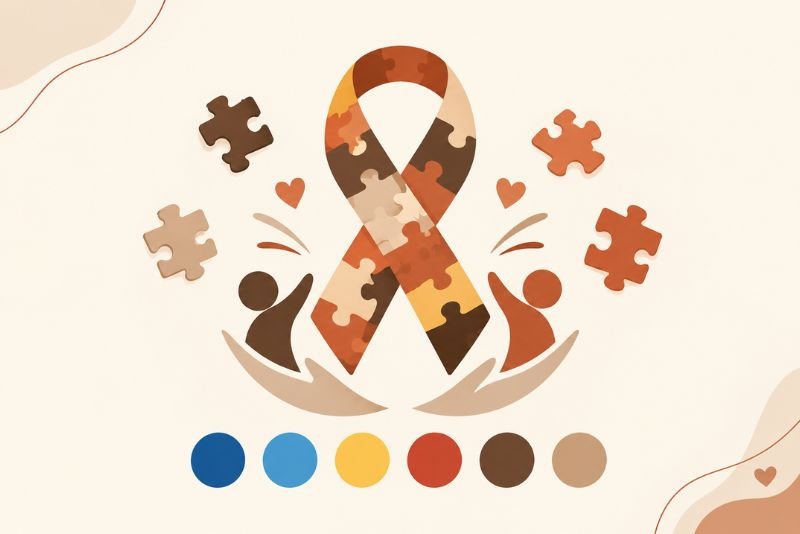
Blue is the color most traditionally associated with autism awareness, largely because of the “Light It Up Blue” campaign. Today, however, there is no single official autism awareness color. Blue, red, gold, and rainbow colors are all used, often reflecting different approaches to awareness, acceptance, neurodiversity, and autistic identity.
Why Are There Different Colors for Autism Awareness?
If you search for the colors for autism awareness, you may find different answers depending on the organization, advocacy group, or community you are looking at.
That is because autism does not have one universally recognized color. Over time, different colors and symbols have developed through awareness campaigns and autistic-led advocacy movements.
Blue became widely recognized through autism awareness campaigns, particularly “Light It Up Blue.” At the same time, many autistic people and advocates have embraced red, gold, and rainbow colors as symbols of acceptance and neurodiversity.
So, if you’re wondering, “What color represents autism?”, the most accurate answer is: there isn’t just one.
The meaning behind a color can also depend on whether a campaign focuses primarily on awareness, acceptance, inclusion, or autistic pride.
What is the Most Common Autism Awareness Color?
Blue is probably the most recognizable color associated with autism awareness.
Its strong connection to autism comes largely from the Light It Up Blue campaign, which encouraged landmarks, buildings, homes, and communities to light up blue around World Autism Awareness Day on April 2. Autism Speaks says the initiative was created in 2010.
Because of the campaign’s international visibility, blue became a familiar choice for:
- Autism awareness events
- Ribbons and clothing
- Social media graphics
- School activities
- Buildings and landmarks
- Fundraising campaigns
- April awareness events
Blue remains widely recognized, but it is important to understand that using blue does not mean everyone in the autism community shares the same view of autism or autism advocacy.
Some autistic advocates have criticized traditional blue-focused campaigns and prefer symbols and colors associated with acceptance and neurodiversity. AutismBC, for example, describes red and gold as more affirming alternatives embraced by many autistic people and advocates.
What Does Blue Represent?
The meaning of blue varies by campaign. In traditional awareness campaigns, it is often used to create visibility and encourage people to learn more about autism.
For someone wearing blue during an autism awareness event, it may simply mean:
“I support greater understanding and inclusion of autistic people.”
It does not necessarily carry one universal message.
What Does Red Represent in Autism Awareness?
Red has become an important color in autism acceptance and advocacy.
Some autistic-led advocacy movements have used red as an alternative to the traditional blue awareness approach. The #RedInstead movement, for example, encouraged people to wear red rather than blue to shift attention from simply being aware of autism toward accepting and supporting autistic people.
For many advocates, red can represent:
- Acceptance
- Advocacy
- Respect
- Autistic identity
- Community
- Challenging stereotypes
Red is therefore often associated with the broader movement toward autism acceptance rather than awareness alone.
This distinction matters because awareness and acceptance are not exactly the same thing.
Awareness means people know autism exists. Acceptance goes a step further by recognizing autistic people as valued members of society and supporting their participation, communication, autonomy, and inclusion.
What Does Gold Represent in Autism Awareness?
Gold is another color increasingly associated with autism acceptance and autistic identity.
One reason is the chemical symbol for gold: Au. The first two letters of “autism” are also “Au,” creating a connection between gold and autism.
Gold is therefore used in the gold infinity symbol, which has become an important autism acceptance symbol. The gold infinity is often connected with ideas such as value, identity, acceptance, and the diversity of autistic experiences.
Gold can be especially meaningful when the goal is to communicate:
- Autistic acceptance
- Autistic pride
- Value and dignity
- Neurodiversity
- Inclusion
There is no universal rule that gold must represent one specific idea, but its association with the infinity symbol has made it increasingly recognizable in acceptance-focused autism advocacy.
What Do Rainbow Colors Represent?
Rainbow colors are commonly seen in the rainbow infinity symbol, which is strongly associated with the neurodiversity movement.
The infinity symbol represents the idea that there are many ways human brains can work, communicate, learn, and experience the world. Its continuous shape can also suggest an ongoing range of possibilities rather than a fixed category.
The rainbow infinity symbol is often used to communicate:
- Neurodiversity
- Inclusion
- Acceptance
- Diversity
- Autistic identity
- The broad range of autistic experiences
It is important to note that rainbow imagery can represent neurodiversity more broadly, not necessarily autism alone.
Some organizations and communities use it specifically for autism acceptance, while others use it to represent a wider group of neurodivergent people.
What About the Autism Puzzle Piece?
The puzzle piece is one of the oldest and most recognizable autism symbols, but it is also one of the most debated.
The symbol dates back to 1963, when the National Autistic Society in the United Kingdom used a puzzle-piece design. Over the years, it became widely associated with autism awareness campaigns and organizations.
For many years, the puzzle piece appeared on:
- Autism awareness ribbons
- Logos
- Stickers
- Clothing
- Educational materials
- Fundraising campaigns
However, some autistic people and advocates dislike the puzzle piece because they feel its imagery can suggest that autistic people are incomplete, mysterious, or something that needs to be solved.
The Autism Society, for example, moved away from the puzzle piece as part of its rebranding and explained that its newer visual identity was intended to emphasize connection, acceptance, and inclusion.
That does not mean everyone rejects the puzzle piece. Some families, organizations, and individuals still use or recognize it.
The important point is that symbols can carry different meanings for different people.
Autism Awareness vs. Autism Acceptance: Why the Difference Matters
The conversation around autism colors has changed alongside a broader discussion about how autism should be represented.
Traditional awareness campaigns often focused on increasing public knowledge of autism. More recent autistic-led advocacy has placed greater emphasis on acceptance, inclusion, self-advocacy, and respect for autistic perspectives.
The United Nations designated April 2 as World Autism Awareness Day in 2007, with the first official observance taking place in 2008. Its broader purpose is to promote awareness and improve the lives of autistic people as part of society.
Today, the conversation often goes beyond simply asking people to recognize autism.
It also asks:
- Are autistic people included?
- Are their voices being heard?
- Are environments accessible?
- Are differences respected?
- Are stereotypes being challenged?
- Are autistic people involved in decisions that affect them?
That is one reason red, gold, and rainbow infinity imagery have become increasingly visible alongside traditional blue awareness campaigns.
Autism Awareness Colors at a Glance
Here’s a simple way to understand the most commonly encountered colors and symbols:
| Color or symbol | Common association |
| Blue | Traditional autism awareness and Light It Up Blue campaigns |
| Red | Autism acceptance, advocacy, and autistic-led movements |
| Gold | Autism acceptance, autistic identity, and value |
| Rainbow | Neurodiversity, diversity, inclusion, and acceptance |
| Gold infinity | Autism acceptance and autistic identity |
| Rainbow infinity | Neurodiversity and inclusion |
| Puzzle piece | Traditional autism awareness symbol; increasingly debated |
These meanings are not official definitions. The same color can mean different things to different people and organizations.
Which Color Should You Use for Autism Awareness?
There is no single “correct” color that everyone must use.
If you’re planning an autism awareness event, creating educational materials, decorating a classroom, or choosing an image for social media, consider the message you want to communicate.
Choose blue if:
You want to participate in a traditional autism awareness campaign or use a color that the general public is likely to immediately associate with autism.
Choose red if:
Your focus is on acceptance, advocacy, and autistic voices, particularly in connection with the #RedInstead movement.
Choose gold if:
You want to emphasize autistic identity, acceptance, and value.
Choose rainbow colors if:
You want to highlight neurodiversity, inclusion, and the wide range of human experiences.
If you’re representing autistic people directly, an especially respectful approach is to listen to the preferences of the people you’re supporting rather than assuming that one symbol or color is universally preferred.
Why There Isn’t One “Official” Autism Color
It can be tempting to look for a simple answer such as “blue is the official autism color.”
But that would leave out an important part of the story.
There is no single universally accepted autism color.
Blue became highly recognizable through major awareness campaigns. Red and gold became important within acceptance and advocacy movements. Rainbow colors became closely connected with neurodiversity and infinity symbolism.
The differences reflect the fact that autism is discussed from several perspectives.
A parent may see a blue ribbon as a way of showing support for their child. An autistic adult may prefer a gold infinity symbol because it reflects identity and acceptance. A school may use rainbow colors to communicate inclusion.
These choices do not always have to be treated as a competition.
What matters most is the message behind the symbol and whether the people being represented are treated with respect, dignity, and inclusion.
How to Show Autism Support Beyond Colors
A colored shirt, ribbon, profile picture, or building illuminated in blue can attract attention. But meaningful support goes beyond visual symbols.
You can support autistic people by:
- Learning about autism from reliable sources
- Listening to autistic people and self-advocates
- Using respectful language
- Promoting accessibility and inclusion
- Supporting communication differences
- Avoiding stereotypes about what autism “looks like”
- Respecting individual preferences
- Making schools, workplaces, and community spaces more accessible
- Sharing accurate information instead of myths
- Supporting autistic-led organizations and initiatives
A color can start a conversation, but understanding and action can make that conversation meaningful.
What Are the Colors for Autism Awareness in April?
April is widely associated with autism awareness and acceptance activities, and April 2 is World Autism Awareness Day. The United Nations established the observance to promote greater awareness and support the rights and well-being of autistic people.
During April, you may see:
- Blue clothing and lights
- Red clothing
- Gold infinity symbols
- Rainbow infinity symbols
- Multicolored autism graphics
- Autism-themed ribbons
- School and community displays
The color you see may depend on the organization behind the event.
Rather than assuming that every color has the same meaning, look at the message accompanying it. That can tell you whether the campaign is emphasizing awareness, acceptance, advocacy, inclusion, or neurodiversity.
Conclusion
So, what are the colors that represent autism awareness?
Blue is the most traditionally recognized autism awareness color, largely because of the Light It Up Blue campaign. But there is no single official color for autism. Red, gold, and rainbow colors are also widely used, particularly in autism acceptance and neurodiversity contexts.
The meaning of each color can vary depending on the organization or community using it. For that reason, the most thoughtful approach is not simply choosing a color, but understanding what that color represents to the people you want to support.
At AutismCue, we aim to provide clear, accessible information about autism, therapies, communication, parenting, education, and everyday support. We believe good autism information should make room for different perspectives while keeping the focus on accurate and respectful information.
Disclaimer: This article is for general information only and is not medical advice. AutismCue is an informational platform, not a medical professional or healthcare provider.
FAQ’s
1. What is the main color for autism awareness?
Blue is the most traditionally recognized color for autism awareness, largely because of the Light It Up Blue campaign. However, there is no single official autism color.
2. Is red an autism awareness color?
Yes. Red is used by some autistic advocates and acceptance-focused movements, including the #RedInstead movement, which emphasizes acceptance rather than awareness alone.
3. What does the gold autism symbol mean?
Gold is associated with autism partly because the chemical symbol for gold is Au, which also begins the word “autism.” The gold infinity symbol is commonly associated with autism acceptance and identity.
4. What does the rainbow infinity symbol mean?
The rainbow infinity symbol is commonly associated with neurodiversity, inclusion, and acceptance. It is used by many autistic people and advocates as an alternative to the traditional puzzle-piece symbol.
5. Is there an official color for autism?
No. Blue is the best-known traditional awareness color, but red, gold, and rainbow colors are also used. The meaning depends on the organization, campaign, or community using the color.