
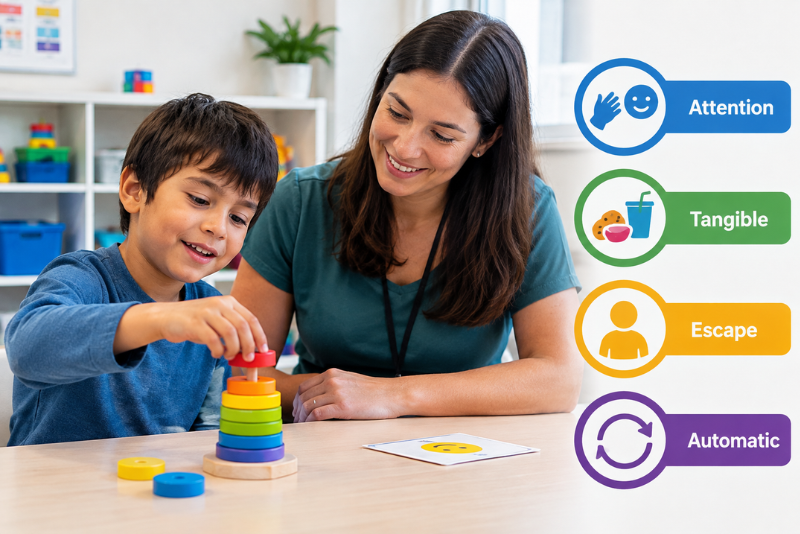
The functions of behavior in ABA are the four reasons a behavior keeps happening: attention, escape (avoidance), access to tangibles, and sensory (automatic) reinforcement. Every behavior serves at least one of these purposes. Once you know the function, you can respond in a way that actually helps.
Understanding the Function of Behavior in ABA
In Applied Behavior Analysis (ABA), the function of a behavior is the reason it keeps happening. It is what the person gets or avoids as a result of the behavior.
ABA does not focus only on what a behavior looks like, such as screaming, hitting, or running away. It asks a different question: “What is this behavior doing for the person?”
Two children can both throw a toy. The behavior may be an attempt to gain a parent’s attention. The other may be trying to stop a task. The behavior looks the same, but the reason is different, so the right response is different too.
This idea comes from the principle that consequences shape behavior. If a behavior works, meaning it gets something wanted or removes something unwanted, it is more likely to happen again.
The 4 Functions of Behavior in ABA
Behavior analysts group the functions into four categories. They are often shortened to the acronym SEAT (Sensory, Escape, Attention, Tangible) or a similar variation.
Attention
Attention-maintained behavior occurs when a person’s actions consistently result in attention from others. The attention can be positive, like praise and laughter, or negative, like scolding or correction.
Examples:
- A child calls out loudly in class, and the teacher turns to look.
- A toddler drops food on the floor while watching a parent’s face.
- A teenager makes a rude comment to get friends to laugh.
Common signs: The behavior mostly happens when other people are nearby but not paying attention. It often stops or drops when the person is alone.
For many people, even a scolding is better than being ignored. As a result, attention-seeking behavior may persist even when adults believe they are responding to it with punishment.
Escape (Avoidance)
Escape-maintained behavior happens to get out of, delay, or avoid something the person finds unpleasant, difficult, boring, or overwhelming. In ABA, this is called negative reinforcement: something unwanted is taken away.
Examples:
- A child cries and pushes away homework, and the homework is put away.
- A student leaves the room when a hard math worksheet is handed out.
- An adult with autism covers their ears and leaves a loud store.
Common signs: The behavior happens right after a demand, request, or change in routine. It often stops when the demand is removed.
This function is very common in learners who find a task too hard, too long, or too stressful. In these cases, the behavior may be a form of communication: “This is too much for me.”
Access to Tangibles
Tangible-maintained behavior happens to get a specific item or activity, such as a toy, snack, tablet, or favorite game.
Examples:
- A child screams in the store until a parent buys candy.
- A student grabs a classmate’s toy.
- A child melts down when screen time ends and calms down once the tablet is returned.
Common signs: The behavior happens when a preferred item is out of reach, removed, or denied. It stops when the person gets the item.
Giving in once can strengthen this pattern. This is why consistency matters.
Sensory (Automatic Reinforcement)
Sensory, or automatic, behavior feels good or relieves discomfort in itself. It is not linked to other people or outside rewards. The behavior creates its own reinforcement.
Examples:
- Hand flapping or rocking during excitement or anxiety.
- Humming, tapping, or spinning objects.
- Chewing on clothing or objects.
- Scratching or skin picking that relieves an itch or discomfort.
Common signs: The behavior happens in many settings, whether the person is alone or with others, and whatever else is happening around them.
Not all sensory behavior is a problem. Stimming is often harmless and can help people manage their emotions. Support is usually needed only when a behavior causes injury, blocks learning, or limits daily life.
Quick Comparison of the 4 Functions
| Function | What the person wants | Example |
| Attention | A reaction from others | Calling out to get noticed |
| Escape | To avoid or stop something | Crying to end a task |
| Tangible | An item or activity | Screaming for a toy |
| Sensory | A feeling or sensation | Rocking or humming |
Why Knowing the Function Matters
Without the function, people often guess. A response that works for one function can make another worse.
- Letting a child take a break after screaming may reinforce escape-based behavior.
- Ignoring a behavior may reduce attention-seeking, but it won’t address sensory needs.
- Giving a toy to stop a tantrum may strengthen a tangible pattern.
Knowing the function helps teams:
- Choose strategies that fit the real cause
- Teach better replacement skills
- Reduce frustration for the learner and the family
- Avoid accidentally reinforcing the problem behavior
How Do Professionals Find the Function of a Behavior?
Behavior analysts do not guess. They use a structured process called a Functional Behavior Assessment (FBA). It usually includes:
- Interviews and questionnaires. Parents, teachers, and caregivers describe when and where the behavior happens.
- Direct observation. The analyst watches the person in natural settings.
- ABC data collection. This tracks three things:
- Antecedent: what happened right before the behavior
- Behavior: what the person did
- Consequence: what happened right after
- Functional analysis (sometimes). In some cases, conditions are carefully controlled to test which consequence maintains the behavior. This is done only by trained professionals, with safety measures in place.
Patterns in the ABC data usually point to the function. For example, if a behavior repeatedly follows a demand and ends with the demand being removed, escape is likely.
Can a Behavior Have More Than One Function?
Yes. This is common. A behavior can serve more than one function, or its function can change across settings.
A child might cry at school to avoid work (escape) and cry at home to get a parent’s comfort (attention). That is why a good assessment looks at behavior across different times and places.
What Is Done After the Function Is Known?
Once the function is clear, a Behavior Intervention Plan (BIP) is usually written. Common elements include:
- Prevention strategies. Changing the environment or routine to reduce triggers, such as breaking tasks into smaller steps.
- Replacement behaviors. Teaching a safer, more useful way to get the same result. This is often done through Functional Communication Training (FCT). For example, a child learns to say “break, please” instead of screaming to escape a task.
- Consistent responses. Adults respond the same way each time so the new skill works better than the old behavior.
- Reinforcement. Rewarding the new skill so it keeps happening.
Good plans respect the person’s dignity and needs. The goal is not to remove all unusual behavior, but to help the person communicate, learn, and stay safe.
Practical Tips for Parents and Caregivers
- Write down what you see. Note what happened before and after the behavior.
- Look for patterns. Does it happen at certain times, places, or with certain people?
- Stay calm and consistent. Reacting each time differently can confuse the learner.
- Teach a replacement skill. Offer a clear alternative, such as a card, gesture, or word.
- Check for other causes. Pain, hunger, tiredness, or illness can also affect behavior. Talk to a doctor if you are unsure.
- Seek qualified help. A Board Certified Behavior Analyst (BCBA) can run an assessment and design a plan for your situation.
Final Thoughts
The functions of behavior in ABA give a simple but powerful way to understand why behavior happens. Whether it is attention, escape, tangibles, or sensory input, every behavior has a purpose. By looking at the reason behind the behavior instead of only the behavior itself, families, teachers, and therapists can respond with more understanding and better results.
FAQs
What are the 4 functions of behavior in ABA?
The four functions are attention, escape (avoidance), access to tangibles, and sensory (automatic) reinforcement. Each describes why a behavior keeps happening, based on what the person gains or avoids. Knowing the function helps professionals and families choose the most effective response.
Why is the function of behavior important in ABA?
Understanding the function shows why a behavior occurs, not just what it looks like. This helps teams choose strategies that fit the real cause, teach useful replacement skills, and avoid accidentally reinforcing the behavior. Without it, interventions are often based on guesswork and may not work.
How do you identify the function of a behavior?
Professionals use a Functional Behavior Assessment (FBA). It includes interviews, direct observation, and ABC data (antecedent, behavior, consequence). Patterns in this data show what happens before and after the behavior, which points to its function. A BCBA usually leads this process.
Can one behavior have more than one function?
Yes. A single behavior can serve different purposes at different times or in different settings. For example, a child may cry to avoid homework at school and to get comfort at home. A thorough assessment looks at behavior across many situations.
Is sensory behavior always a problem?
No. Many sensory behaviors, such as hand flapping or humming, are harmless and help people feel calm or comfortable. Support is usually needed only when the behavior causes injury, interferes with learning, or limits daily activities. The goal is safety and quality of life, not removing every unusual behavior.
Disclaimer: The information in this article is for general educational purposes only and does not replace professional medical, psychological, or behavioral advice. Every individual is different. Please consult a qualified professional, such as a Board Certified Behavior Analyst (BCBA) or your healthcare provider, before making decisions about assessment or intervention.
Pingback: Behavior Intervention Plan: What It Is & Who Needs One