
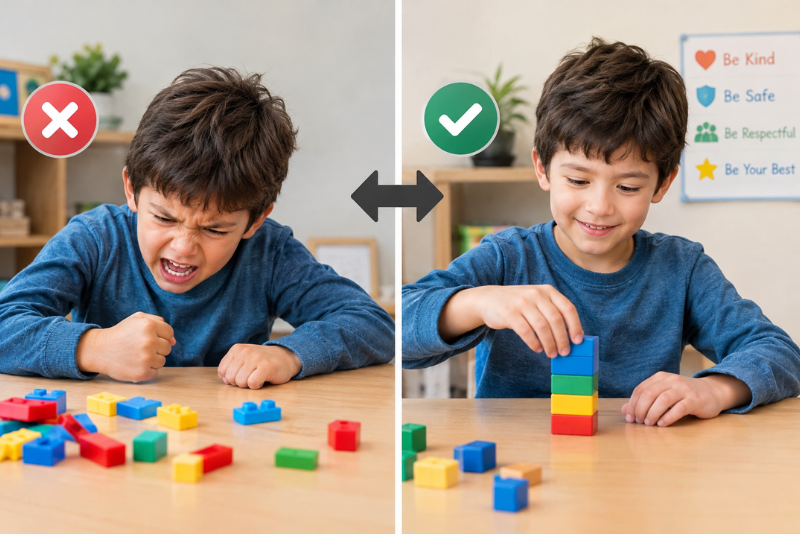
Ever noticed a child work hard in one setting, then act very differently in another, right after the rewards changed? That pattern may be linked to behavior contrast in ABA. It is a well-known effect in behavior analysis, and it helps explain why changing the rules in one place can shift behavior somewhere else.
This guide explains behavior contrast in ABA in plain language. You will learn the definition, the main types, real-life examples, why it happens, and what it means for therapy and daily life.
What Is Behavior Contrast in ABA?
Behavior contrast (also called behavioral contrast) is a change in how often a behavior happens in one situation, caused by a change in reinforcement in a different situation. The behavior moves in the opposite direction of the reinforcement change. If reinforcement goes down in one setting, behavior in the other setting can go up. If reinforcement goes up in one setting, behavior in the other can go down.
The key detail is that nothing changed in the second setting. Its reinforcement stayed the same, yet the behavior there still shifted.
Key Terms to Know
To understand behavioral contrast in ABA, a few terms help:
- Reinforcement: Something that follows a behavior and makes it more likely to happen again, such as praise, a snack, or a token.
- Multiple schedule: Two or more conditions that take turns, each signaled by a clear cue (for example, a red light and a green light, or math time and reading time).
- Component: One of those conditions inside a multiple schedule.
- Discriminative stimulus: The cue that tells the learner which condition is active.
Where Did Behavior Contrast Come From?
The effect was first described by researcher George S. Reynolds in 1961. He worked with pigeons that pecked a key for food. The pigeons faced two signals that alternated: one color and then another. At first, pecking earned food equally under both colors.
Then Reynolds stopped giving food under one color. As expected, pecking dropped under that color. The surprise was that pecking rose under the other color, even though food delivery there had not changed. Scientists named this effect behavioral contrast, and it has since been studied in many species, including people.
The Main Types of Behavioral Contrast
Negative Behavior Contrast
This is the most common version. Reinforcement decreases in one condition, and behavior in the unchanged condition increases. The learner seems to “make up for” what was lost.
Positive Behavior Contrast
Here reinforcement increases in one condition, and behavior in the unchanged condition decreases. The second setting now looks less rewarding by comparison, so the learner does less there.
Other Forms Researchers Describe
- Local contrast: The change appears right after a switch between conditions, such as a burst of responding in the first moments after the cue changes.
- Anticipatory contrast: Behavior changes before a switch because the learner expects a richer or poorer condition coming next.
In short, the pattern is always the same: what happens in one place changes what a person does in another.
Simple Examples of Behavior Contrast
Example 1: Classroom Tokens
A student earns tokens for finishing worksheets in both math and reading. The teacher then stops giving tokens in reading but keeps them in math. Work output in reading falls. If the student starts finishing more math work than before, even though math tokens stayed the same, that is negative behavior contrast.
Example 2: Two Therapists, Two Rules
A child asks for help politely with Therapist A and with Therapist B. Therapist A begins to give attention and praise every single time. Therapist B’s rules stay unchanged. If polite requests with Therapist B then become less frequent, that fits positive behavior contrast. Time with Therapist A now seems much better.
Example 3: Home vs. School
Imagine a child’s tantrums no longer work at school because staff use extinction (they stop giving the reward the tantrum used to earn). At home, the tantrums still get attention. Tantrums at home may increase. That increase at home, while the school plan works, is a real-world pattern that looks like behavior contrast.
These examples are simplified. In real life, many other factors are at play, so one change rarely explains everything.
Why Does Behavior Contrast Happen?
Researchers do not fully agree on one answer. Several explanations are discussed:
- Relative reinforcement: Behavior depends on how good one option is compared with the others. When a setting gets worse, the remaining one looks better, and vice versa.
- Reallocation of effort: If a learner can no longer earn rewards in one place, energy may move to the place where rewards still work.
- Emotional or frustration effects: Losing reinforcement can create frustration that spills into other settings.
- Response–reinforcer links: Some theories focus on how closely each setting’s rewards are tied to the behavior itself.
No single theory explains every case, which is why the topic remains active in research.
Why Behavior Contrast Matters in ABA Practice
Applied behavior analysis often changes reinforcement. Therapists may use extinction, differential reinforcement, token systems, or reinforcement thinning (gradually giving rewards less often). Because of behavior contrast, these changes can have effects beyond the target setting.
Here is why that matters:
- Side effects can show up elsewhere. A plan that works in one room may raise problem behavior in another.
- Consistency across settings becomes important. Parents, teachers, and therapists working from the same plan lower the risk of contrast effects.
- Data should be collected in more than one setting. Tracking only the target setting can hide shifts in behavior somewhere else.
- Progress can be misread. A drop in behavior in one place is not always a full win if it appears in another place.
How to Reduce Unwanted Contrast Effects
Behavior analysts commonly use these practical steps:
- Use the same plan across settings. Share the strategy with every caregiver and teacher involved.
- Teach a replacement skill. If a behavior no longer works, give the learner a better way to get what they need, such as asking for a break.
- Change reinforcement gradually. Sudden drops in rewards are more likely to trigger big swings.
- Make cues clear. Learners should know which rules apply in which setting.
- Monitor several settings. Record behavior at home, at school, and in therapy when possible.
- Review data regularly. If behavior rises somewhere unexpected, adjust the plan with a qualified professional.
Behavior Contrast vs. Similar Concepts
Behavior contrast is sometimes confused with other ideas:
| Concept | What it means | How it differs |
| Behavioral contrast | Behavior changes in the opposite direction of a reinforcement change in another setting | Needs two or more signaled conditions |
| Stimulus generalization | Behavior learned in one setting shows up in similar settings | Behavior moves in the same direction |
| Response induction | Changes in one behavior cause changes in related behaviors | Focuses on behaviors, not settings |
| Extinction burst | Temporary rise in behavior right after reinforcement stops | Happens in the same setting where reinforcement stopped |
What Research Says (and Its Limits)
Behavior contrast is best supported by laboratory studies, especially with animals, where conditions can be tightly controlled. Studies with children and adults exist, and some show contrast effects, but results are more mixed. Real life is also messier than a lab, so contrast is best seen as one possible influence on behavior, not a rule that always applies.
For this reason, anyone using these ideas in a treatment plan should rely on individual data and guidance from a Board Certified Behavior Analyst (BCBA).
Key Takeaways
- Behavior contrast: ABA describes a change in behavior in one setting caused by a reinforcement change in another.
- The change goes in the opposite direction of the reinforcement change.
- It was first described by Reynolds in 1961 using pigeons.
- Negative contrast and positive contrast are the two main types.
- Consistent plans and data from different settings can help make things more predictable.
Frequently Asked Questions
What is behavior contrast in ABA?
Behavior contrast in ABA is a change in behavior in one setting that happens because reinforcement changed in another setting. The behavior moves in the opposite direction of the reinforcement change, even though the reinforcement in the affected setting stayed the same.
What is the difference between behavior contrast and behavioral contrast in ABA?
There is no real difference. Behavior contrast and behavioral contrast are two names for the same concept. “Behavioral contrast” is the traditional term used in research, while “behavior contrast” is a shorter version commonly used in ABA training and everyday discussions.
What are the two types of behavior contrast?
The two main types are negative and positive contrast. In negative contrast, reinforcement drops in one condition and behavior rises in the unchanged one. In positive contrast, reinforcement rises in one condition and behavior falls in the unchanged one.
Who discovered behavioral contrast?
George S. Reynolds first described behavioral contrast in 1961. In his experiments with pigeons, removing food in one signaled condition caused more pecking in another condition where food was still available. His findings opened a long line of research on how reinforcement conditions affect each other.
Why does behavior contrast matter in ABA therapy?
It matters because changing reinforcement in one place can affect behavior in another. Therapists may see problem behavior rise at home after a school plan begins. Knowing this helps teams keep plans consistent, track several settings, and respond quickly to unexpected changes.
How can parents and teachers reduce contrast effects?
Use the same plan across settings, teach a replacement skill, and avoid sudden drops in rewards. Keep cues clear so the child knows which rules apply where. Track behavior in more than one setting, and share the data with the child’s BCBA.
Disclaimer: The information on AutismCue is provided for general educational purposes only. It is not medical, psychological, or therapeutic advice, and it should not replace guidance from a qualified professional such as a Board Certified Behavior Analyst (BCBA), doctor, or therapist. Always consult a professional before making decisions about a child’s or individual’s treatment plan.