
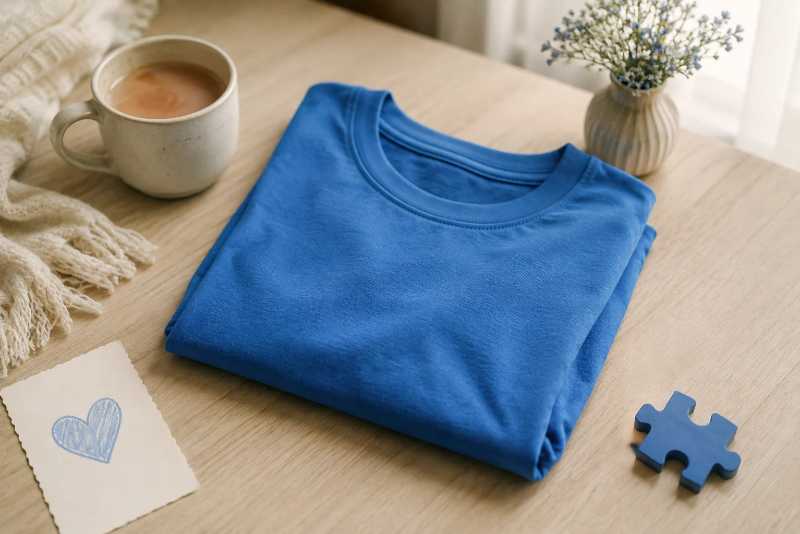
Every April, blue shirts start showing up in classrooms, workplaces, and social media feeds. April 2nd is World Autism Awareness Day, designated by the United Nations in 2007, and for years the “Light It Up Blue” campaign has encouraged people to wear blue as a show of support.
But if you’ve spent any time in autistic-led spaces recently, you may have noticed something surprising: a growing number of autistic people actively avoid wearing blue in April, and some see the color as something to think carefully about rather than adopt automatically.
So which is a meaningful gesture of solidarity, or a symbol worth questioning? The honest answer is that both views come from real experience, and understanding why they conflict tells you a lot about how the conversation around autism has evolved. This piece presents both sides as perspectives and opinions people hold, not as settled facts about any single organization.
The Case for Wearing Blue
For many people personally connected to autism, blue shirts are a simple, visible way to start conversations. Some longtime supporters of Light It Up Blue describe wearing blue every April as a tradition going back more than a decade, often tied to their own diagnosis earlier in life. For them, blue can carry personal meaning beyond the campaign itself a color associated with calm and honesty, and one some gravitate toward from childhood experiences with sensory sensitivities.
Practically, the shirts also do a job: they prompt questions. Supporters often recall being asked by curious onlookers, year after year, why they were wearing blue an opening to talk about autism. Some also describe moments speaking at local community events, where kids showed up wearing blue in every form imaginable, from shirts to earrings, as a sign of how far the conversation has reached young people.
The throughline in this perspective is connection: the idea that a shared, visible symbol helps autistic people and their families feel less isolated, and keeps a public conversation about autism alive.
The Case Against Wearing Blue
A different and increasingly vocal perspective comes from autistic self-advocates who reject blue awareness campaigns outright. Some autistic writers and disability rights advocates have described why they stopped wearing favorite blue shirts during April, despite loving the shirts themselves.
The objection usually isn’t to the color blue in the abstract it’s to where the color and the campaign originated. Many critics trace “Light It Up Blue,” and similar blue-themed campaigns run by affiliated organizations, back to Autism Speaks. Some autistic advocates have criticized the organization’s past messaging and campaigns, arguing that earlier materials framed autism primarily as a problem to be solved rather than a natural form of human difference.
Critics also point to the puzzle-piece imagery long associated with these campaigns, arguing it implies autistic people are incomplete or a problem to be solved. It’s worth noting that Autism Speaks says its mission and messaging have evolved over time, and the organization disputes some of these characterizations — but the criticism itself remains a significant and widely shared view within parts of the autistic community.
For many in this camp, the deeper issue is the word “awareness” itself. In this view, awareness campaigns can sometimes frame autism as a burden mainly on parents and caregivers, rather than centering the experiences and voices of autistic people.
Some advocates describe seeing this framing in school displays funded by blue-campaign-affiliated organizations, and have instead chosen to speak directly to teachers and students about what autism means to them separate from any blue banner.
This is why some autistic people choose not to wear pro-autistic messaging specifically during April: not because they’re ashamed of the message, but because they worry it could be misread as support for a campaign they feel doesn’t represent them.
Why This Disagreement Matters
This isn’t a fringe disagreement; it reflects a broader, ongoing shift in the autism community from “awareness” toward what many self-advocates call “acceptance.” Some autistic-led organizations have moved away from blue entirely, favoring alternative colors or symbols (red and gold “Autism Acceptance” campaigns, for instance) explicitly to distance themselves from Autism Speaks.
At the same time, plenty of individuals — including autistic people themselves, as well as parents and caregivers continue to find genuine, personal meaning in Light It Up Blue, independent of any organization’s politics.
What This Means If You’re Deciding What to Wear
If you’re weighing whether to wear blue on April 2nd, a few questions can help you think it through:
- Do you know why you’re wearing it? A shirt with a message you personally connect to is different from wearing blue simply because it’s expected.
- Have you heard from autistic people directly? Autistic voices are not uniform on this topic — some embrace blue campaigns, others reject them so it’s worth listening to a range of perspectives rather than assuming one view speaks for everyone.
- What message do you want to send? If your goal is solidarity, consider that a shirt with your own words, or a color chosen deliberately outside the blue-campaign tradition, might carry the message more clearly than a color with a complicated history behind it.
There’s no single “correct” shirt to wear in April. What matters more is understanding that the color carries different weight for different people, and being willing to have the conversation — whichever shirt you choose to start it with.
Here’s My Take
Honestly? I don’t think this is a question with one right answer, and I’d be a little suspicious of anyone who tells you it is.
What strikes me most, reading both sides closely, is that they actually agree on more than it seems. Nobody here is saying “don’t care about autistic people.” Everybody’s trying to support autistic people well — they just disagree on what “well” looks like, and that disagreement mostly comes down to who gets to define the message. One side says a shared symbol builds connection. The other says the symbol itself sends a message some autistic people never agreed to.
If you take one thing from this, let it be this: autistic people are not a single voice, and neither “side” of this debate speaks for all of them. So before you default to whatever shirt is easiest to grab, it’s worth asking an actual autistic person in your life — if you have one — what feels right to them. Their answer might surprise you. It might not match anyone in this article.
Wear the blue shirt, don’t wear it, wear your own words instead — just don’t let the shirt do all the talking. Have the conversation too.
Honestly? I don’t think this is a question with one right answer, and I’d be a little suspicious of anyone who tells you it is.
This article draws on two publicly available perspectives: a piece from the Autism Speaks blog advocating for Light It Up Blue, and an essay titled “Autism Awareness Harms: Why I Don’t Wear my Blue Shirt in April”, published by Women With Disabilities Australia. As with much of what we cover on AutismCue, there isn’t one right answer here — just different lived experiences worth understanding.