
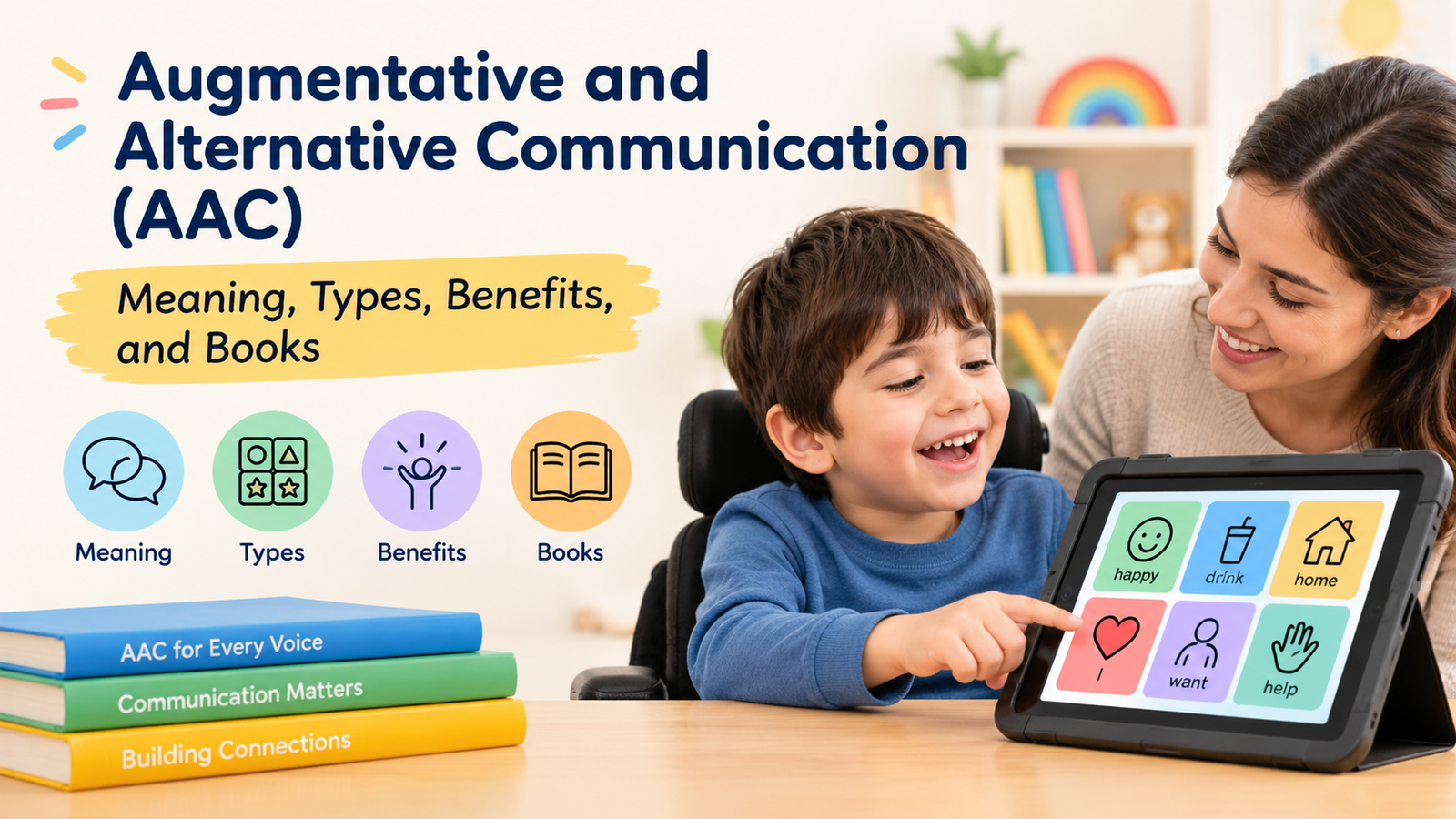
If your child isn’t talking yet, or is hard to understand, you’ve probably wondered what comes next. AAC is one answer. It’s a set of tools and strategies that help a person communicate when speech isn’t enough. Many families find it’s easier to start than they expected. This guide covers what AAC is, the different types, and how it helps children with autism.
What AAC means
AAC stands for augmentative and alternative communication. It covers the tools, systems, and strategies that support or replace spoken language for people who can’t rely on speech all the time.
The two “A” words describe two different jobs:
- Augmentative means adding to speech. Someone whose speech is hard to understand might add pictures, signs, or a letter board so the listener gets the message.
- Alternative means using something in place of speech. A person who can’t speak, or whose speech isn’t understood by others, needs another way to get their message across.
Some people use AAC all day. Others use it only in certain moments, such as in a noisy room or when stress makes speaking harder. It can also change over time. The system that fits a child today may not be the one they need next year.
Who uses AAC
Estimates suggest well over 2 million people with significant expressive language difficulties use AAC. The reasons vary across the lifespan. Some people were born with conditions that affect speech. Others lose speech later through illness, stroke, or injury. Conditions linked to AAC use include:
- Autism
- Cerebral palsy
- Genetic syndromes
- Intellectual disability
- Hearing impairment
- Multiple disabilities
- Stroke and head injury
The main types of AAC
AAC splits into two groups: unaided and aided.
Unaided AAC needs no tools. It includes facial expressions, body language, gestures, and manual signs. It works best with a partner who knows the person well enough to read the message, and it usually depends on good motor control.
Aided AAC uses an outside tool. That can be low-tech, such as picture cards, choice boards, communication books, or alphabet charts. It can also be high-tech, such as a tablet app or a speech-generating device that speaks the message aloud.
Aided systems also differ in what they use to represent language:
- Symbol-based AAC uses pictures or symbols for words and phrases. It suits people who can’t yet read or spell.
- Text-based AAC uses a keyboard. It suits people who can read and spell and want to type what they mean.
Most AAC users communicate in several ways
AAC is rarely the only tool someone uses. Most people who use it are multimodal communicators. A child might combine a device with sounds, word approximations, gestures, and photos from a phone. Every one of these methods counts. Professionals encourage families to value and respond to all of them instead of treating the device as the only “real” communication.
A child may even use different methods with different people, such as signing with parents at home and using a device at school. That’s normal and often helpful.
When to start
Many parents wait because they feel their child isn’t “ready.” Current evidence says there are no set prerequisites for starting AAC. Age, motor skills, cognitive level, and language ability don’t need to hit a certain mark first. Having some speech doesn’t rule AAC out either. A child with limited or hard-to-understand speech can use AAC alongside it.
The decision works best as a team effort between the individual, their family, and professionals such as a speech-language pathologist (SLP). The guiding principle is simple: no one should go without a way to communicate.
Why AAC matters
People who use AAC describe real changes in their lives. They report:
- Stronger friendships and relationships
- More frequent, richer social interaction
- More independence and say over their own lives
- More respect from others
- Greater participation in family and community life
- Clearer communication with doctors, which supports safety in care settings
- More chances for school, work, and volunteering
People who went without a communication system describe the opposite: more loneliness, more frustration, feeling shut out of decisions about their own lives, and being unable to show what they know. Because people often judge the abilities of someone who doesn’t speak, AAC also helps others see the thinking and personality behind the silence. Many advocates call communication a basic human right.
How AAC helps children with autism
Communication differences are central to autism for many children. AAC supports them in practical ways:
- Less frustration. A child who can say “I need a break” is less likely to reach a breaking point.
- Fewer misunderstandings. Adults stop guessing and start listening.
- More independence. The child can choose, request, refuse, and share ideas.
- Visual support. Many autistic children process pictures and symbols more easily than spoken words.
- Stronger connection. A shared way to talk opens the door to play, friendships, and family conversation.
How AAC systems are chosen
Choosing an aided system takes care. A good assessment looks at:
- The child’s current skills, strengths, and needs
- The symbols, systems, and access methods available (touch, switches, eye gaze)
- The places and people the child needs to communicate with
- Vision, hearing, movement, motivation, language, and literacy
- The skills and support available to the people around them
Experts also warn against limiting a child’s potential. A system should leave room to grow. Many teams use a dynamic assessment, which means they keep adjusting as the child learns.
How to talk with someone who uses AAC
- Speak to the person, not their parent or aide.
- Give them time. Building a message can take longer.
- Don’t finish their sentences unless they ask.
- Ask before touching the device. It’s their voice.
- Assume they understand. Using AAC says nothing about intelligence.
- Value every form of communication, including gestures, sounds, and photos.
Steps to get started
- Talk to your child’s pediatrician or school about an evaluation.
- Work with a speech-language pathologist to choose tools that fit.
- Start with a few words your child uses every day.
- Use AAC yourself during daily routines so your child sees it modeled.
- Be patient. Learning any language takes time and repetition.
Frequently Asked Questions
What is AAC in simple terms?
AAC is any tool or method that supports or replaces speech, such as gestures, picture boards, or speech-generating devices.
Is AAC only for autistic children?
No. People with many conditions use it, and some start after an illness or injury as adults.
Does my child need certain skills before starting AAC?
No. Evidence shows there are no required age, cognitive, or motor skills to begin.
Can my child use AAC and speech together?
Yes. Having some speech doesn’t rule AAC out, and many people use both.
Will AAC stop my child from talking?
Many professionals find AAC supports communication overall. Ask your child’s speech-language pathologist what to expect for your child.
Who decides which AAC system is right?
A team made up of the individual, their family, and professionals, usually led by a speech-language pathologist.
Disclaimer: This article is written for informational purposes and draws on guidance from the American Speech-Language-Hearing Association (ASHA) Practice Portal on augmentative and alternative communication, and educational material from AssistiveWare. It is not medical or therapeutic advice. The article includes a paid placement for the book mentioned. For advice about AAC for your child, please consult a licensed speech-language pathologist.