
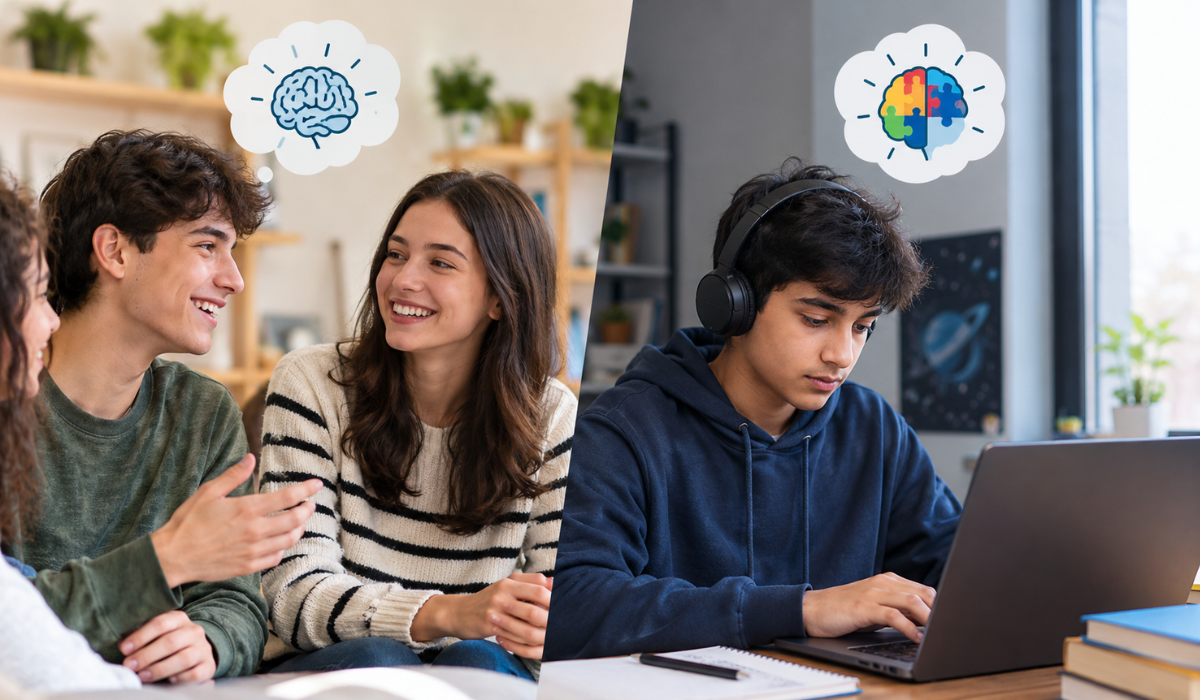
You may have seen the word “neurotypical” in an article, a social media post, or a conversation about autism. Many people use it without explaining it, which can be confusing if you have never heard it before.
This guide explains what neurotypical means in plain language. You will see where the word came from, how it shows up in daily life, and how it relates to autism. It is written especially for neurotypical readers who want to understand the autistic people around them.
What Does Neurotypical Mean?
‘Neurotypical’ means having a brain that develops and works in the way most people’s brains do. A neurotypical person learns, communicates, pays attention, and handles sensory information in ways that society generally expects.
The word breaks into two parts. “Neuro” refers to the brain and nervous system. “Typical” means common or usual. Put together, it describes a brain that follows the usual pattern.
Neurotypical is not a medical diagnosis. You cannot get tested for it, and a doctor will not write it on a chart. It is only a descriptive word, like “right-handed”. Most people are right-handed, but that does not make left-handed people wrong or broken. They just do things a little differently.
Where Did the Word Come From?
The term grew out of the autistic community in the 1990s. Autistic people were writing and talking with each other, often online, and they needed a simple way to refer to people who were not autistic. “Neurotypical” filled that gap.
Around the same time, the idea of neurodiversity became popular. It says that differences in how brains work are a natural part of being human, much like differences in height or eye colour. Under this view, autism is not something to be “fixed”. It is one way a brain can work.
Neurotypical vs. Neurodivergent
To understand neurotypical, it helps to know its opposite.
‘Neurodivergent’ describes people whose brains work differently from the typical pattern. This includes people with:
- Autism
- ADHD
- Dyslexia
- Dyspraxia
- Tourette syndrome
- Dyscalculia
‘Neurotypical’ describes everyone who does not fall into that group.
Notice that “neurodivergent” is a wide umbrella. Autism sits under it, but so do many other conditions. That means neurotypical is not simply the opposite of autistic. It is the opposite of neurodivergent as a whole.
Examples of Neurotypical Thinking and Behaviour
Every person is different, and no list describes everyone. Still, some patterns are common among neurotypical people. Here are a few everyday examples.
Social communication. Neurotypical people often pick up unspoken social rules without being taught them. They may naturally know when to take a turn in a conversation, how close to stand to someone, or when a friend is hinting at something without saying it.
Reading tone and body language. Many neurotypical people can quickly sense a change in someone’s voice, face, or posture. They often understand sarcasm, jokes, and polite hints without needing them explained.
Handling change. Changes in plans, such as a late bus or a switched meeting time, are usually annoying for neurotypical people but manageable.
Sensory input. A noisy restaurant, a flickering light, or a scratchy clothing tag may be a small nuisance. For most neurotypical people, these things fade into the background.
Small talk. Chatting about the weather or weekend plans tends to feel natural and even enjoyable, though some neurotypical people find it dull.
Again, these are patterns and not rules. A neurotypical person can be shy, can hate crowds, or can love routines. Being neurotypical does not mean being the same as everyone else.
How Does Neurotypical Relate to Autism?
Autism spectrum disorder is a neurodevelopmental condition. It affects how a person communicates, interacts with others, and experiences the world. According to the CDC, about 1 in 31 eight-year-old children in the United States were identified as autistic in a 2022 data review.
Because autistic brains work differently from the typical pattern, autistic people are neurodivergent, not neurotypical. The two groups often have different natural styles in several areas:
Communication. Autistic people may prefer direct, literal language. They may find hints, sarcasm, or vague wording harder to read. Some are nonverbal or use other ways to communicate.
Social interaction. Many autistic people find unwritten social rules tiring to follow. They may like deep conversations on topics they love and find casual small talk less meaningful.
Sensory experiences. Sounds, lights, textures, tastes, and smells can feel much stronger, or sometimes weaker, for autistic people.
Routines and interests. Many autistic people feel safer with predictable routines. Many also develop intense, long-lasting interests that bring them great joy.
None of this makes one style better than the other. They are different ways of experiencing the world.
The “Double Empathy Problem”
Here is an idea that helps neurotypical people see the full picture. In 2012, autistic researcher Dr Damian Milton described what is now called the double empathy problem.
It says that misunderstandings between autistic and neurotypical people go both ways. For a long time, people assumed the autistic person was the one who “couldn’t understand” others. But communication needs two people. If an autistic person and a neurotypical person misread each other, both are struggling to understand a different style.
Research has since supported this view. Studies have found that autistic people often communicate well with other autistic people and that mix-ups tend to rise when the two styles meet. So when a conversation goes wrong, it helps to ask, “Are we just speaking differently?” instead of “What is wrong with them?”
Common Myths About Being Neurotypical
Myth: “Neurotypical” means “normal”, and everyone else is abnormal.
Not true. ‘Neurotypical’ only describes the more common brain pattern. Common does not mean better or healthier.
Myth: Neurotypical people have no struggles.
Also false. Neurotypical people can live with anxiety, depression, trauma, and many other challenges. Neurotype and mental health are separate things.
Myth: Neurotypical is a rude or insulting word.
It is a neutral term. It becomes unkind only if someone uses it as a put-down.
Myth: You are either fully neurotypical or fully autistic.
Real life is messier. Many people have a few traits that overlap with neurodivergence without meeting the criteria for any diagnosis. Many adults also discover they are autistic later in life, after years of assuming they were neurotypical.
Is Neurotypical a Diagnosis?
No. There is no test, score, or official label for being neurotypical. People generally describe themselves this way when they have no diagnosed or suspected neurodevelopmental condition.
If you often feel that everyday life is harder for you than for others, such as in social settings, with noise, or with changes in routine, you may want to speak with a qualified healthcare professional. Only a trained clinician can evaluate whether autism or another condition might be involved.
How Neurotypical People Can Support Autistic People
Understanding the word is a good first step. These simple habits can make daily life easier for autistic family members, friends, classmates, and coworkers:
- Say what you mean. Clear, direct words are usually kinder than hints. Rather than saying, “It’s getting late,” you could say, “We’ll be leaving in about ten minutes.”
- Give notice about changes. A quick heads-up about new plans helps many autistic people feel calmer.
- Respect sensory needs. If someone needs a quieter room, sunglasses, or headphones, treat that as a normal request.
- Don’t force eye contact. Many autistic people listen better when they are not made to look someone in the eye.
- Listen without judging. Believe people when they describe what is hard for them.
- Learn from autistic voices. Books, blogs, and talks by autistic people offer insight no outside explanation can match.
- Avoid “fixing” language. Autistic people don’t need to become neurotypical. They need understanding, support, and fair chances.
Final Thoughts
‘Neurotypical’ means having a brain that follows the most common developmental pattern. It is a simple, neutral word, not a measure of worth, health, or intelligence. Autistic people are neurodivergent, so their brains work in a different, equally valid way.
When neurotypical people learn how autistic people think, communicate, and experience the world, everyone benefits. Better understanding leads to fewer misunderstandings, kinder conversations, and more inclusive homes, schools, and workplaces.
Frequently Asked Questions
What does ‘neurotypical’ mean in simple words?
‘Neurotypical’ means your brain develops and works in the way most people’s brains do. You learn, communicate, and process senses in ways society expects. It is not a medical diagnosis. It is simply a word used to describe people who are not neurodivergent.
Is ‘neurotypical’ the opposite of ‘autistic’?
Not exactly. Autistic people are one group within the neurodivergent community, and ‘neurotypical’ describes people outside that community. So an autistic person is not neurotypical. However, neurotypical is not only the opposite of autism. It also refers to not having conditions such as ADHD, dyslexia, Tourette syndrome, or other forms of neurological variation.
Can a neurotypical person have anxiety or depression?
Yes. Anxiety and depression are mental health conditions, not neurotypes. Many neurotypical people live with them, and many autistic people do too. Being neurotypical only describes how a brain develops and processes information. It does not mean a person is free from stress, sadness, or other health challenges.
Is “neurotypical” a rude word?
No. ‘Neurotypical’ is a neutral, descriptive term. It is not an insult or a label for being “normal” or “better”. Autistic and neurodivergent communities use it to describe the majority without judgement. Like any word, tone matters, so use it respectfully and avoid using it to compare people unfairly.
How Do I Know If I’m Neurotypical?
You cannot confirm it with a test, because ‘neurotypical’ is not a diagnosis. People usually consider themselves neurotypical when they have no diagnosed or suspected neurodevelopmental condition. If daily life, social situations, or sensory experiences often feel unusually hard, speaking with a qualified healthcare professional can help you understand why.
What percentage of people are neurotypical?
No exact number exists because neurodivergence is not always diagnosed. Many sources estimate that around 15 to 20 percent of people are neurodivergent, which means roughly 80 to 85 percent are neurotypical. These figures are rough estimates, and they change depending on which conditions researchers include.
Pingback: Neurotypical vs. Neurodivergent: What's the Difference in Autism?