
When Can Autism Signs Show Up in a Baby?
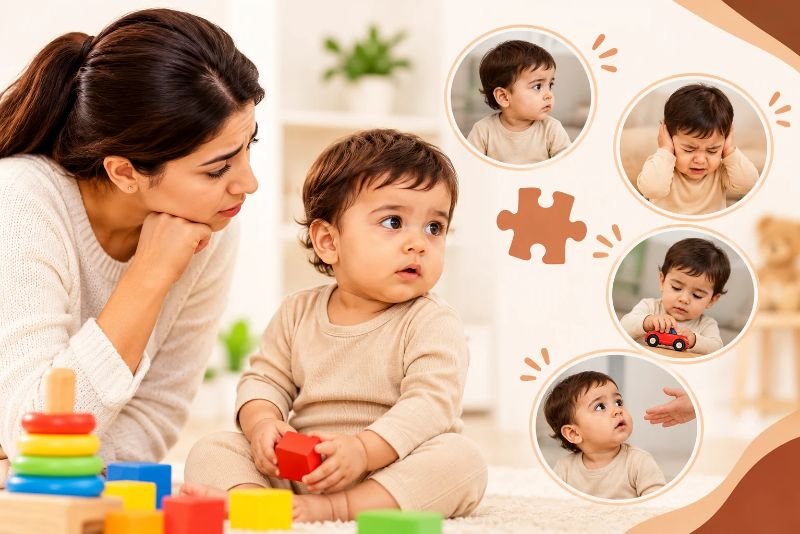
Some babies show differences as early as 2 to 6 months, but most signs become clearer between 9 and 24 months. Research suggests that babies who later receive an autism diagnosis may begin making less eye contact from around 2 months of age. These early differences are subtle and easy to miss.
Doctors usually hesitate to give a firm diagnosis before about 18 months, though some children are identified earlier. Not being diagnosed yet does not mean your concerns are wrong. You can act on concerns long before a formal diagnosis.
What Are the Signs of Autism in a 2 to 6 Month Old?
At this age, babies are learning to connect with people. Signs that may need a closer look include:
- Little or no eye contact when you feed, talk to, or play with them
- No social smile by around 2 to 3 months
- Few warm, happy expressions directed at you
- Not following your face or voice
- Seeming very stiff or very floppy
Babies vary a lot here. A sleepy or fussy baby may skip eye contact on a given day. What matters is whether the difference is consistent.
What Are the Signs of Autism in a 9 to 12 Month Old?
This is the age when many parents start noticing real gaps, because babies become more interactive. Watch for:
- No response when you call their name
- No babbling, or very little sound-making back and forth with you
- Not sharing sounds, smiles, or looks with you
- No gestures such as reaching up to be picked up, waving, or pointing
- Not looking at something when you point to it
A baby who rarely responds to their name should also have their hearing checked, since hearing loss can look similar. Your doctor can arrange this easily.
What Are the Signs of Autism in a 12 to 18 Month Old?
By now, communication is usually moving fast. Signs to discuss with your pediatrician include:
- Not saying any words, or no “mama” or “dada” used meaningfully
- Not pointing to show you something interesting
- Little interest in simple games like peek-a-boo
- Not copying your actions or sounds
- Playing with toys in a repetitive way, such as lining them up or spinning wheels, instead of using them as intended
- Strong reactions to sounds, textures, or lights
Is Losing a Skill a Warning Sign?
Yes. If your baby had a skill and then lost it, such as babbling, waving, or making eye contact, tell your doctor soon. This is called regression. It is one of the clearer red flags and should not be treated as a phase.
What Does Normal Baby Behavior Look Like?
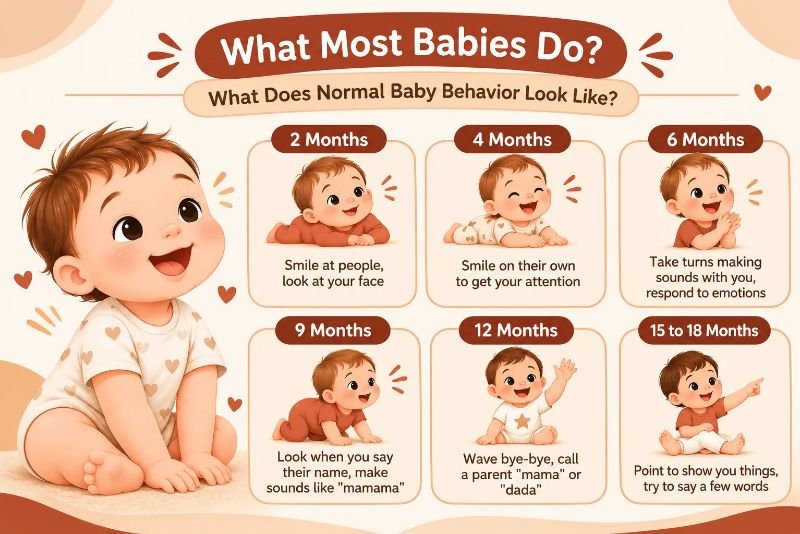
Most babies who skip a milestone are not autistic. Babies develop at their own pace, and premature babies often reach milestones later. Here is a rough guide to typical development:
| Age | What most babies do |
| 2 months | Smile at people, look at your face |
| 4 months | Smile on their own to get your attention |
| 6 months | Take turns making sounds with you, respond to emotions |
| 9 months | Look when you say their name, make sounds like “mamama” |
| 12 months | Wave bye-bye, call a parent “mama” or “dada” |
| 15 to 18 months | Point to show you things, try to say a few words |
The CDC publishes a full, free milestone checklist for every age from 2 months onward, and it is the most reliable reference to compare against: CDC Learn the Signs. Act Early. milestones. They also have a free Milestone Tracker app.
Are Repetitive Movements in Babies a Sign of Autism?
Not always. Hand flapping, rocking, or repeating movements (often called “stimming”) can be part of normal development in babies. It becomes more of a concern when it is intense, happens a lot, and comes with other signs such as limited eye contact or no response to name. One behavior alone tells you very little.
Does Having an Older Sibling With Autism Raise the Chances?
Yes. Autism tends to run in families, so babies with an autistic brother or sister are watched more closely. If this applies to you, mention it at every checkup and do not wait for a long list of signs before asking questions. Studies also show parents are quite good at spotting early differences, especially when they have seen them before.
What Should You Do If You Notice These Signs?
You do not need to wait and see. A simple path:
- Write down what you notice: Note the behavior, how often it happens, and your baby’s age. A short video on your phone helps a doctor a lot.
- Compare with the CDC milestones: Use the checklist for your baby’s exact age.
- Talk to your pediatrician: Share your notes and ask for a developmental screening. The American Academy of Pediatrics recommends autism-specific screening at 18 and 24 months, plus general developmental screening at regular visits.
- Ask about a hearing test: It rules out a common look-alike.
- Ask for an early intervention evaluation: In the US, you can request this yourself without a doctor’s referral. In India and other countries, ask your pediatrician about a child development center or a developmental pediatrician.
Why Does Early Support Matter?
The brain is very flexible in the first years of life. Early support helps children build communication, play, and social skills when learning is easiest. One 2021 study found that parent-led therapy for babies with early signs of autism reduced the chance of an autism diagnosis at age 3 by 66%. Support also helps your baby even if the final answer is not autism, because many of these skills are useful for every child.
What is the M-CHAT Screening Test?
The M-CHAT (Modified Checklist for Autism in Toddlers) is a short parent questionnaire used for children between 16 and 30 months. A high score does not mean your child is autistic. It means a closer evaluation is a good idea. Many pediatricians use it at the 18 and 24 month visits.
What Should You Avoid Doing?
- Do not panic over a single sign. Look for patterns.
- Do not compare your baby with a cousin’s or neighbor’s child. Use milestone checklists instead.
- Do not accept “they will grow out of it” if your concerns continue. Ask for a screening anyway. It costs little and tells you a lot.
- Do not blame yourself. Autism is not caused by anything a parent did or did not do.
Frequently Asked Questions
1. Can a 3-month-old baby show signs of autism?
Possibly, but it is hard to tell at this age. Reduced eye contact and few social smiles can be early hints, yet many typical babies also show these on some days.
2. How can I tell if my baby has autism or is just developing slowly?
Slow development usually shows delay across skills but steady progress. Autism more often involves differences in social connection, such as eye contact, response to name, and gestures.
3. Does not responding to their name mean my baby is autistic?
Not necessarily. Many babies ignore their name when focused on something else, and hearing problems can cause the same behavior.
4. What is the earliest age autism can be diagnosed?
Some specialists can diagnose autism reliably around 18 to 24 months, and occasionally earlier. Signs may be noticed from 6 months or sooner.
5. Is lack of eye contact always a sign of autism in babies?
No. Tired, sick, or distracted babies often look away. Eye contact usually begins around 2 months. Read More