
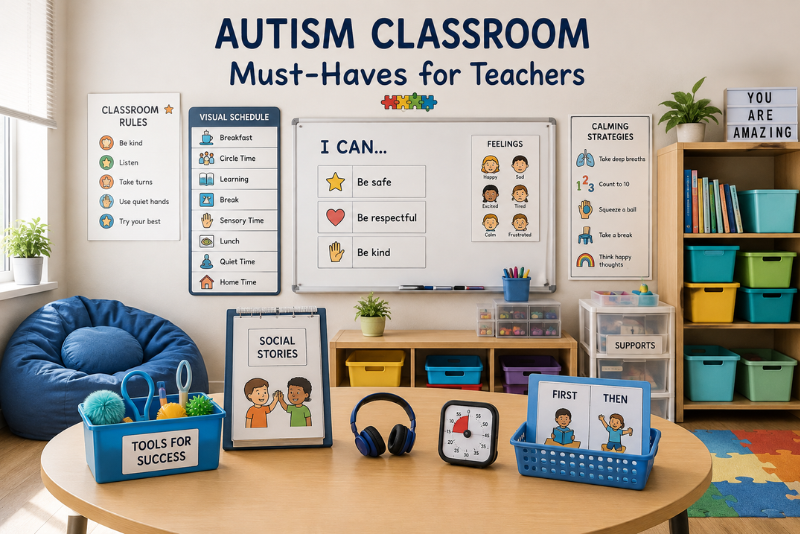
Setting up a classroom for autistic students can feel overwhelming, especially if it’s your first year or you’re starting from scratch. The good news: you don’t need an unlimited budget or years of experience to build a classroom that genuinely works. A handful of core tools, set up thoughtfully, can make daily routines smoother for both students and staff.
Here’s a practical rundown of what experienced special education teachers consistently point to as classroom essentials.
1. Visual Schedules
Visual schedules are widely considered the single most important tool in an autism classroom. Because many autistic students process visual information more easily than verbal instruction, a posted schedule (whether it’s a full-day layout or a simple picture sequence) helps students know what’s coming next and reduces anxiety around transitions.
A few practical tips:
- No single schedule format fits every student. Some students do best with picture-based schedules, others with written word schedules, and some need a mix of both. It’s worth differentiating by student rather than using one system for the whole class.
- Velcro is your friend. Making schedule pieces removable and re-attachable means you can adjust a student’s rotation without having to remake the entire schedule from scratch.
- Keep a few spares ready. Building 2 to 3 extra schedules at the start of the year saves scrambling if new students join after day one.
Beyond individual schedules, many classrooms also benefit from group schedules, check-in visuals (sometimes called “docking stations”), and mini-schedules for specific activities like circle time or transitions between subjects.
2. Flexible Seating Options
Comfort and choice matter more than they might seem. Many autistic students have specific sensory or postural needs, and a rigid one-seat-fits-all setup can make it harder for them to focus or stay regulated.
Common flexible seating options include:
- Rocking or scoop chairs
- Wobble chairs or wobble cushions
- Standard chairs paired with alternative seating for sensory breaks
Offering a few different seating choices, rather than assuming every student needs the same setup, tends to support better focus and comfort throughout the day.
3. Independent Work Systems
Autistic students can become dependent on adult prompting fairly quickly if independence isn’t built into the routine early. Structured, independent work systems (sometimes based on the TEACCH model) give students a clear, predictable way to complete tasks on their own, which also frees up staff time for small-group instruction.
Useful independent work station ideas include:
- Task boxes with clearly defined start and finish points
- File folder activities and matching tasks
- Leisure or “choice” centers for downtime
- Listening centers or simple learning apps
The clearer the visual boundaries of a task (a clear start, a clear end, and an obvious “what to do with it when I’m done”), the more successfully students can complete it independently.
4. Communication Systems and Supports
Every classroom needs a reliable way for all students, verbal and nonverbal alike, to communicate. This might include:
- AAC (Augmentative and Alternative Communication) boards or devices
- Core vocabulary boards to supplement a student’s individual communication system
- Visual supports that reinforce verbal instructions
Having classroom-wide communication supports in place (not just relying on each student’s individual system) helps fill in gaps and ensures every student has a way to express needs, choices, and ideas throughout the day.
5. Sensory Materials and Movement Tools
Sensory tools and movement breaks aren’t just “nice to have,” they’re often essential for helping students manage anxiety, regulate their bodies, and stay engaged in learning. Common options include:
- Fidget toys
- Mini trampolines or other safe movement equipment
- Weighted balls, lap pads, or vests (used according to any specific guidance from an OT)
- Designated calm-down or sensory break spaces
Building movement breaks into the daily schedule, rather than treating them as a last resort during a meltdown, tends to help students stay regulated throughout the day.
6. A Home-School Communication System
Many autistic students, especially those who are nonverbal or minimally verbal, aren’t able to tell their families much about their school day. A simple, consistent home-school communication system (like a daily check-off note or brief digital update) helps bridge that gap.
This doesn’t need to be a long, detailed report each day. A short checklist with room for a quick comment is often enough to build trust with families and catch small issues before they grow into bigger ones.
7. Differentiated Curriculum
Special education classrooms often include students at very different academic levels within the same room. A flexible, differentiated curriculum, one that allows the same general framework to be adjusted by skill level, is far more sustainable than trying to build entirely separate lesson plans from scratch for each student.
Look for curriculum resources that include built-in differentiation, embedded data tracking, and pre/post assessments, so you can actually measure progress over time rather than guessing.
8. Behavioral Supports
Positive, proactive behavioral supports help set students up for success rather than just reacting after something goes wrong. Common tools include:
- Visual classroom rules, posted clearly and simply
- Social stories explaining classroom routines and expectations
- Token boards or simple reinforcement systems tied to individual goals
The most effective behavioral supports tend to be visual, consistent, and tied to genuine positive reinforcement, not just consequences for difficult moments.
Getting Started Without Overwhelm
If you’re setting up a classroom from scratch, it’s tempting to try to do everything at once. Experienced teachers generally recommend prioritizing these categories in roughly this order:
- Visual schedules (day one essential)
- Independent work systems and communication supports
- Sensory tools and flexible seating
- Behavioral supports and home-school communication
- Curriculum, refined as you get to know your students
You don’t need every single tool perfected before the first day. Getting the basic structures in place, and adjusting as you learn each student’s individual needs, is a far more realistic goal than trying to build the “perfect” classroom from day one.
A Few Honest Reminders
- Every classroom, and every student, is different. These are common starting points, not a rigid checklist every classroom must follow exactly.
- Individualize wherever possible. A tool that works beautifully for one student may not suit another, adjust based on what you learn about each child.
- You don’t have to do this alone. Collaborating with occupational therapists, speech-language pathologists, and behavior specialists on your team can help you fine-tune these systems to your specific students’ needs.
This article draws on general classroom setup practices commonly shared by experienced special education teachers and consultants, reworded here for informational purposes. It isn’t a substitute for guidance from your school’s special education team or related service providers.