
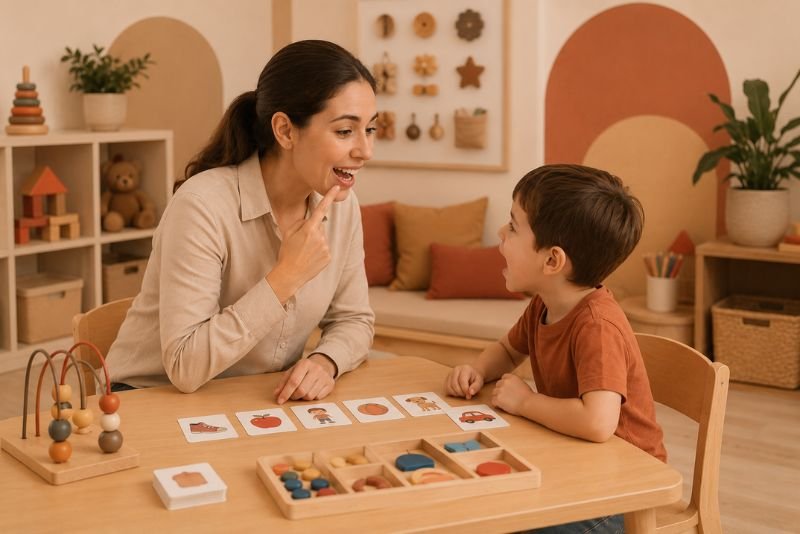
ABA therapy activities work best when they turn everyday moments snack time, playtime, story time, into chances to practice talking, listening, and connecting with others. Below you’ll find 20+ practical activities used to build communication and social skills, organized by the type of skill they target, along with tips on how to use them and when to loop in a qualified professional.
Why Communication & Social Skills Are Central to ABA
Applied Behavior Analysis, or ABA, is one of the most widely used approaches for helping children with autism and related developmental differences build practical, real-world skills. Two of the areas it focuses on most heavily are communication and social interaction because these skills touch nearly every part of a child’s day, from asking for a snack to playing with a classmate at recess.
A lot of the strategies behind ABA therapy activities aren’t complicated. They rely on modeling a behavior, giving a child a chance to try it, and reinforcing the attempt, whether that’s a word, a gesture, or a full sentence. Over time, small, repeated practice sessions like this can help a skill feel more natural in everyday settings, not just during a formal session.
Activities for Building Expressive Communication
Expressive communication is about helping a child share what they want, need, or feel whether through words, signs, gestures, or a communication device.
- Labeling objects during play. Naming toys, foods, or household items out loud as a child interacts with them helps build vocabulary naturally.
- Requesting with choices. Offering two options (“apple or banana?”) gives a low-pressure way to practice asking for something.
- Picture exchange or AAC practice. For children using picture cards or an AAC device, short practice rounds during snack or playtime keep the skill active.
- “I see…” games. Taking turns describing something in the room builds descriptive language in a playful way.
- Fill-in-the-blank songs. Pausing a familiar song for the child to supply the next word encourages verbal participation without pressure.
Read More: 25+ Autism Awareness Activities
Activities for Building Receptive Communication (Listening & Understanding)
Receptive skills are about understanding language and instructions, an area that often gets less attention than expressive language, but matters just as much.
- Simon Says. A classic for a reason, it reinforces listening to and following spoken directions.
- Two-step instructions. Asking a child to “pick up the ball, then bring it to me” builds sequencing and comprehension together.
- Following a visual schedule. Pointing to each step of a routine while naming it out loud connects spoken language to action.
- Matching games with verbal prompts. Asking a child to find “the red block” or “the biggest cup” ties listening skills to a hands-on task.
- Story time with pause-and-predict questions. Stopping mid-story to ask “what happens next?” checks understanding in a natural way.
Activities for Turn-Taking & Reciprocal Play
Turn-taking is one of the building blocks of both play and conversation and it’s a skill that tends to need a lot of repeated, low-stakes practice.
- Rolling a ball back and forth. Simple, but effective for teaching the rhythm of “my turn, your turn.”
- Board games. Games like Candy Land or a basic memory-matching game naturally require waiting and turn-taking.
- Building towers together. Alternating who adds the next block keeps a shared activity going while reinforcing patience.
- Passing an object during a group activity. Something as simple as passing a bean bag around a circle builds the same skill in a group setting.
Activities for Emotion Recognition & Empathy
Understanding emotions, both a child’s own and other people’s, is a foundational social skill that supports everything from conflict resolution to friendship-building.
- Emoji or emotion card sorting. Laying out cards face-down and having a child pick and name the emotion is a simple, repeatable warm-up.
- Mirror play. Making a facial expression and asking a child to copy it, then naming the feeling together, links expression to vocabulary.
- Social stories. Short, simple stories that walk through a scenario (like feeling frustrated when a game ends) help children connect language to feelings.
- “How do you think they feel?” during shows or books. Pausing during a favorite show or story to talk about a character’s feelings builds perspective-taking.
Activities for Conversation & Peer Interaction
Once foundational skills are in place, many ABA approaches shift toward practicing more natural back-and-forth interaction with peers.
- Role-playing common scenarios. Practicing how to ask to join a game, greet a classmate, or ask for help gives a child a script to fall back on in real situations.
- Structured playdates. A short, adult-guided playdate with one clear activity (like building a puzzle together) offers a manageable way to practice peer interaction.
- Peer-mediated play. Involving a sibling or classmate in a guided activity helps skills transfer from therapy settings to real relationships.
- Practicing conversation starters and endings. Simple prompts like “what’s your favorite game?” or “see you later!” give structure to the trickiest parts of small talk, starting and ending a conversation.
How to Choose the Right Activity for Your Child
There’s no single “right” activity, the best choice depends on what a child is currently working on and what naturally holds their interest. A few things to keep in mind:
- Match the activity to current goals. If a child’s team is focused on requesting, prioritize activities like choice-making and picture exchange over conversation practice.
- Follow their interests. An activity built around a favorite character or toy will almost always hold attention longer than a generic one.
- Keep sessions short. A few focused minutes, repeated often, tends to work better than one long, tiring session.
- Reinforce right away. Praise, a high-five, or access to a preferred item immediately after a good attempt helps the connection stick.
- Loop in the professionals. A BCBA (Board Certified Behavior Analyst) or ABA therapist can help tailor these ideas to a child’s specific treatment plan and track what’s actually working.
FAQ’s
1. What are ABA therapy activities?
ABA therapy activities are structured or play-based exercises used to teach and reinforce specific skills like communication, social interaction, and daily living tasks using principles of positive reinforcement and repetition.
2. Can ABA therapy activities be done at home?
Many ABA-style activities, like turn-taking games or visual schedules, can be practiced at home to support skills a child is already working on. It’s best to coordinate with your child’s therapist so home practice lines up with their treatment goals.
3. How do ABA activities help with social skills specifically?
They break social interaction into smaller, practiceable pieces like turn-taking, greeting someone, or reading facial expressions so a child can build confidence in low-pressure settings before using the skill in real life.
4. Do you need special materials for ABA therapy activities?
No. Many effective activities use everyday items already at home, like blocks, picture books, emoji printouts, or household objects for sorting and labeling.
5. Is this article a substitute for professional ABA therapy?
No. This content is meant to inform and provide ideas, it isn’t a diagnosis, treatment plan, or substitute for guidance from a licensed behavior analyst or healthcare provider.
Note: This article is provided for general informational purposes only. It is not medical or clinical advice, and it does not replace an evaluation, diagnosis, or treatment plan from a licensed healthcare provider or behavior analyst. Every child’s needs are different — please consult a qualified professional before starting or adjusting any therapy program.