
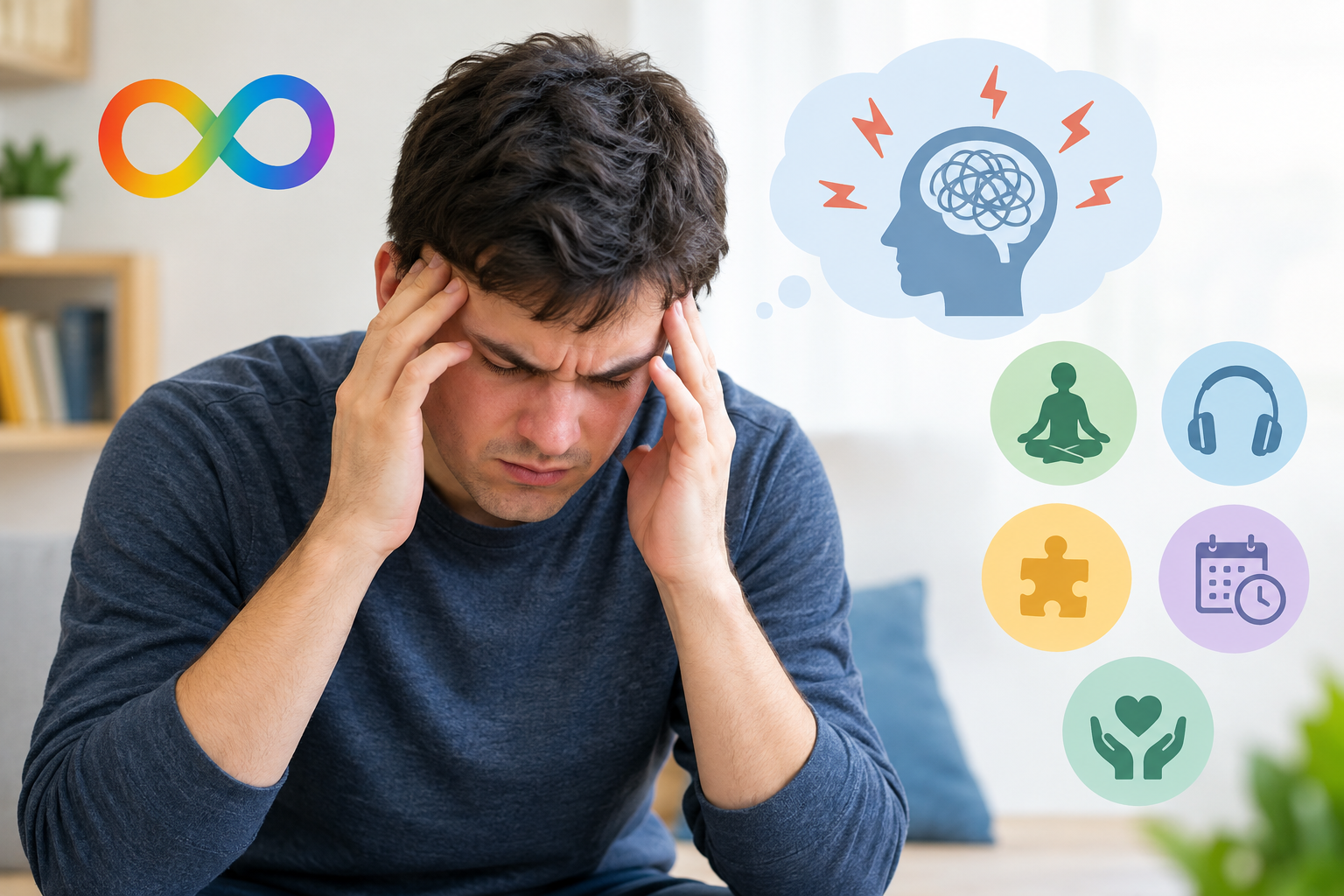
If you’ve watched someone you love go from calm to completely overwhelmed in what feels like seconds, or if that someone is you, this article is for the actual problem, not the stereotype. Autism and anger get lumped together in a lot of unhelpful ways online. Let’s talk about what’s actually happening, why it happens, and what genuinely helps.
It’s rarely “just anger”
Here’s the thing that gets missed constantly: what looks like anger in an autistic adult is often something else wearing anger’s face. It’s frequently the end result of overwhelm, not an emotional reaction in the way most people experience anger.
A lot of autistic adults experience something called alexithymia, which is difficulty identifying and naming their own emotions in the moment. Someone might be anxious, overstimulated, exhausted, or in physical discomfort, and the only signal that reaches the surface is irritability or anger, because the more specific feeling never got clearly recognized along the way. That’s not someone being difficult. That’s a real difference in how emotional information gets processed.
Understanding this distinction matters because it changes the entire approach. You don’t manage “anger” the same way you manage overwhelm, and treating the two as identical tends to make things worse, not better.
What actually triggers it
A few patterns show up again and again in autistic adults dealing with frequent anger or meltdowns.
Sensory overload. Bright lights, loud or layered background noise, crowded spaces, certain textures can build up over a day without the person even fully registering it’s happening until the accumulated load finally spills over. It often looks sudden from the outside. It rarely is.
Masking burnout. A lot of autistic adults spend enormous energy suppressing or disguising their natural responses to get through work, social situations, or daily life. That effort runs up a kind of debt, and anger is frequently what shows up when that debt finally gets called in, usually at home, with the people who feel safest, which is exactly why partners and family often see it the most.
Communication breakdowns. When it’s hard to express a need clearly, or when someone else keeps misreading what’s actually being communicated, frustration builds fast. This is especially common when an autistic adult feels unheard or when a conversation keeps going sideways despite real effort to be clear.
Disrupted routines or unexpected change. Predictability isn’t a preference for a lot of autistic adults; it’s a genuine regulating force. A sudden schedule change, a canceled plan, or an unexpected transition can trigger real distress that looks disproportionate to whatever just happened, because the change itself, not the specific event, is what’s hard.
Feeling dismissed or misunderstood. Years of being told to “just calm down,” having real sensory or communication struggles brushed off as overreacting, or masking to the point that nobody around you realizes how much effort things take, builds up its own kind of resentment and exhaustion over time.
Strategies that actually help
Build a trigger map, not a guess. Rather than waiting for the next outburst to analyze afterward, start tracking specific patterns: what was happening right before, what the environment was like, and how much sleep or downtime came before it. Over a few weeks, real patterns tend to show up, and they’re often more specific and more manageable than “I just get angry sometimes.”
Create an exit plan before you need one. Having a clear, agreed-upon way to step away from an overwhelming situation, without it being treated as rude or a failure, removes a lot of pressure. This might be as simple as a specific phrase that means “I need five minutes alone,” decided on in advance, during a calm moment, not negotiated in the middle of a meltdown.
Address the sensory load directly. If noise, light, or crowding are recurring triggers, build in deliberate recovery time: noise-reducing headphones, a quiet space to retreat to, sunglasses indoors if lighting is harsh, and scheduled downtime after high-stimulation events rather than back-to-back commitments.
Name the feeling out loud, even imperfectly. For someone working through alexithymia, practicing naming emotions, even roughly, even with help from a partner or therapist asking, “Does this feel more like frustration, or more like exhaustion?” can slowly build the skill of catching overwhelm earlier, before it turns into anger.
Reduce the total daily load where you can. A lot of anger episodes aren’t really about the triggering moment; they’re about everything that built up before it. Looking honestly at a week’s schedule and finding where recovery time is missing, not just where triggers are, often does more than trying to manage any single difficult moment.
Get support that’s actually built for this, not generic anger management. Standard anger management programs are often designed around assumptions that don’t fit autistic experiences well, like assuming the anger stems from poor impulse control rather than sensory and communication overload. A therapist with real experience in autism, ideally someone trained in approaches adapted specifically for autistic adults, tends to get much further than a generic program.
For partners, family, and friends
If you’re the person on the receiving end of someone else’s anger, a few things are worth knowing. The anger you’re seeing is very often the visible tip of exhaustion, overwhelm, or sensory overload that built up long before it reached you, not a reflection of how they feel about you specifically. That doesn’t mean you have to simply absorb it without boundaries; you’re allowed to set limits on how you’re treated, even while understanding where it’s coming from.
It helps enormously to work together, during calm periods, on a plan for what support actually looks like in the moment, rather than improvising during the hardest moments. And if you’re consistently walking on eggshells or feeling unsafe, that’s worth addressing directly and honestly, ideally with a couples or family therapist who understands autism specifically, rather than assuming it will resolve on its own.
When to seek professional support
It’s worth reaching out to a professional, ideally one experienced with autistic adults specifically, if anger is happening frequently enough to affect relationships or work, if it’s escalating in intensity over time, if there’s any risk of harm to yourself or someone else, or if you simply feel like you’ve lost a sense of control over your own reactions and don’t know where to start untangling it.
This isn’t a sign of failure. Emotional regulation support exists because this is a genuinely hard, common experience, not a rare or shameful one.
Frequently Asked Questions
Is anger a common symptom of autism in adults?
Anger itself isn’t a core diagnostic feature of autism, but difficulty with emotional regulation, often linked to sensory overload, communication challenges, or alexithymia, is common and can show up as anger or irritability.
What is alexithymia, and how does it relate to autism anger?
Alexithymia is difficulty identifying and describing one’s own emotions. It’s common among autistic adults and can mean that more specific feelings, like anxiety or exhaustion, surface as anger instead, since the underlying emotion was never clearly recognized.
Can autistic adults learn to manage anger better over time?
Yes. With the right strategies, like trigger tracking, sensory accommodations, and therapy adapted specifically for autistic adults, many people see real improvement in how often and how intensely anger builds up.
Is it normal for autistic adults to feel more angry at home than anywhere else?
Yes, this is extremely common and is often linked to masking burnout. A lot of energy goes into appearing composed in public or at work, and home is often where that effort finally gets to stop, which can mean emotional reactions show up there instead.
If anger ever comes with thoughts of harming yourself or someone else, please reach out for support right away. In the US, you can call or text 988 for the Suicide & Crisis Lifeline, available 24/7.
Disclaimer: This article is written from an informational perspective to help autistic adults and their families better understand emotional regulation challenges related to autism, including anger, sensory overload, and alexithymia. It draws on established clinical concepts widely discussed in autism research and therapeutic literature. This content is not medical or psychological advice and should not be used as a substitute for individualized care. If anger, emotional regulation, or related distress is significantly affecting your life or relationships, please consult a licensed therapist or healthcare professional experienced in supporting autistic adults.