
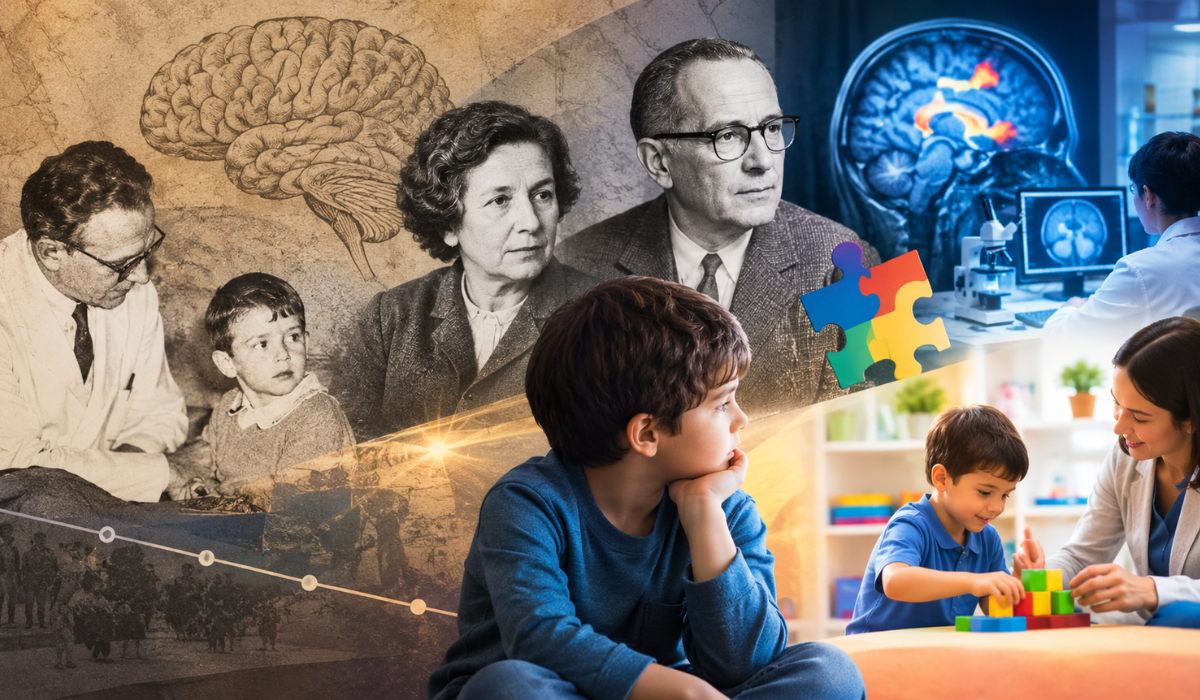
If you’re wondering when autism was first identified, the short answer is 1943. That year, a doctor in the United States wrote the first widely recognised medical description of autism. But the full story is longer and more interesting than a single date. Autistic people have always existed. What changed over time was how doctors named, studied, and understood autism.
This article walks through that history step by step, from early descriptions of unusual behaviour to today’s research.
The Short Answer: When Was Autism Discovered?
Autism was first described as its own condition in 1943 by Leo Kanner, a child psychiatrist at Johns Hopkins Hospital in Baltimore. A year later, in 1944, Hans Asperger, a doctor in Vienna, published a similar description of children he worked with.
Neither man “invented” autism. They noticed a pattern that had existed for a very long time and gave it careful medical attention.
Early Signs of Autism in History
Long before the word “autism” existed, people wrote about individuals who behaved in ways that sound familiar to us today.
One often-cited example is Hugh Blair of Borgue, a Scottish man whose mental abilities were questioned in a 1747 court case. Witnesses described a person who followed strict routines, struggled with social understanding, and had unusual ways of speaking. Historians who have studied the case believe he may have been autistic.
Another well-known case is Victor of Aveyron, a boy found living alone in the forests of France in 1797. A young doctor named Jean Marc Itard worked with him for years. Victor did not speak and showed little interest in people. Some researchers today think his traits resemble autism, though no one can say for sure.
There were also many people in villages and families who were simply described as “odd”, “shy”, or “different”. Without a medical name, they were often misunderstood, hidden away, or placed in institutions.
Where the Word “Autism” Came From
The word itself was created by a Swiss psychiatrist named Eugen Bleuler. Around 1908 to 1911, he used the term “autism” to describe a symptom he saw in adults with schizophrenia. He derived the term from the Greek word “autos”, meaning “self”. For Bleuler, it described a person who withdrew from the outside world and lived in their inner world.
This is an important point. Bleuler’s meaning was very different from how we use the word now. Autism was not yet a condition on its own. It was only a description of withdrawal.
The 1920s: An Overlooked Description
In 1925, a Soviet child psychiatrist named Grunya Sukhareva described a group of children with strong interests, difficulty with social contact, sensitivity to sound and touch, and unusual behavioural patterns. Her work was written in Russian and did not reach doctors in other countries for many years. The English translation was published in 1996.
Her case shows that doctors in more than one country were noticing the same pattern at about the same time, even though they did not know about each other’s work.
1943: Leo Kanner Describes Autism
In 1943, Leo Kanner published a paper called “Autistic Disturbances of Affective Contact”. He described 11 children he had met in his clinic. Although they were all different, he noticed some shared traits:
- Difficulty connecting with other people
- Delayed or unusual speech
- A strong need for sameness and routine
- Deep focus on certain objects or topics
- Strong reactions to sounds, textures, or changes
Kanner chose the word “autism” because the children seemed absorbed in their own world. He believed the condition was present from birth. This is the moment most historians point to when they answer, “When was autism discovered?”
1944: Hans Asperger and “Autistic Psychopathy”
While Kanner was working in the United States, Hans Asperger was studying children in Vienna. In 1944, he wrote a paper describing boys who had good language skills and strong interests but struggled with social situations and often seemed awkward in how they moved and spoke.
Because Asperger wrote in German during World War II, his work was not widely read in the English-speaking world for decades. Later, in the 1980s and 1990s, it became well known and led to the diagnosis called Asperger’s syndrome.
It is also worth knowing that in 2018, historians including Herwig Czech and Edith Sheffer published research on Asperger’s career under the Nazi government in Austria. Their findings raised serious questions about his role in the system at that time. Autism history is not only about science. It also includes difficult chapters about how people with disabilities were treated.
The 1950s and 1960s: Wrong Ideas About the Causes
For many years after Kanner’s paper, autism was poorly understood. In the 1950s and 1960s, many doctors blamed parents, especially mothers. This explanation became known as the “refrigerator mother” theory. It claimed that cold parenting caused autism. Psychologist Bruno Bettelheim helped spread this belief.
This theory was wrong, and it caused a great deal of guilt and pain for families.
In 1964, psychologist Bernard Rimland, who was himself the father of an autistic son, published a book called Infantile Autism. He argued that autism had biological causes, not parenting causes. His work changed the direction of research. In 1965, the Autism Society of America was founded, partly to support families and push for better understanding.
The 1970s: Science Points to Biology
Research began to show that autism was a developmental condition linked to the brain. British psychiatrist Michael Rutter helped show that autism was different from childhood psychosis. In 1977, a twin study by Susan Folstein and Michael Rutter found that identical twins were far more likely to both be autistic than non-identical twins. This was strong evidence that genes play a major role.
Around the same time, researchers Lorna Wing and Judith Gould studied children in London and found that autistic traits appeared in many different forms. This led to the idea of a “spectrum.” In 1981, Wing wrote about Asperger’s work in English and brought the term “Asperger’s syndrome” into wider use.
The 1980s and 1990s: Official Recognition
Autism became an official diagnosis in 1980, when the third edition of the DSM (the manual American doctors use to diagnose conditions) listed “infantile autism” as its own category. Before that, children were often given other labels.
In 1987, the manual updated the term to “autistic disorder”, and in 1994, the fourth edition added Asperger’s disorder and other related diagnoses. In the United States, a 1990 law also named autism as a category for special education services, which gave many children access to school support.
Other events shaped this period:
- 1986: Temple Grandin published Emergence: Labelled Autistic, one of the first books by an autistic person describing her own experience.
- 1988: The film Rain Man made autism more visible to the public, though it also created narrow stereotypes.
- 1998: A research paper claimed a link between vaccines and autism. It was later found to be seriously flawed and was retracted in 2010. Many large studies since then have found no connection.
- Late 1990s: Sociologist Judy Singer introduced the word “neurodiversity”, the idea that brain differences are a natural part of human variety.
2013: One Spectrum
In 2013, the fifth edition of the DSM combined autistic disorder, Asperger’s disorder, and related diagnoses into a single label: autism spectrum disorder, or ASD. The change reflected research showing that these were not separate conditions but different points on one spectrum. Doctors now describe the level of support a person needs rather than placing them in separate boxes.
The World Health Organization’s ICD-11 manual uses a similar approach.
Autism Research Today
Autism diagnosis has grown a lot over the past few decades. According to the CDC in the United States, about 1 in 150 children aged eight were identified with autism in the 2000 data. In the 2022 data, reported in 2025, the figure was about 1 in 31. Experts say much of this rise comes from wider diagnostic definitions, more awareness, and better screening, especially among girls, women, and people who were missed in the past.
Current research looks at many areas:
- Genetics: Researchers have identified hundreds of genes associated with autism.
- Early development: Studies look at brain growth and early signs in infancy.
- Late diagnosis: More adults are learning they are autistic.
- Support and quality of life: Researchers are paying more attention to what autistic people themselves say they need.
Quick Timeline of Autism History
| Year | Event |
| 1747 | Hugh Blair of Borgue’s court case in Scotland |
| 1797–1800 | Victor of Aveyron found and studied |
| 1908–1911 | Eugen Bleuler uses the word “autism”. |
| 1925 | Grunya Sukhareva describes autistic traits in children |
| 1943 | Leo Kanner publishes his paper on 11 children. |
| 1944 | Hans Asperger describes similar children in Vienna. |
| 1964 | Bernard Rimland challenges the “refrigerator mother” idea. |
| 1977 | A twin study shows genes play a major role |
| 1980 | Autism appears in the DSM-III. |
| 1994 | Asperger’s disorder was added to the DSM-IV. |
| 2013 | DSM-5 creates autism spectrum disorder |
Final Thoughts
So, when was autism discovered? Most sources date it to 1943, when Leo Kanner described it in medical writing, with Hans Asperger’s 1944 work running alongside. But autism itself is not new. Autistic people have lived in every era. What has changed is our ability to recognise autism and, in many ways, to listen to autistic people. The history of autism research includes real progress but also mistakes that hurt families. Learning about autism’s history highlights the importance of sharing accurate and respectful information today.
Frequently Asked Questions
When was autism first discovered?
Autism was first described as a distinct condition in 1943 by American psychiatrist Leo Kanner. Hans Asperger described similar traits in Vienna in 1944. However, people with autistic traits lived long before that, and earlier writers had described similar behaviours without using the word autism.
Who coined the term autism?
Swiss psychiatrist Eugen Bleuler introduced the word “autism” around 1908 to 1911. He used it to describe a symptom of schizophrenia, where a person withdraws into their own inner world. The meaning changed later, when Kanner and Asperger used the word for a separate childhood condition.
Is Asperger’s syndrome still diagnosed?
Not exactly. Asperger’s syndrome was once a separate diagnosis for people with autistic traits but typically fewer language delays. In 2013, the DSM-5 merged it, along with other labels, into one diagnosis called autism spectrum disorder. Some people still use the term Asperger’s for themselves.
Are autism diagnoses more frequent now than they were in previous decades?
Diagnosis rates have risen sharply. The CDC reported about 1 in 150 children in 2000 data and about 1 in 31 in 2022 data. Experts link much of this rise to broader diagnostic criteria, better awareness, and improved screening, though research continues on other possible contributing factors.
Do vaccines cause autism?
No. Large studies involving millions of children have found no link between vaccines and autism. The 1998 paper that suggested a link was retracted in 2010 after serious ethical and scientific problems were found. Research points mainly to genetic and early developmental factors.
Is autism a new condition?
No. Autism is not new; it was simply not named until the 20th century. Historical records describe people with similar traits going back centuries. What changed was medical understanding, language, diagnosis, and public awareness, not the existence of autistic people.
Pingback: How Does the ASD Evaluation Process Work?