

No, ABA therapy is not only for autistic children. It is used most often for autism in childhood, but teenagers, adults, and people with other developmental needs can also use ABA-based support.
Why people think ABA is only for autistic children
Most ABA you hear about comes from autism clinics and early intervention programs. Parents get an autism diagnosis, and ABA is one of the first therapies mentioned. Insurance rules and school programs also tend to attach ABA to autism. So the link feels exclusive, even though the method itself is broader.
What ABA therapy actually is
ABA is built on one idea: behavior is shaped by its surroundings. If a behavior leads to something good, it is more likely to happen again. A therapist watches what comes before a behavior, what happens after it and uses that to teach a better way.
The CDC describes ABA as encouraging desired behaviors and discouraging undesired ones to improve a variety of skills, with progress tracked and measured. In practice, a session might involve:
- Breaking a skill (like brushing teeth) into small steps
- Rewarding each step the person completes
- Practicing in real settings such as home, school, or the community
- Reviewing data and changing the plan when something isn’t working
Nothing in this process depends on a person’s age or on autism specifically. That is why ABA principles show up in classrooms, workplaces, and animal training too.
Is ABA therapy only for children?
No. Children get most of the attention because early support matters. The CDC says early intervention can greatly improve a child’s development, but that help at any age can be useful.
Here is how ABA changes with age:
- Young children: Play-based learning, early communication, imitation, and daily routines.
- School-age children and teenagers: Social skills, classroom behavior, self-care, and handling frustration.
- Adults: Life skills like cooking, money handling, travel, and workplace habits. Therapists may also support people who need help with safety or daily routines.
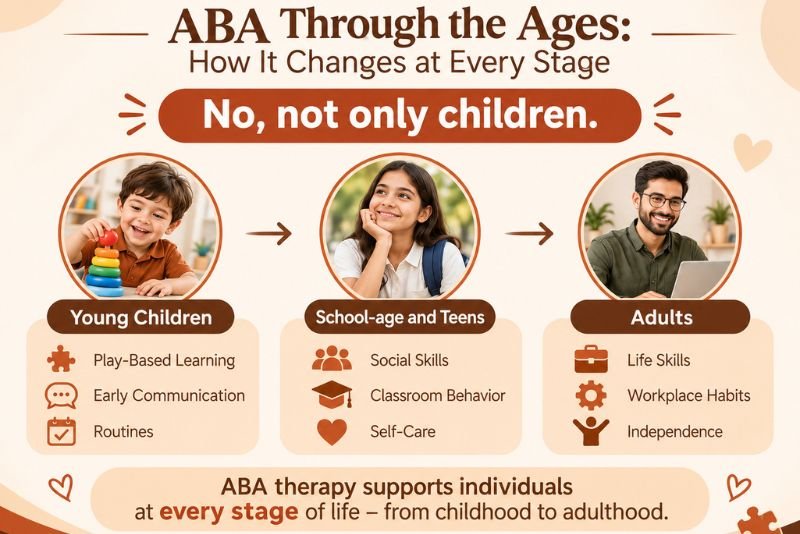
An adult program should look very different from a toddler program. It should be built around the person’s own goals, not a child’s curriculum. If a provider offers the same approach to a 25-year-old as to a 4-year-old, that’s a red flag.
Is ABA therapy only for autism?
No, but this part needs honesty. ABA grew up in autism research, and that’s where the evidence is strongest. The CDC notes that behavioral approaches have the most evidence for treating autism symptoms.
Outside autism, ABA-based methods are used for:
- Developmental delays and intellectual disabilities, to teach daily living and communication skills
- Conditions like Down syndrome or cerebral palsy, to build skills such as self-care and independence
- Severe problem behaviors, like self-injury, when they have a clear cause that can be addressed
- Schools and workplaces, to build routines, track progress, and encourage consistent habits
Some provider websites also say ABA helps with ADHD or anxiety. Treat those claims carefully. Many of these pages are written by clinics that sell ABA services, and the research for ADHD and anxiety is much thinner than for autism. For those conditions, other approaches such as CBT, parent training, or medication (where a doctor recommends it) are usually the first-line options. ABA-style strategies may be added as support, not as the main treatment.
Who ABA is mainly designed for
ABA is most often recommended for people who:
- Have an autism diagnosis and need help with communication, daily skills, or behavior
- Have a developmental delay that affects learning or independence
- Show behaviors that are unsafe or get in the way of daily life, and need someone to work out why
It is not a good fit for someone who doesn’t need skill-building or behavior support. Autism alone doesn’t mean a person needs ABA. Plenty of autistic people do well with speech therapy, occupational therapy, or no formal therapy at all.
The criticism you should know about
Many autistic adults have spoken out against ABA, and their concerns deserve a fair hearing. The main complaints are:
- Older ABA put heavy focus on compliance and on hiding autistic traits, which some say caused stress and harm
- Some programs have used long hours of therapy with little attention to the child’s comfort
- Goals sometimes target “looking typical” instead of helping the person live well
Modern ABA providers say their methods have changed, with more focus on consent, choice, and the person’s own goals. Quality varies a lot between providers. That’s the practical lesson: the question isn’t only “should we do ABA?” but “what kind of ABA, and with whom?”
How to decide if ABA is right
Before starting, ask these questions:
- What exactly are the goals? They should be about real-life skills and wellbeing, not just reducing behaviors.
- Who set the goals? The person (or family) should have a say, and goals should be reviewed regularly.
- How many hours a week? More is not always better. The plan should fit the person’s needs and energy.
- Is the therapist qualified? Look for a Board Certified Behavior Analyst (BCBA) overseeing the plan.
- What happens if the person says no or is distressed? A good provider has a clear, respectful answer.
- Are other supports included? Speech and occupational therapy often work alongside ABA.
If a provider can’t answer these clearly, keep looking.
Conclusion
ABA therapy is not limited to autistic children. It can be adapted for teens, adults, and people with other developmental needs, but the strongest evidence is still in autism. The best approach is to match the therapy to the person, look closely at how a provider works, and listen to the person receiving support.
For more on how ABA fits among other autism approaches, see the CDC’s overview of autism treatment. To check a therapist’s credentials, use the Behavior Analyst Certification Board. For family-focused guidance, Autism Speaks has a resource library.
Frequently Asked Questions
1. Can adults get ABA therapy?
Yes. ABA has no age limit. Adult programs focus on life skills, workplace behavior, and independence. They should be built around the adult’s own goals, not a child’s plan.
2. Is ABA therapy only for people with autism?
No. It’s also used for developmental delays, intellectual disabilities, and some severe problem behaviors. The research is strongest for autism, so evidence for other conditions is more limited.
3. Is ABA therapy good for ADHD or anxiety?
It isn’t the usual first choice. ABA strategies may help with routines and habits, but CBT, parent training, and medication (when a doctor recommends it) have more research for these conditions. Talk to a clinician before starting.
4. At what age should ABA therapy start?
There’s no single right age. For autistic children, earlier support is often encouraged, but help at any age can be useful. A professional evaluation can say what fits your child.
5. Does an autism diagnosis mean my child needs ABA?
No. Some autistic children benefit from ABA, while others do better with speech therapy, occupational therapy, or school support. Needs vary a lot from person to person.