

Many autistic children want friends but find it hard to read cues, join a game, or know what to say next. A one-to-one therapy room can teach these skills, but it does not feel like a playground. Group therapy closes that gap. This article explains how it works, what research says, and how parents can help.
What is Group Therapy for Autism?
Group therapy for autism is a small, structured program where children of similar age and ability meet weekly to learn and practice social skills. Researchers call it a group-based social skills intervention (GSSI). A meta-analysis on PubMed Central describes it as the most widely used approach for school-age children and teens on the spectrum.
Psychologists, speech-language pathologists, occupational therapists or behavior analysts usually lead the group. Most programs run about 8 to 18 weeks, with weekly sessions of 60 to 90 minutes.
How Group Therapy Builds Social Skills
- Practice with real peers: A therapist can model a greeting, but only another child answers in an unpredictable way. Groups give children live practice with peers, plus chances to learn by watching others.
- Skills taught in small steps: Many programs use four steps: show the skill, role-play it, give feedback, then practice it outside the group.
- Role-play, games and visual aids: Programs often use role-play, video clips, prompt cards, games and homework tasks.
- Emotion and body-language lessons: Children learn to name feelings, read faces and notice tone of voice, starting with simple emotions and building up.
- Less isolation: In one clinic study, children reported feeling more support from classmates at school after finishing the group.
What a Typical Session Looks Like
Programs differ, but many follow a similar flow. The KONTAKT program, for example, uses these parts:
- Opening round to welcome everyone
- Review of last week’s practice task
- Themed discussion, such as small talk or turn-taking
- Group activity, such as role-play or social games
- A new “mission” to practice outside the group
- Closing round
Skills Children Commonly Work On
- Greeting others and starting a conversation
- Taking turns and sharing
- Joining a game already in progress
- Reading facial expressions and tone
- Handling losing or disagreements
- Asking for help and listening to others
When a Group May Help
A group may be worth considering if your child:
- Wants to connect but struggles to join play or start talking
- Has trouble with turn-taking, sharing or losing
- Misses cues like tone of voice or facial expressions
- Spends most break times alone
A specialist can confirm whether your child is ready, since groups work best when a child can take part in small-group activities with support.
What Does the Research Say?
The evidence is positive but measured:
- Overall: A major meta-analysis found these groups modestly effective, but the gains may not carry over to school settings or to what children report about themselves.
- School-age children: A randomized trial of 122 children aged 9 to 13 found small but significant benefits after 15 sessions. Six months later, results had neither improved nor faded.
- Teens: A 2022 review found moderate-certainty evidence for better social responsiveness, social skills and social knowledge, but low certainty for more real-world social participation.
- Who is studied: Many studies include verbal children without intellectual disability, so less is known about other children.
The takeaway: group therapy is a useful tool, not a cure. It works best as one part of wider support.
Why Skills Don’t Always Carry Over
A skill learned in a clinic can stay in the clinic. In one early study, children improved at greetings and play, but conversation gains were less clear and fewer changes showed up outside the clinic. Experts also note that weekly therapy does little without daily practice in everyday settings.
That is why strong programs involve parents. The Cleveland Clinic’s Social Spies program, for example, runs parent sessions alongside the children’s sessions and shares tips with teachers.
What parents can do:
- Ask the therapist which skill is the focus each week.
- Role-play it at home in short, low-pressure scenes.
- Set up small playdates with one friendly, understanding peer, as ASAT’s parent-led program guide suggests.
- Practice with different people and in different places, not only one.
- Praise effort, not only success.
- Share the skill with your child’s teacher.
Group Therapy vs. Individual Therapy
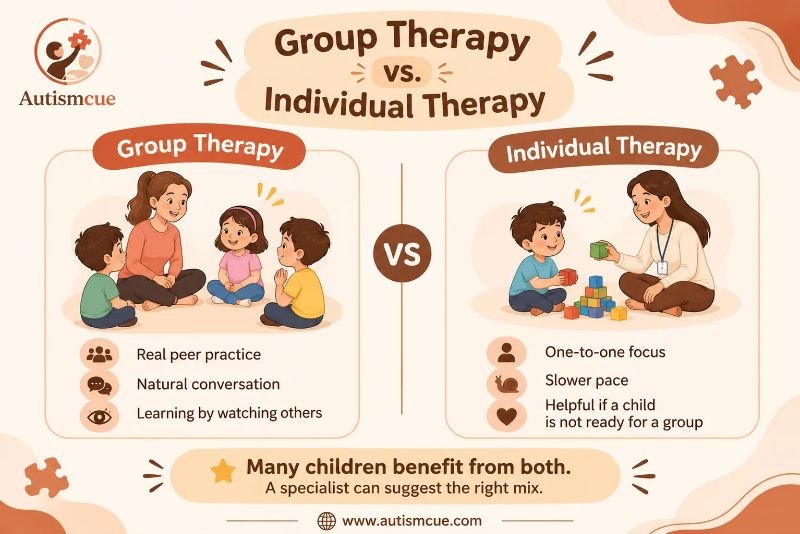
- Group: real peer practice, natural conversation, learning by watching others.
- Individual: one-to-one focus, slower pace, helpful if a child is not ready for a group.
Many children benefit from both. A specialist can suggest the right mix.
How to Choose a Good Group
Look for:
- Children grouped by age and ability
- A leader trained in autism
- Clear goals and a weekly structure
- Parent involvement and home tasks
- Practice in real settings, such as outings or school
- Respect for who your child is: the aim is to give tools, not to hide autistic traits
- Regular progress updates for you
Conclusion
Group therapy gives autistic children what a one-to-one session cannot: live practice with peers in a supported space. The gains are modest, and they grow when practice continues at home and school. Pick a structured group, stay involved, and measure progress by real moments, like your child joining a game or starting a chat.
Frequently Asked Questions
Can group therapy help autistic children make friends?
It can build the skills friendship needs, such as starting a chat, taking turns and joining play. Research shows modest gains in social skills, but friendships grow mainly through ongoing practice outside the group.
What age is best to start a social skills group?
Most research covers school-age children and teens, roughly 8 to 15 years, so the evidence is strongest there. Younger children may join play-based groups. A specialist can match the group to your child’s development, not only age.
How long does group therapy take to work?
Most programs run about 8 to 18 weeks, and research shows modest gains by the end. Lasting change depends on daily practice at home and school after the program.
Is group therapy better than individual therapy for autism?
Neither is better for every child. Group therapy gives real peer practice, while individual therapy offers one-to-one focus. Many children do best with a mix, and a specialist can advise based on your child’s needs.
What if my child feels overwhelmed in a group?
Tell the therapist early. A good program can start with smaller groups, shorter sessions, predictable routines and breaks. If a group is still too much, individual sessions first can build comfort.
Pingback: 10 Signs of High Functioning Autism in 6 Year Old Boy