
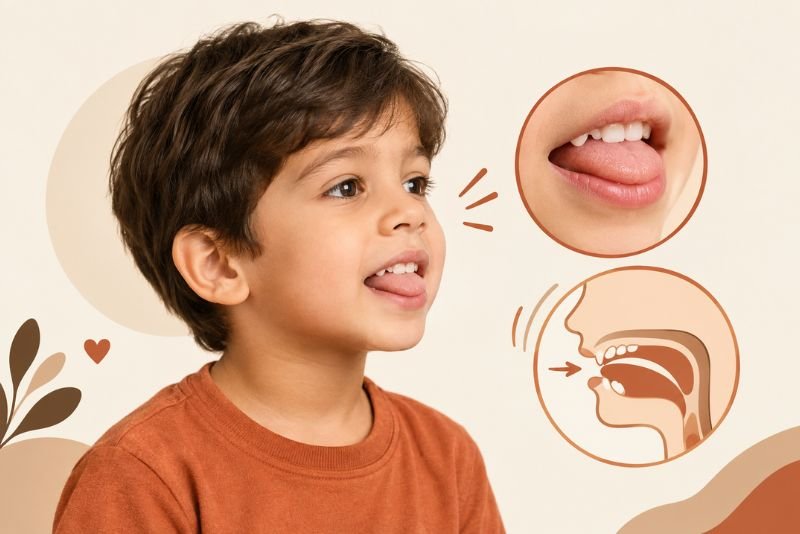
Tongue thrust is not considered a standalone sign of autism. It is a pattern involving the position and movement of the tongue during swallowing or at rest, and it can have several possible causes. Some autistic children may also have oral-motor or feeding differences, but tongue thrust alone does not point to autism. Here’s how to understand the connection.
What is Tongue Thrust?
Tongue thrust, sometimes called a tongue-thrust swallow, describes a swallowing or resting pattern in which the tongue moves too far forward, sometimes between the upper and lower front teeth.
Babies naturally use forward tongue movements when swallowing. As children grow, their swallowing pattern generally becomes more mature. However, some children continue to push the tongue forward when swallowing, speaking, eating, or even when the mouth is at rest.
Tongue thrust is considered an orofacial myofunctional pattern when it occurs as part of broader difficulties involving the muscles and functions of the mouth, face, and jaw.
It does not automatically mean that something is seriously wrong.
In some children, it may have little noticeable effect. In others, it can occur alongside speech, feeding, swallowing, or dental concerns.
Is Tongue Thrust a Sign of Autism?
No. Tongue thrust is not considered a standalone sign or diagnostic feature of autism.
Autism spectrum disorder is a neurodevelopmental condition involving differences in social communication and interaction, along with restricted or repetitive patterns of behaviour, interests, or activities.
Tongue thrust does not establish that a child meets those criteria.
However, there can be some overlap. Research and clinical literature describe oral-motor, feeding, swallowing, and oral-habit differences in some autistic children. These may include tongue thrust, drooling, mouth breathing, chewing difficulties, and other oral behaviours.
That is an important distinction:
Tongue thrust may occur in some autistic children, but having a tongue thrust does not mean a child is autistic.
A child who has tongue thrust but does not show other developmental characteristics associated with autism should not be assumed to have autism based on this behaviour alone.
Why Might a Child Have Tongue Thrust?
There is no single cause of tongue thrust. Several factors can contribute to the way a child’s tongue, lips, jaw, and airway function.
1. Normal developmental patterns
Young children naturally use a more forward tongue position when swallowing.
As oral skills mature, the swallowing pattern usually changes. Some children, however, continue using a forward tongue position beyond the stage when a more mature pattern would typically be expected.
2. Mouth breathing
Children who regularly breathe through their mouths may develop a different resting position of the jaw and tongue.
Mouth breathing can be associated with conditions such as allergies, chronic nasal congestion, enlarged tonsils, or enlarged adenoids. When nasal breathing is difficult, a child may naturally position the mouth and tongue differently to help maintain an open airway.
3. Thumb or finger sucking
Persistent sucking habits can influence the position of the tongue, teeth, and jaws.
Thumb sucking and other non-nutritive sucking behaviours are among the oral habits clinicians may consider when evaluating a child’s oral function.
4. Dental or jaw differences
The shape and position of the teeth and jaws can affect how the tongue fits and moves inside the mouth.
For example, children with an open bite, excessive overjet, crowded teeth, or other dental differences may have an altered tongue position.
5. Oral-motor differences
Some children have difficulty coordinating the tongue, lips, jaw, and other muscles involved in chewing, swallowing, or speaking.
These difficulties can be considered when evaluating an orofacial myofunctional disorder.
6. Other developmental or neurological conditions
Tongue thrust can occur alongside a number of developmental or neurological conditions. Cleveland Clinic, for example, notes that conditions affecting speaking and swallowing muscles can be associated with tongue thrust.
This does not mean that tongue thrust identifies any particular condition.
It simply means that the behaviour can have different explanations and should be considered in the context of the individual child.
What Does Tongue Thrust Look Like?
Parents may notice tongue thrust during everyday activities rather than during a formal examination.
Possible signs include:
- The tongue appears between the front teeth when swallowing.
- The tongue pushes forward while eating or drinking.
- The tongue rests unusually far forward.
- The child frequently keeps their mouth open.
- Certain speech sounds are difficult or sound different.
- Food or liquid may sometimes move forward during swallowing.
- Drooling continues beyond the age when it would usually be expected.
- The child’s teeth appear to be changing position.
- An orthodontist or dentist notices an open bite or another dental concern.
ASHA lists forward or interdental tongue positioning, speech sound differences, drooling, abnormal resting posture, and tongue thrust during swallowing among possible signs associated with orofacial myofunctional disorders.
Having one of these features does not automatically mean a child has a disorder or autism.
Can Tongue Thrust Affect Speech?
Sometimes, the tongue plays an important role in producing many speech sounds. A forward tongue position may affect how certain sounds are produced.
ASHA notes that tongue thrust can be associated with distorted production of sounds such as /s/ and /z/ and altered tongue placement for sounds including /t/, /d/, /l/, /n/, /sh/, and related sounds.
Parents may therefore notice a lisp or another speech-sound difference.
But speech differences have many possible causes. A speech sound difficulty should not automatically be interpreted as evidence of autism.
A speech-language pathologist (SLP) can evaluate a child’s speech and oral-motor patterns when these concerns are present.
Can Tongue Thrust Affect Teeth?
It can be associated with dental and orthodontic concerns.
One commonly discussed concern is an anterior open bite, where the upper and lower front teeth do not meet normally when the mouth is closed.
Tongue position, sucking habits, dental development, jaw structure, and other factors can interact in complex ways. ASHA identifies dental malocclusions, including open bite and excessive overjet, among findings that may occur with orofacial myofunctional disorders.
Research on autism and dental differences is more complicated.
A systematic review has found associations between autism and some forms of malocclusion and oral habits, but the evidence is not consistent enough to suggest that a particular oral habit can be used to identify autism.
A more recent study of autistic and non-autistic children also found differences in some oral habits at different stages of dental development, while several observed differences were not statistically significant.
What Is the Connection Between Tongue Thrust and Autism?
This is where parents can easily become confused.
Some children with autism have feeding, chewing, swallowing, sensory, or oral-motor differences. Research discussing feeding and swallowing in autistic children has reported features such as altered oral sensitivity, delayed oral-motor abilities, mouth breathing, drooling, articulation difficulties, and tongue thrust.
But an association does not mean that tongue thrust causes autism or that tongue thrust is an autism symptom by itself.
Autism is identified by a broader developmental pattern.
For example, a clinician evaluating possible autism may consider differences involving:
- Social communication
- Social interaction
- Restricted or repetitive behaviours
- Repetitive movements or speech
- Strong preference for routines
- Restricted interests
- Sensory differences
- Developmental history
- How these characteristics affect everyday life
Tongue thrust belongs to a different area of assessment: oral function.
That distinction can help prevent a single behaviour from being given too much meaning.
Does Tongue Thrust Mean My Child Has Autism?
Not necessarily, If your child has tongue thrust but is otherwise developing typically, there is no reason to conclude that the tongue thrust itself indicates autism.
Likewise, if your child is autistic and also has tongue thrust, the two can occur together without the tongue thrust being the reason for the autism diagnosis.
A child’s overall developmental history matters much more than one oral behaviour.
If you are concerned about autism because you have noticed several developmental differences not just tongue thrust consider discussing those concerns with the child’s paediatrician or another qualified developmental professional.
When Should Parents Have Tongue Thrust Evaluated?
An evaluation may be worth discussing when tongue thrust is persistent or appears to be affecting everyday functions.
Consider bringing it up with a healthcare or dental professional if you notice:
- Difficulty chewing or swallowing
- Frequent coughing or choking while eating
- Persistent drooling
- Significant speech-sound difficulties
- An open bite or noticeable changes in tooth position
- Persistent mouth breathing
- Difficulty keeping the lips comfortably closed at rest
- Feeding difficulties
- Concern about the child’s oral-motor development
Depending on the concern, evaluation may involve a dentist, orthodontist, paediatrician, speech-language pathologist, or another appropriate professional.
The right professional depends on what you are noticing.
How Is Tongue Thrust Evaluated?
Evaluation generally involves looking at how the tongue, lips, teeth, jaw, and other structures work during everyday functions.
A clinician may ask about:
- Your child’s developmental history
- Feeding history
- Speech development
- Oral habits
- Thumb or finger sucking
- Pacifier use
- Mouth breathing
- Allergies or nasal congestion
- Dental history
- Chewing and swallowing
- Sleep and snoring
- Previous therapies or interventions
ASHA’s clinical guidance specifically recommends considering developmental, oral, respiratory, dental, feeding, swallowing, speech, and hearing histories when evaluating orofacial myofunctional concerns.
This broader evaluation is important because tongue thrust can have different contributing factors.
What Can Parents Do If Their Child Has Tongue Thrust?
The first step is understanding why it is happening and whether it is causing a functional problem.
There is no single approach that is appropriate for every child.
Depending on the child’s individual needs, professionals may consider concerns involving speech, swallowing, dental development, breathing, oral habits, or feeding.
A speech-language pathologist may evaluate speech and swallowing. A dentist or orthodontist may assess tooth and jaw development. A medical professional may investigate persistent nasal obstruction or breathing concerns.
This multidisciplinary approach can be especially useful when several issues occur together.
Parents should also be cautious about online claims promising that a particular exercise, device, supplement, or technique will correct tongue thrust or address autism.
The evidence for oral-motor interventions varies depending on the specific problem and intervention. For example, a Cochrane review found limited evidence supporting non-speech oral-motor treatment as an addition to conventional speech intervention for developmental speech sound disorders.
Tongue Thrust vs. Autism: What Should Parents Remember?
It helps to keep the two questions separate.
Question 1: Does my child have a tongue thrust?
This is an oral-function question.
Question 2: Could my child have autism?
This is a developmental question requiring consideration of social communication, interaction, repetitive or restricted behaviours, sensory features, developmental history, and other relevant characteristics.
One does not answer the other.
A child can have tongue thrust without autism. A child can be autistic without tongue thrust. And a child can have both.
Quick takeaway
| Concern | What it may indicate |
| Tongue pushing between teeth | Possible tongue-thrust pattern |
| Mouth breathing | Possible airway, nasal, or oral-function issue |
| Lisp or speech-sound difficulty | May warrant speech evaluation |
| Open bite or tooth-position changes | May warrant dental/orthodontic evaluation |
| Feeding or chewing difficulties | May warrant feeding/swallowing evaluation |
| Social-communication differences plus repetitive behaviours | May warrant developmental evaluation |
| Tongue thrust alone | Does not diagnose autism |
Conclusion
So, is tongue thrust a sign of autism? Not by itself.
Tongue thrust is an oral-motor pattern that can have many possible causes. It may occur in some autistic children, particularly alongside broader feeding, swallowing, sensory, or oral-motor differences, but it is not a standalone autism indicator.
If you notice tongue thrust in your child, focus on what else is happening. Look at eating, swallowing, speech, breathing, dental development, and overall development rather than trying to interpret one behaviour in isolation.
And if autism is your concern, consider the child’s whole developmental picture rather than using tongue thrust as a test.
Frequently Asked Questions
1. Is tongue thrust a sign of autism?
No. Tongue thrust alone is not a diagnostic sign of autism. Some autistic children may have tongue thrust or other oral-motor differences, but the behaviour also occurs in children who are not autistic.
2. Can an autistic child have tongue thrust?
Yes. Research and clinical literature describe tongue thrust as some oral-motor and feeding differences that may occur in autistic children. However, this does not mean that autism causes every case of tongue thrust.
3. What causes tongue thrust in children?
Possible contributing factors include developmental swallowing patterns, mouth breathing, oral habits such as thumb sucking, dental or jaw differences, and oral-motor difficulties.
4. Can tongue thrust affect speech?
It can. A forward or interdental tongue position may be associated with difficulties producing certain speech sounds, including /s/ and /z/. A speech-language pathologist can assess whether tongue position is affecting a child’s speech.
5. When should I talk to a professional about tongue thrust?
Consider discussing it with a qualified professional if it is persistent or occurs with feeding or swallowing difficulties, speech concerns, persistent mouth breathing, drooling, or dental changes. Depending on the concern, a paediatrician, dentist, orthodontist, or speech-language pathologist may be appropriate.