
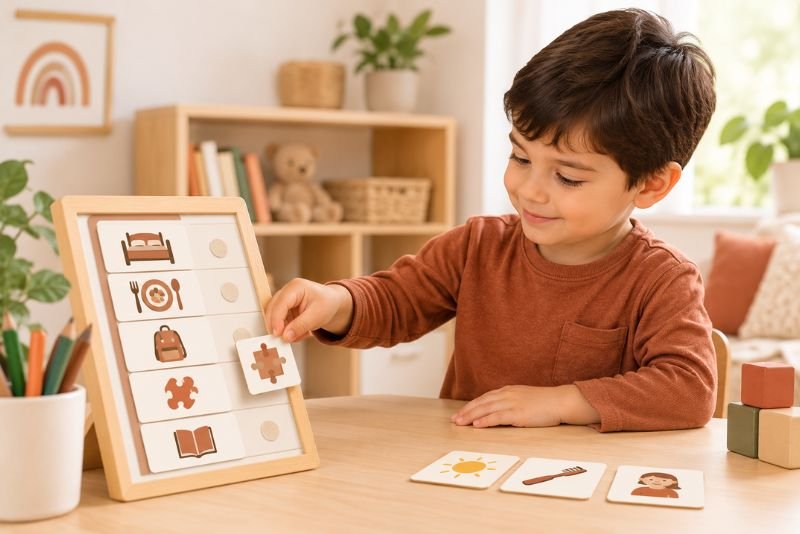
Autism routine and structure can help make everyday activities more predictable and easier to understand. A consistent routine may support transitions, independence, communication, and participation in daily tasks. However, a good routine does not mean every minute must follow a strict schedule. The goal is to create predictability with enough flexibility for real-life changes.
What are Autism Routine and Structure?
Autism routine and structure refers to organising everyday activities in a way that makes it easier for an autistic person to understand what is happening, what comes next, and what is expected.
A routine might include familiar activities such as:
- Getting dressed after waking up
- Eating breakfast
- Brushing teeth
- Going to school or work
- Completing homework
- Having therapy or other appointments
- Playing or pursuing hobbies
- Eating dinner
- Following a bedtime routine
Structure is slightly broader than routine. It can include the physical arrangement of a space, clear expectations, visual schedules, step-by-step instructions, predictable transitions, and consistent ways of completing tasks.
For some autistic children and adults, knowing what comes next can make daily life easier to navigate. Changes to familiar activities, people, places, or plans can sometimes be difficult, so preparation and visual information may be useful.
Importantly, routine is not a treatment or cure for autism. It is a practical way of organising information and everyday activities around an individual’s needs and preferences.
Why Can Routine and Structure Be Helpful for Autistic People?
Not every autistic person needs the same amount of structure. Some people prefer highly predictable schedules, while others prefer a looser routine.
The right approach depends on the person’s age, communication style, sensory needs, abilities, preferences, environment, and daily responsibilities.
1. It Can Make the Day More Predictable
A predictable routine can answer questions such as:
What happens now? What happens next? When will an activity end? What happens after that?
Instead of relying entirely on spoken instructions, a person can use a familiar sequence to understand what is happening.
Visual schedules are one example. They can use photographs, symbols, written words, objects, or other forms of visual information to show activities and their sequence.
For example:
Wake up → Get dressed → Breakfast → Brush teeth → School
Over time, this sequence can become familiar.
2. It May Make Transitions Easier
Moving from one activity to another can be challenging for some autistic children.
A child may be happily playing with a favourite toy and then be expected to stop immediately for dinner, school, bathing, or bedtime.
A routine can make the transition more predictable.
For example:
Play → Clean up → Bathroom → Dinner
A parent can also provide advance notice:
“Five more minutes of play, then dinner.”
Visual schedules, warnings, and social stories are commonly used to help autistic children prepare for changes.
Research on visual schedules has found that they can support transitions and independence for some autistic individuals, although they do not work identically for everyone.
3. It Can Support Independence
A routine does not have to mean an adult tells a child what to do every step of the way.
In fact, one useful goal is to gradually help the person use the routine as a guide.
For example, instead of saying:
“Brush your teeth. Get your pyjamas. Go to the bathroom. Put your clothes away.”
A visual checklist could show:
- Put toys away
- Put on pyjamas
- Brush teeth
- Use the bathroom
- Choose a book
- Get into bed
The child can work through the list with fewer verbal reminders.
Visual activity schedules have been studied as a way to help autistic individuals complete sequences of activities with greater independence.
4. It Can Make Daily Tasks Easier to Understand
Some everyday activities contain many small steps.
Take getting ready for school.
An adult may see it as one simple task. A child may need to remember:
- Get out of bed
- Use the bathroom
- Get dressed
- Eat breakfast
- Brush teeth
- Put on shoes
- Pack the backpack
- Leave the house
Breaking the routine into smaller steps can make it easier to follow.
Task analysis and visual or verbal prompts are commonly used to teach daily living routines and functional skills.
What Does Good Structure Look Like?
Good structure is not necessarily a perfectly organised timetable.
Instead, it should answer practical questions and make the environment easier to navigate.
A supportive structure might include:
- A predictable morning sequence
- A visual schedule
- Clearly labelled storage spaces
- Consistent places for important items
- Simple instructions
- Warnings before transitions
- A familiar bedtime sequence
- Time for breaks
- Choices within the routine
- Preparation for changes
For example, a morning routine might always follow the same general order, but breakfast could change depending on what is available.
That gives the person predictability without unnecessary rigidity.
Autism Routine and Structure: How to Create a Daily Routine
Creating a routine does not have to be complicated.
Start with the parts of the day that already cause confusion, rushing, arguments, or repeated reminders.
Step 1: Start With One Routine
Do not try to organise the entire day at once.
Choose one area.
For example:
- Morning routine
- Bedtime
- Getting ready for school
- Homework
- Mealtime
- Leaving the house
If mornings are difficult, start there.
Step 2: Write Down the Actual Steps
Think about what really happens rather than what you want to happen.
For example:
Morning routine
- Wake up
- Use bathroom
- Get dressed
- Eat breakfast
- Brush teeth
- Put on shoes
- Get backpack
- Leave home
This gives you a starting point.
Step 3: Decide What Format Works Best
Not everyone benefits from the same type of schedule.
You might use:
- Photos
- Drawings
- Symbols
- Written words
- A checklist
- A phone or tablet
- Objects representing activities
- A combination of pictures and words
Visual supports can be especially useful because they provide information that remains available instead of disappearing as soon as someone finishes speaking.
For a young child, photographs or simple pictures may be easier.
For an older child or teenager who reads comfortably, a written checklist may be more appropriate.
Step 4: Keep Instructions Simple
A schedule should make life easier, not create another complicated task.
Instead of:
“Complete your personal hygiene routine before preparing for school.”
Use:
Bathroom → Get dressed → Breakfast → Teeth → Backpack
Simple language is often easier to scan and follow.
Step 5: Teach the Routine Gradually
A new schedule may not work perfectly on the first day.
Show the person how to use it.
For example:
Check schedule → Complete activity → Check schedule again
You can provide support when needed and gradually reduce prompts when the person becomes more familiar with the sequence.
Step 6: Review What Is and Isn’t Working
Ask practical questions:
- Is the schedule too long?
- Are there too many steps?
- Are the pictures understandable?
- Is the timing realistic?
- Is one particular transition difficult?
- Does the person prefer written words or pictures?
- Are there sensory issues affecting the routine?
- Does the schedule allow enough breaks?
A routine should be adjusted to the person, not the other way around.
Examples of Autism Routine and Structure
Morning Routine
A simple morning schedule could look like this:
Wake up → Bathroom → Get dressed → Breakfast → Brush teeth → Backpack → Shoes → Leave
For a child who has difficulty remembering steps, pictures can be placed in the same order.
For an older child, a written checklist may be enough.
After-School Routine
School can be tiring. Instead of immediately expecting homework, a routine could provide a transition period:
Arrive home → Put backpack away → Snack → Break → Homework → Free time → Dinner
The break might involve reading, quiet play, listening to music, or another preferred activity.
The purpose is not to fill every minute. It is to make the sequence easier to understand.
Bedtime Routine
A bedtime routine might include:
Put toys away → Pajamas → Bathroom → Brush teeth → Story → Lights out
Keeping the order reasonably consistent can help establish a familiar sequence.
However, bedtime routines should still be adapted to the individual’s needs. Sleep difficulties can have many causes, and persistent sleep concerns should be discussed with an appropriate healthcare professional.
Homework Routine
Homework may be easier when it is divided into smaller sections.
For example:
Snack → Check homework list → 15 minutes math → Short break → Reading → Pack backpack → Finished
A visual timer or written checklist may help some students understand how much work remains.
Weekend Routine
A weekend does not need to look exactly like a school day.
A flexible weekend schedule might be:
Breakfast → Free time → Chores → Lunch → Outing or hobby → Quiet time → Dinner → Bedtime
The schedule can include choices.
For example:
Outdoor activity OR drawing OR building
Giving choices can provide structure while still allowing the person some control over the day.
How to Handle Changes to a Routine
One important part of autism routine and structure is learning that routines sometimes change.
- Appointments get canceled.
- Schools close.
- Visitors arrive.
- Traffic causes delays.
- A favorite activity may not be available.
- Trying to prevent every change is unrealistic.
Instead, families can gradually introduce ways to communicate changes.
Use a “Change” Card
A visual schedule could include a card that says:
CHANGE
Then show the new activity.
For example:
School → CHANGE → Doctor → Home
Give Advance Notice When Possible
If you know about a change ahead of time, explain it before the change occurs.
You might say:
“Tomorrow is different. There is no school. We are going to the doctor.”
A visual schedule can show the same information.
Leave Room for Flexibility
A schedule does not have to specify every minute.
Instead of:
8:03 Breakfast
8:17 Brush teeth
8:26 Shoes
Try:
Morning routine
This can reduce pressure when everyday events take longer than expected.
Some guidance on supporting autistic children with change recommends building flexibility into visual schedules, including leaving space for unexpected events.
Common Mistakes to Avoid
Making the Routine Too Rigid
- A routine should support daily life—not make ordinary changes impossible.
- If every small variation becomes a crisis, the schedule may be too rigid.
- Include opportunities for choice and small, manageable changes where appropriate.
Creating a Schedule That Is Too Long
- A 20-step schedule may be overwhelming.
- Start with the most important steps.
- You can break a large routine into smaller schedules.
For example:
Morning
rather than displaying every tiny action.
Using Too Many Verbal Instructions
Repeated reminders can become frustrating for both the child and caregiver.
When appropriate, try pairing spoken instructions with a visual cue.
Choosing a Format the Person Does Not Understand
A picture schedule is not automatically better than a written schedule.
The right format depends on the individual.
Some people may prefer:
- Written lists
- Photos
- Icons
- Digital reminders
- Objects
- A combination of methods
Forgetting the Person’s Preferences
A routine should not be built entirely around what adults want.
Ask:
What works for this person?
A teenager may want more independence over their schedule.
An autistic adult may prefer using a phone calendar rather than a wall chart.
A young child may respond better to photographs.
Routine and Structure for Autistic Teens and Adults
Routine can remain useful beyond childhood.
Teenagers and adults may use structure for:
- School
- College
- Work
- Household chores
- Personal care
- Exercise
- Meal planning
- Appointments
- Medication reminders
- Transportation
- Money management
- Hobbies
- Social activities
The goal should increasingly move toward self-management and autonomy.
For example, a teenager might create their own morning checklist.
An adult might use a smartphone calendar with reminders for appointments, work tasks, shopping, and household responsibilities.
Evidence-based approaches for teaching daily living skills can include visual supports, prompting, task analysis, reinforcement, self-monitoring, and technology-based reminders.
Does Every Autistic Person Need a Strict Routine?
No, autistic people are individuals, and their preferences for routine and predictability vary.
Some may strongly prefer familiar routines. Others may enjoy spontaneous activities and have relatively flexible schedules.
A routine should therefore be treated as a support tool, not a requirement for every autistic person.
It is also important to distinguish between supporting predictability and forcing compliance.
If a routine causes significant distress, consider whether the routine itself needs to change.
The person’s communication, sensory needs, preferences, environment, and level of independence should all be considered.
A Simple Autism Routine and Structure Template
Here is a basic template parents and caregivers can adapt:
Morning
- Wake up
- Bathroom
- Get dressed
- Breakfast
- Brush teeth
- Backpack
- Shoes
- Leave
After school/work
- Arrive home
- Snack
- Break
- Homework/work task
- Free time
- Dinner
Evening
- Relaxing activity
- Bath/shower
- Pajamas
- Brush teeth
- Prepare for tomorrow
- Reading or preferred quiet activity
- Bed
Remember that this is only an example. The best routine is one that fits the person’s actual needs and the family’s daily life.
Conclusion
Autism routine and structure can make everyday life more predictable, organized, and understandable for some autistic people. Visual schedules, checklists, consistent sequences, transition warnings, and clear instructions can be useful tools for supporting participation and independence. Research and clinical guidance support the use of visual supports for various everyday and learning situations, although their usefulness varies from person to person.
The goal is not to create a perfectly controlled day.
Instead, think of routine as a framework. It can show what usually happens while still leaving room for choices, preferences, rest, unexpected events, and change.
A successful routine is one that makes daily life more manageable—not one that makes life more restrictive.
Frequently Asked Questions
1. Why is routine important for autism?
Routine can provide predictability and help some autistic people understand what is happening next. It may also support transitions, daily tasks, and independence. However, the importance of routine varies from person to person.
2. What is an example of an autism routine?
A simple morning routine could be wake up → bathroom → get dressed → breakfast → brush teeth → backpack → shoes → school. Pictures, written words, or a checklist can be used depending on the person’s preferences.
3. Do autistic children need a strict routine?
No. Some autistic children prefer predictable routines, but a strict schedule is not necessary for every child. A flexible routine can provide structure while allowing for changes and choices.
4. Can visual schedules help autistic children?
Visual schedules can help some autistic children understand sequences, prepare for transitions, and complete activities more independently. They can use photos, pictures, symbols, written words, or other visual information.
5. How can I help an autistic child handle changes in routine?
Give advance notice when possible, explain what will change, use a visual schedule or social story, and introduce changes gradually when appropriate. It can also help to build some flexibility into the schedule so unexpected events are easier to represent.
Disclaimer: AutismCue is an informational platform and is not a medical professional or healthcare provider. This article is for general information only and is not medical advice. Individual needs can vary, so speak with a qualified professional for personalised guidance.