
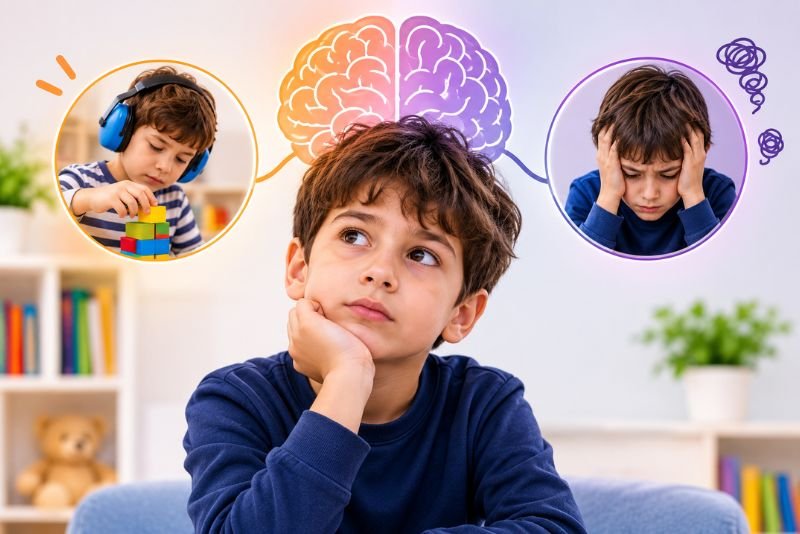
It’s a fair question, and a more common one than you might expect. Autism and schizophrenia can look alike from the outside, so people understandably wonder whether they’re the same thing, whether one leads to the other, or whether someone can really live with both.
Autism and Schizophrenia: A Quick Refresher
Before comparing them, it helps to be clear about what each one is.
What is autism?
Autism is a neurodevelopmental condition that shapes how a person communicates, processes sensory information, and relates to others. It shows up in early childhood, although it isn’t always recognized then. Some people are only identified as adults, once social demands grow beyond what their coping strategies can handle. It’s lifelong, and it really is a spectrum: two autistic people can have very different strengths and support needs.
What is schizophrenia?
Schizophrenia is a mental health condition involving psychosis, which means losing touch with shared reality. That can include hallucinations (such as hearing voices), delusions (strongly held beliefs that don’t match reality), and disorganized thinking or speech. Many people also experience “negative” symptoms like low motivation, reduced facial expression, and social withdrawal. It usually emerges in the late teens to early adulthood. It is not “split personality,” a myth that still causes confusion.
So, Can You Have Both Conditions?
Yes. Autism is about development from early life, while schizophrenia is an illness that typically appears later. Having one doesn’t protect you from the other, and it doesn’t mean you’ll get the other either. When a person meets the criteria for both, clinicians can diagnose both, and the care plan should reflect both.
How Common Is Autism With Schizophrenia?
Researchers have been counting for years, and the numbers shift depending on who was studied and how. The overall pattern, though, is consistent: schizophrenia-spectrum conditions appear more often in autistic people than in the general population.
| Source | What it found |
| 2018 meta-analysis (nearly 2 million people) | Schizophrenia was about 3.6 times as common among autistic people as in comparison groups |
| 2026 CMAJ clinical review | Roughly 4% of autistic people had a schizophrenia-spectrum disorder, versus about 0.46% in the general population |
| 2022 review of adult studies | Psychosis was found in about 9.4% of autistic adults (a broader category than schizophrenia alone) |
Why such a spread? Studies differ in age groups, in how diagnoses were confirmed, and in whether people with intellectual disability were included. Most of the research also takes a single snapshot in time, so it can’t tell us which condition came first or whether one raises the risk of the other.
The reverse question, how many people with schizophrenia are also autistic, is even murkier. Estimates run from about 3% to over 50%, but the studies behind them were small, so it’s best not to lean on any one figure.
One point is worth keeping in mind: the majority of autistic people never develop schizophrenia. Higher risk is not the same as likely.
Why Autism and Schizophrenia Get Mixed Up
Part of the confusion is historical. Before 1980, autism was often described as “childhood schizophrenia.” Researchers have since separated the two, but that early link left a long shadow.
The other part is that the two conditions can look similar at a glance. Both may involve:
- Pulling back from social situations
- Limited eye contact or reduced facial expression
- Unusual speech patterns
- Difficulty keeping up relationships
Imagine a quiet 19-year-old who has stopped seeing friends and speaks in a flat tone. That could be an autistic young adult who has always found socializing draining, or it could be early signs of something new. From the outside it’s hard to say, which is exactly why a careful assessment matters.
How Professionals Tell Them Apart
There’s no single test. Clinicians piece together several clues, and these are the main ones.
Timing and developmental history
Autistic traits must be present from early development, and they tend to stay fairly stable over time. Schizophrenia more often appears as a change, a noticeable shift from how someone used to think, speak, or function. This is why a detailed history, ideally with input from parents or others who knew the person as a child, carries so much weight.
The type of symptoms
Hallucinations, delusions, and strong suspiciousness point toward psychosis. Repetitive or stereotyped speech, atypical mannerisms, and deep, focused interests point toward autism. Research suggests the two are separated more reliably by these “positive” psychotic symptoms than by withdrawal or flat expression, which both can share.
Speech and thinking patterns
Autistic people often have distinctive ways of speaking, such as very literal phrasing or long, detailed talk about a favorite subject. Clinicians compare current speech with the person’s own baseline. Speech that has become newly disorganized or hard to follow is treated differently from a communication style that has always been there.
| Autism | Schizophrenia | |
| Typical onset | Early childhood | Late teens to early adulthood |
| Course | Generally stable | Often involves a marked change |
| Hallmark features | Social communication differences, sensory differences, focused interests | Hallucinations, delusions, disorganised thinking |
| Speech | Consistent personal style (literal, repetitive, detailed) | May become newly disorganised |
Why Might the Two Be Linked?
Scientists don’t have a complete answer yet. Studies point to overlapping genetic risk factors and shared pathways in early brain development, which may help explain why the conditions cluster. Still, overlap in risk is not proof that one causes the other.
Here’s some reassuring context. Research on autistic young people considered at clinical high risk for psychosis suggests they go on to develop schizophrenia at rates similar to non-autistic peers. In other words, being autistic doesn’t by itself predict that psychosis will follow.
Why Getting the Right Diagnosis Matters
Misreading these conditions can go wrong in both directions. An autistic person with no psychosis may be mislabeled with schizophrenia because they seem withdrawn or speak unusually. On the other hand, real psychotic symptoms can be brushed off as “just part of being autistic,” which can delay help.
This is made harder by a practical problem: few specialists are experienced in both areas. If you’re seeking an assessment, it’s reasonable to look for a clinician who understands neurodevelopmental conditions as well as psychosis.
Clinical reviews note that schizophrenia guidelines also apply to autistic people who have schizophrenia, and that referral to an early intervention psychosis program is recommended. Autistic people can be more sensitive to medication side effects, so clinicians often proceed carefully. All of that is general background, not treatment advice. Any plan should come from the person’s own care team.
What to Do If You’re Concerned
If you’re worried about yourself or someone close to you, a few practical steps can make an appointment far more useful:
- Write down a timeline. Note when changes began and how they differ from the person’s usual self.
- Describe specifics. “Hears voices when alone” tells a clinician more than “seems off.”
- Bring someone who knows the history. A parent, sibling, or long-time friend can fill in the early picture.
- Ask about experience. It’s fine to ask whether the clinician has worked with both autism and psychosis.
Please avoid self-diagnosis or diagnosing a loved one. If someone seems unable to stay safe or is in immediate danger, contact your local emergency services right away.
Frequently Asked Questions
1. Can autism turn into schizophrenia?
No. Autism doesn’t transform into schizophrenia. They’re separate conditions, though some autistic people do go on to develop schizophrenia, and most never do.
2. Is autism a type of schizophrenia?
No. They were grouped together decades ago, but today they’re understood as distinct diagnoses with different timelines and core features.
3. Do autistic people hear voices?
Hearing voices isn’t a core feature of autism. If it’s happening, it’s worth discussing promptly with a qualified professional rather than assuming it’s autism-related.
4. How do doctors tell autism and schizophrenia apart?
They look at developmental history, when symptoms began, the kinds of symptoms present, and how the person’s speech and behavior compare with their usual baseline.
5. Who can diagnose both conditions?
A qualified clinician, such as a psychiatrist or clinical psychologist, ideally one with experience in both neurodevelopmental and psychotic disorders.