
If you are comparing autism vs Down syndrome, you are probably worried about a child, a family member or maybe just trying to understand what you read online. The two are often mixed up because both can involve delays in speech and learning. But what causes them, how they show up, and how doctors diagnose them are very different.
This guide explains the difference between autism and Down syndrome in plain words, so you can understand what each one means and what to do next.
Autism vs Down Syndrome at a Glance
| Autism | Down syndrome | |
| What it is | A neurodevelopmental condition | A genetic (chromosomal) condition |
| Cause | Not fully known; many factors, including genes | An extra copy of chromosome 21 |
| Visible at birth? | No. Nothing about looks sets it apart | Often yes, through physical features |
| How it is diagnosed | Observing behavior and development; no blood test | A chromosome test (karyotype), sometimes suspected before birth |
| Core features | Social communication differences, repetitive behaviors or interests, sensory differences. | Intellectual disability, recognizable physical features, higher chance of certain health problems. |
| Intellectual ability | Varies widely, from gifted to significant disability. | Usually mild to moderate intellectual disability. |
| Lifelong? | Yes, though needs and symptoms change. | Yes |
| Can it be cured? | No, but support helps a lot. | No, but support helps a lot. |
What is Autism?
Autism spectrum disorder (ASD) is a developmental condition linked to differences in how the brain works. The CDC explains that people with autism often have challenges with social communication and interaction, along with restricted or repetitive behaviors or interests. They may also learn, move, or pay attention in different ways.
It is called a spectrum because it looks different in every person. Some autistic people speak fluently and live independently. Others are nonverbal and need daily support.
Common signs include:
- Limited eye contact or less response to their name
- Trouble understanding other people’s feelings or sharing their own
- Repeating words, movements, or routines
- Strong, narrow interests
- Being very sensitive, or not very sensitive, to sounds, lights, textures, or tastes
- Getting upset by small changes in routine
Autism is about four times more common in boys than in girls, according to the CDC. It can show up in every racial, ethnic, and economic group.
What is Down Syndrome?
Down syndrome, also called trisomy 21, happens when a baby is born with an extra copy of chromosome 21. Most people have two copies. The extra one changes how the body and brain develop.
There are three types, as listed by the CDC:
- Trisomy 21: about 95% of cases. Every cell has three copies of chromosome 21.
- Translocation Down syndrome: an extra part of chromosome 21 is attached to another chromosome.
- Mosaic Down syndrome: only some cells have the extra copy.
Common features include low muscle tone, upward-slanting eyes, a flatter nose bridge, small ears, and slower speech and learning. Many children also have health conditions such as heart defects, hearing or vision problems, and thyroid issues, so they need regular medical checkups.
Down syndrome affects about 1 in every 700 babies born in the United States.
What Causes Autism vs Down Syndrome?
Down syndrome has one clear cause. It comes from the extra chromosome 21. Nothing a parent did or did not do causes it. In most cases it happens by chance when the egg or sperm forms. Only translocation Down syndrome can be passed from parent to child.
Autism has no single known cause. Researchers believe several factors work together, including genes and early brain development. The CDC lists some risk factors, such as having a sibling with autism, being born to older parents, and certain genetic conditions like fragile X syndrome. Vaccines do not cause autism.
That is the main split. Down syndrome is a known chromosome change. Autism is a developmental pattern with many possible paths.
Signs of Autism vs Down Syndrome
The signs overlap in a few areas, mostly speech, learning, and behavior. But the starting point is different.
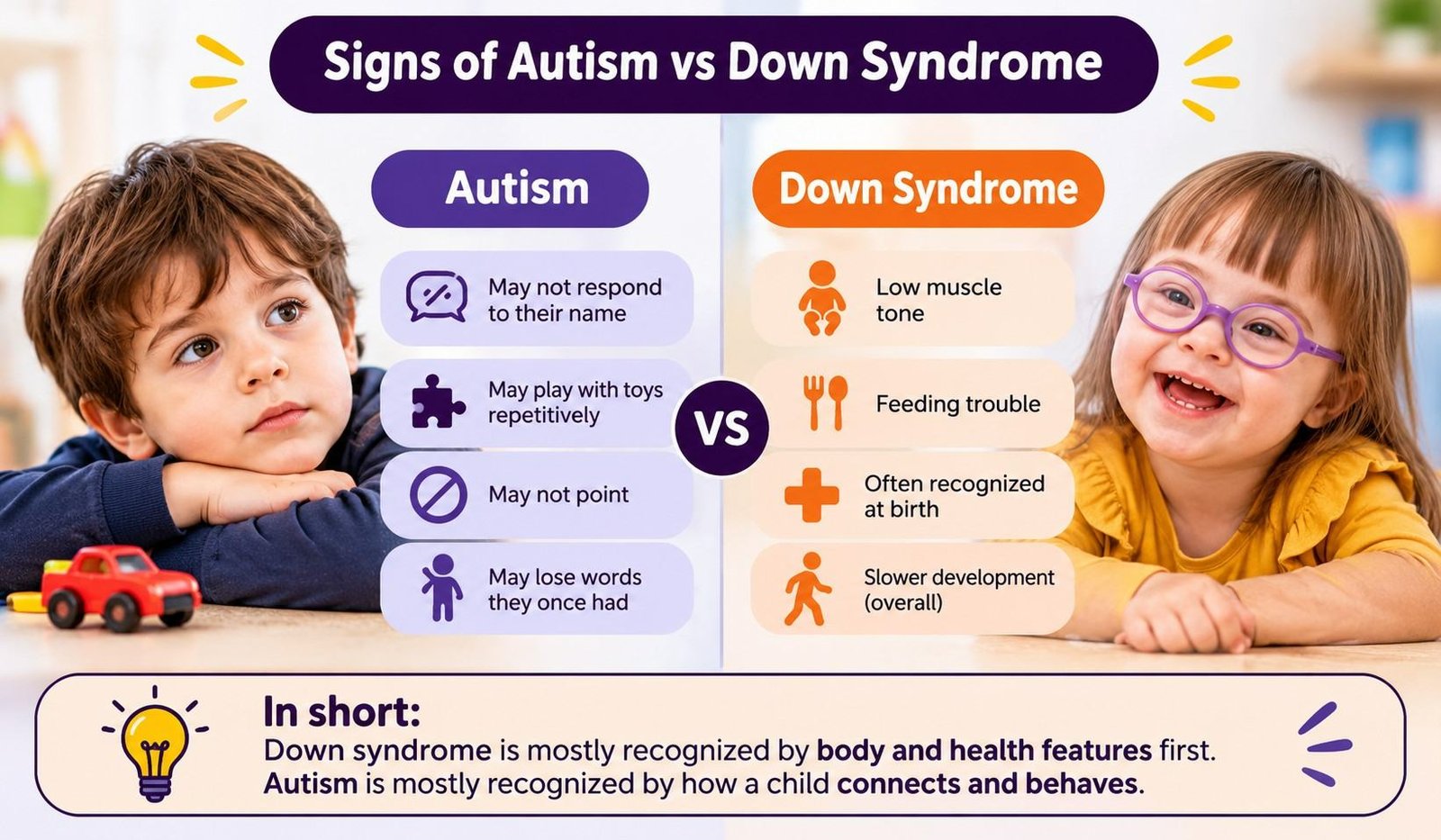
In Down syndrome, the first things parents notice are usually physical and medical: low muscle tone, feeding trouble, and a doctor’s early recognition of the condition, often at birth or even before. Development is slower across the board, including walking, talking, and learning.
In autism, babies often look typical. The signs are in behavior and communication. A toddler may not point, may not respond to their name, may play with toys in repetitive ways, or may lose words they once had.
A simple way to think about it: Down syndrome is mostly recognized by body and health features first. Autism is mostly recognized by how a child connects and behaves.
Can Down Syndrome Be Mistaken for Autism?
Yes, sometimes. A child with Down syndrome may have speech delay, limited eye contact, repetitive habits, or trouble with change. Those same behaviors are also part of autism, so families and even doctors can find it hard to tell them apart.
The key is whether the behaviors go beyond what you would expect from the child’s overall development. A child with Down syndrome who is slower to talk is not automatically autistic. But if the child also shows strong social withdrawal, intense repetitive behaviors, or major sensory reactions, an autism evaluation makes sense.
Is Down Syndrome a Form of Autism?
No. Down syndrome is not a form of autism, and autism is not a form of Down syndrome. One is a chromosome condition. The other is a neurodevelopmental condition without a single known genetic cause. They have different origins, even though they can look alike in some behaviors.
Can a Child Have Both Autism and Down Syndrome?
Yes. Autism is more common in people with Down syndrome than in the general population, though the numbers vary by study.
- A 2023 clinical study at a large Down syndrome program found that 13% of 562 children also had autism, while other research has reported rates as high as 39%.
- A 2025 study of US children, published in the Journal of Autism and Developmental Disorders, found children with Down syndrome had about five times higher odds of an autism diagnosis than children without it.
The range is wide because researchers use different methods to measure autism. Still, the message is the same: it happens often enough that doctors should watch for it.
Children with both conditions are often diagnosed later. Existing developmental delays can hide the autism signs, and autism in typically developing children is usually spotted by 18 to 24 months. The 2023 study also found that boys were more likely to have both, and that these children had more stomach and bowel problems, such as constipation and reflux, and more feeding difficulties.
If your child has Down syndrome and you notice a sudden loss of skills, very little social interest, or intense repetitive behavior, talk to your doctor and ask about an autism evaluation.
How Are Autism and Down Syndrome Diagnosed?
Down syndrome can be suspected during pregnancy through screening tests and confirmed with diagnostic testing. After birth, a blood test that looks at the chromosomes gives a definite answer.
Autism has no blood test. Specialists such as developmental pediatricians, child psychologists, or neurologists watch the child’s behavior and review development history. The CDC says a diagnosis by an experienced professional can be reliable by age 2, though many children are diagnosed much later, and some people are not diagnosed until they are teens or adults.
For a child with Down syndrome, an autism assessment works best when the specialist knows how Down syndrome typically affects development.
Support and Treatment
Neither condition can be cured, and neither needs to be. What helps is early, steady support.
For Down syndrome: speech therapy, physical therapy for low muscle tone, occupational therapy, special education support, and regular health screening for heart, hearing, vision, and thyroid.
For autism: speech and communication therapy, occupational therapy for sensory needs, behavioral and social skills support, and school accommodations. Plans are tailored to the person.
For both together: a mix of the above, guided by a team that understands how the two conditions interact. Therapies for language delay do not need to wait for a formal autism diagnosis. Starting early can make a real difference.
When to Talk to a Doctor
Speak to your child’s pediatrician if you notice:
- No babbling, pointing, or gestures by around 12 to 18 months
- Loss of words or social skills at any age
- Little response to their name or to people
- Strong distress with small changes
- Any worry about development, even if you cannot name it
You do not have to wait for a perfect answer. Your observations count, and early evaluation never hurts.
Frequently Asked Questions
Is autism the same as Down syndrome?
No. Autism is a neurodevelopmental condition affecting communication and behavior, while Down syndrome is a genetic condition caused by an extra chromosome 21. They have different causes and are diagnosed differently, but a person can have both.
Can a child have autism and Down syndrome together?
Yes. Studies suggest roughly 1 in 10 to 1 in 3 children with Down syndrome also meet criteria for autism, depending on the research method. It is often diagnosed later because early delays can hide the signs.
Is Down syndrome a type of autism?
No. Down syndrome is not a type of autism. It is caused by a chromosome change, while autism has no single known cause. Some behaviors look similar, which is why people confuse them.
What is the main difference between autism and Down syndrome?
The main difference is the cause and how they are identified. Down syndrome comes from an extra chromosome 21 and is confirmed by a chromosome test. Autism is identified by observing behavior and development, as there is no blood test.
Can Down syndrome be mistaken for autism?
Yes, because both can involve speech delay, repetitive behaviors, and trouble with change. A specialist who knows both conditions can tell whether the behaviors go beyond what Down syndrome alone explains.
Are autism and Down syndrome genetic?
Down syndrome is a genetic condition caused by an extra chromosome 21, though it usually happens by chance and is rarely inherited. Autism is strongly linked to genetics, but it also involves other factors, and no single gene explains it.
How are autism and Down syndrome diagnosed?
Down syndrome is confirmed with a chromosome blood test, sometimes after prenatal screening. Autism is diagnosed by specialists through observation, developmental history, and standard assessments, since no lab test exists.
Conclusion
Autism and Down syndrome are different conditions with different causes, different signs, and different paths to diagnosis. They can also exist together, and when they do, a child needs a team that looks at the whole picture. If you are unsure about your own situation, a pediatrician or developmental specialist is the best next step.